


👋 This is a monthly free edition of MKT1 Newsletter—a deep dive into a B2B startup marketing topic, brought to you by Attio, UserEvidence, and Omni Lab.
Upgrade to a paid subscription for: Full access to our new MKT1 MCP Server | 100+ templates & resources | Post to MKT1 Job Board | MKT1 Newsletter Archive
It’s been just over a month since I went all-in on Claude and started writing about agents and Claude Code. Naturally, I’ve also been helping a lot of marketers get up to speed.
One big observation so far: Most marketers using Claude are skipping ahead. You’re trying to produce outputs with Claude based on faulty (or nonexistent) inputs.
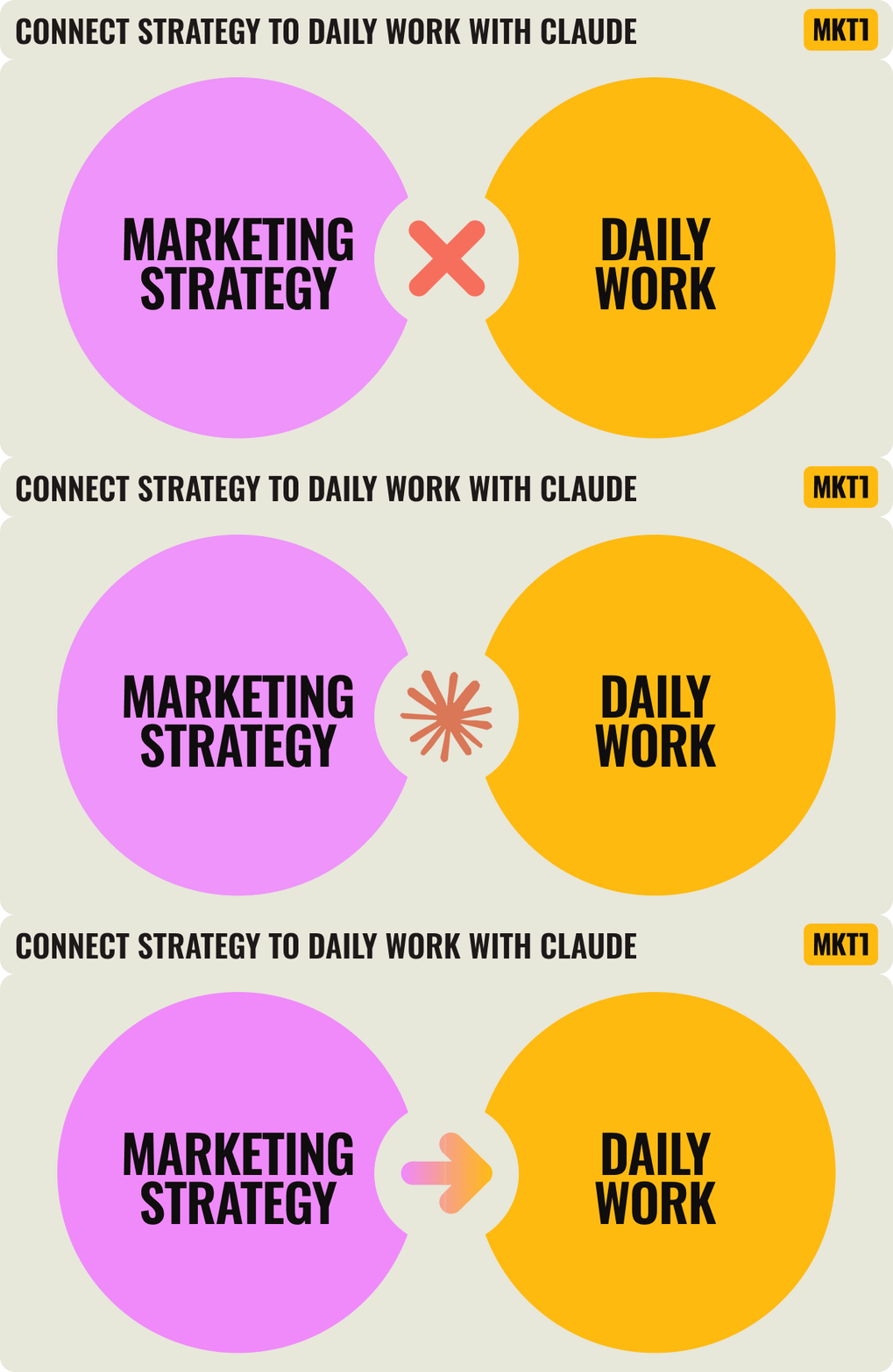
The problem with your agents (and honestly your marketing efforts in general) isn’t that you don’t have enough people, tools, or time. It’s that the strategy behind the work isn’t built out enough, high-impact enough, or connected enough to your company’s context.
This has always been a challenge for marketers: You make strategy docs (hopefully), but you rarely look at them again. You update foundational things like ICPs and positioning, but your team doesn’t actually work from the same foundation when planning campaigns or reviewing outputs. So, you end up doing random acts of marketing, random acts of agenting, and random acts of AI-ing instead of focusing on the things that actually help you win.
Here’s what’s different now: Claude can help you build your marketing strategy and then actually use it—in every brief, campaign review, and prioritization decision. Your strategy can live inside Claude and you and Claude can update it regularly as things evolve.
This newsletter explains exactly how to do this step by step. But there’s a shortcut: paid subscribers can use our new MKT1 MCP Server, it has the whole process built in, ready for you to run. Either way, do the damn thing and get your marketing strategy into Claude so your day-to-day work gets better.
Recommended products & agencies
We only include sponsors we’d recommend personally to our community. If you are interested in sponsoring our newsletter, email us at sponsorships@mkt1.co.

Attio is the AI-native CRM with built-in enrichment, flexible workflows, and fast set up. Their new “Ask Attio” agent has changed how I personally CRM: It can update fields, do company research, and more with a single AI prompt.
🎁 Offer: MKT1 subscribers get 15% off your first year.
—
UserEvidence acquired Zealot. Now you can capture customer proof and build advocates in one place, which means it’s easier than ever to turn customers into your #1 growth channel.
🎁Offer: Mention MKT1 get your first 2 months free
—
Omni Lab helps growth-stage startups scale their paid media & demand gen strategy. They focus on building early brand awareness, expanding reach, and optimizing for revenue, not just top-of-funnel metrics.
🎁Offer: Mention MKT1 to get a $2500 paid media assessment free (10 available).
In this newsletter:
How to create a central /marketing-strategy skill in Claude that becomes your team’s living strategy doc
How to run 7 exercises in Claude to build your strategy skill: company overview, ICP prioritization, Marketing Advantages, Perceptions, positioning, Revenue Levers, and Big Bet Campaign exercises
Tips for using your /marketing-strategy skill daily to turn your strategy into actual growth
How to share and maintain skills across your team using GitHub
Shortcut for paid subscribers: Our new MKT1 MCP Server can run you through this whole process step-by-step in Claude.
Need help? Join our first ever Buildathon on 4/3/26 and we’ll walk you through how to build your /marketing-strategy skill in Claude Code.
The process: Build a /marketing-strategy skill
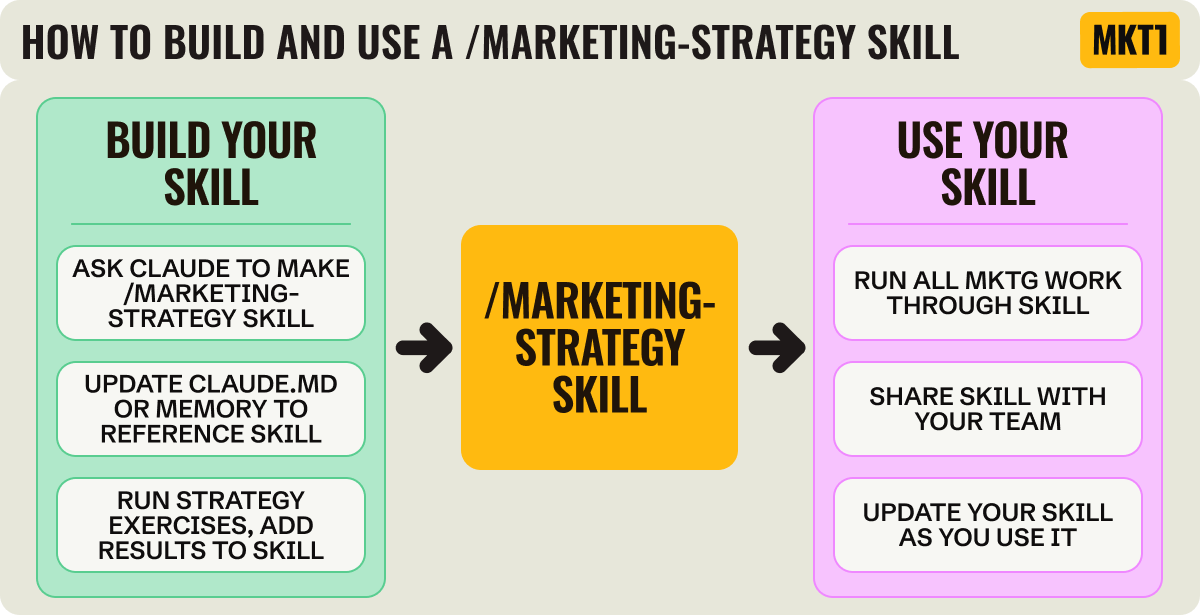
To build your strategy in Claude, first create one central file: your /marketing-strategy skill. Then run multiple marketing strategy exercises (detailed in the next section) and save the outputs into this skill file. Over time your /marketing-strategy skill becomes a living, breathing foundation for all of your marketing work—not a strategy doc you made once, but something Claude actually uses every time you work.
The MKT1 MCP Server automatically makes you a /marketing-strategy skill file and guides you through the steps below. Paid subscribers get full access here ➜
Here’s how to set it up:
Step 1: Make your skill
Ask Claude to create a marketing-strategy.md file (that’s your skill!) to hold all your high-level strategy info.
Here’s a prompt you can use:
“Create a Claude skill called /marketing-strategy. It should be a SKILL.md file with a description that tells Claude to reference this skill whenever I’m working on marketing—including briefs, campaigns, content review, positioning, planning, and prioritization decisions. Leave the body empty for now.”
Then tell Claude to reference your new skill whenever your doing something marketing-related for your company. Set this up to happen automatically:
In Claude Code or Cowork: Say, “Add this line to my Claude.MD file: reference marketing-strategy.md for anything marketing related.” Your CLAUDE.md file is the instructions file Claude reads at the start of every conversation.
In Claude Chat: Ask Claude to update its memory to reference your /marketing-strategy skill for anything marketing related. You can also add it to the instructions for a specific project. Or you can add the /marketing-strategy skill itself to each project.
If you get stuck on any of this, just ask Claude for help and ask it to reference its own “product-self-knowledge” skill.
Step 2: Run strategy exercises and add results to your /marketing-strategy skill
Run the strategy exercises detailed below, one at a time. After each one, ask Claude to save the output into your /marketing-strategy skill.
Tell Claude to reference what’s already in the /marketing-strategy skill as you run each exercise. Each exercise builds on the last: company overview feeds ICP prioritization, which feeds marketing advantages, and so on.
After completing all the exercises, you’ll have a fully built /marketing-strategy skill. More details on each exercise below.
Step 3: Use your /marketing-strategy skill every day
Once your skill is built, reference it in everything you do: briefs, campaign reviews, prioritization decisions, etc.
Keep it updated: Give Claude feedback when something feels off, and re-run exercises when things shift. More on this later in the newsletter.
Once you’ve done all 3 steps, your strategy “docs” now live in Claude as skill. You can reference it anywhere in Claude using /marketing-strategy.
Can I just use my CLAUDE.md file for this? Why build a separate /marketing-strategy skill?
You may have heard advice to add marketing strategy details to your CLAUDE.md file. I don’t recommend using it in this way.
CLAUDE.md should be short. Anthropic recommends keeping this personal instructions file under 200 lines. The longer it gets, the more Claude ignores parts of it. Your marketing strategy will almost certainly be longer than 200 lines on its own.
A skill is shareable. Unlike CLAUDE.md, a /marketing-strategy skill can be used across your team, every project, and all three Claudes: Code, Cowork, and Chat.
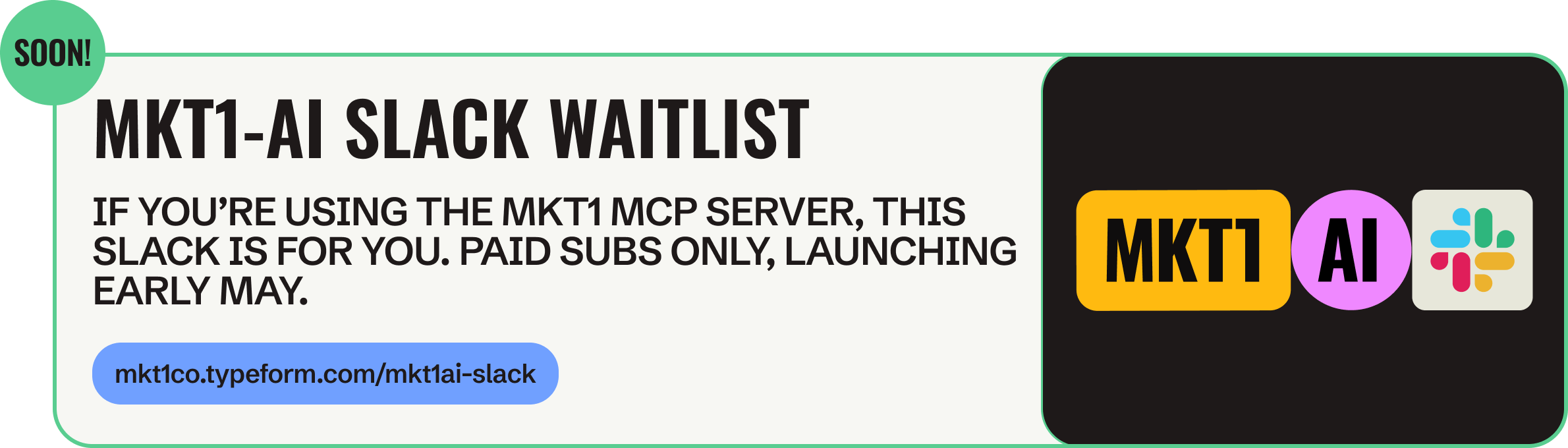
Good news, we’re launching a Slack just for talking about using Claude Code or Cowork and/or our MCP Server. It’s invite-only for paid subscribers using the MKT1 MCP Server users. Get on the list ➜
Run these exercises to add context to your skill
Company overview exercise
Why it matters:
Copying another company’s playbook or stealing random tactics doesn’t work. Your startup is, in fact, a bit of a special snowflake. It has unique attributes that should shape every marketing decision you make. This exercise forces you to document what actually makes your business specific so everything downstream matches the reality. And without it, Claude might make some assumptions about your business model that are out of date or just wrong.
What to document:
The basics: stage, team size, and funding
Your business model: ARR, number of customers, GTM motion, how teams adopt your product, and how they expand
Your high-level audience and TAM, product description, market category, competitive landscape, and ecosystem info (you’ll go deeper on audience and competitors in the ICP and positioning exercises)
How to run the exercise:
Ask Claude to help you build a company overview. Give it your URL and let it research your company first, then confirm what it finds and fill in any gaps.
Share your stage, company size, pricing model, how customers buy, and anything else unique to how you operate and earn revenue.
Ask it to output a clean summary you can save, then tell it to add this to your /marketing-strategy skill (that I detailed how to make in the step above).
Already have the MKT1 MCP Server? Tell Claude to run the mkt1-company-overview exercise. It will research your company, give you a starting point, ask the right questions, and save it all to your /marketing-strategy skill.
ICP prioritization exercise
Why it matters:
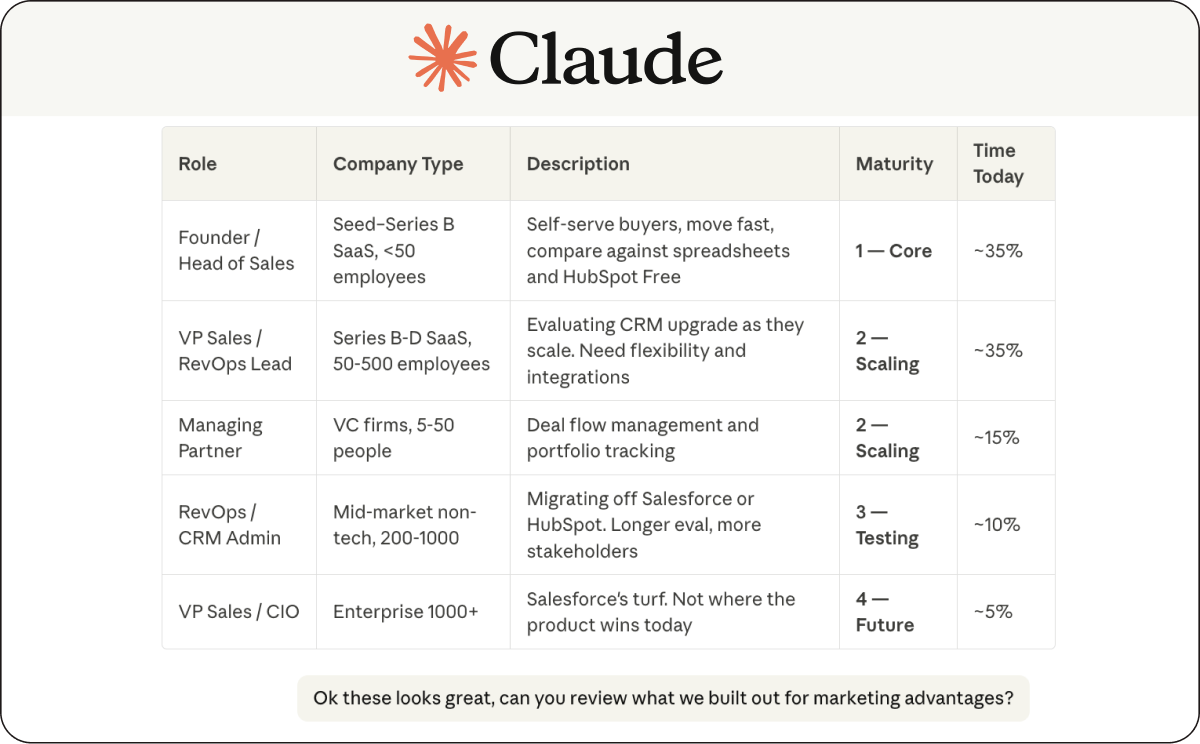
Most companies have some version of ICPs, maybe even a persona deck with vanity profiles like “Sales Sally” you never look at. What you actually need are robust ICPs that include both role and company, and you need to prioritize them. Not every segment should get the same effort, budget, or tactics. This exercise forces you to operationalize who you’re spending time on.
What to document:
Your ICP segments: Both company type and role, and whatever criteria you use to build segments
Maturity level for each ICP: I recommend using proven/core, scaling, testing, and not a priority.
Time allocation: Roughly how much overall time your team should allocate to each segment over the next quarter or year.
How to run the exercise:
Ask Claude to help you prioritize your ICPs. You can share a list of customers or give Claude access to your CRM to help.
Reference your /marketing-strategy skill if you’ve already started building it (so Claude has context on your company)
Ask it to output a prioritized table of your segments with maturity levels and time allocation, then add it to your /marketing-strategy skill.
Already have the MKT1 MCP Server? Tell Claude to run the mkt1-icp-prioritization exercise. It will pull in your company overview, walk you through each segment, and save the prioritized list to your strategy file.
Marketing Advantages exercise
Why it matters:
Most companies don’t think deeply about how they can win on GTM before they just start doing. They pick channels, launch campaigns, and copy tactics without thinking about their “accelerants.” Marketing Advantages are the unique catalysts, dynamics, or strengths of your business, product, team, or story that help you grow faster when you focus your marketing efforts here.
What to document:
The advantages you have—or could have.
I bucket advantages into 4 categories based on what drives the advantage: product, marketing/ecosystem, fuel, and engine advantages. You can see the broader list I’ve documented here, but you might come up with others that don’t fall neatly into these.
Strength and maturity of each: How strong is this advantage today, and how strong could it be when fully accelerated? Can it drive step-change growth, or is it just useful? How much energy and focus have you put into this advantage to date?
Competitive check: Does your closest competitor have the same advantage? If yes, it’s likely a pretty weak advantage.
Combination check: Are two advantages more impactful together? The best strategies exploit multiple advantages at once.
⠀How to run the exercise:
Ask Claude to help you audit your marketing advantages by sharing the descriptions above, this section and diagram from our field guide, and this marketing advantages exercise.
Tell it to reference your /marketing-strategy skill and research your top 1-2 competitors. Then confirm what advantages it thinks could catalyze your growth in a meaningful way.
Ask it to output a table with each advantage, its strength, and whether it’s competitively differentiated, then add it to your /marketing-strategy skill.
Already have the MKT1 MCP Server? Tell Claude to run the mkt1-marketing-advantages exercise. It will research your company and competitors, help you separate real advantages from aspirational ones, and save it to your /marketing-strategy skill.
Perceptions exercise
Why it matters:
Perceptions are the key narratives you want to drive in your market. They're written from the perspective of your audience and are the foundational tenets of your story. Creating perceptions helps you tell a consistent, repeatable story across all fuel efforts. The majority of your content should ladder up to and support these perceptions.
What to document:
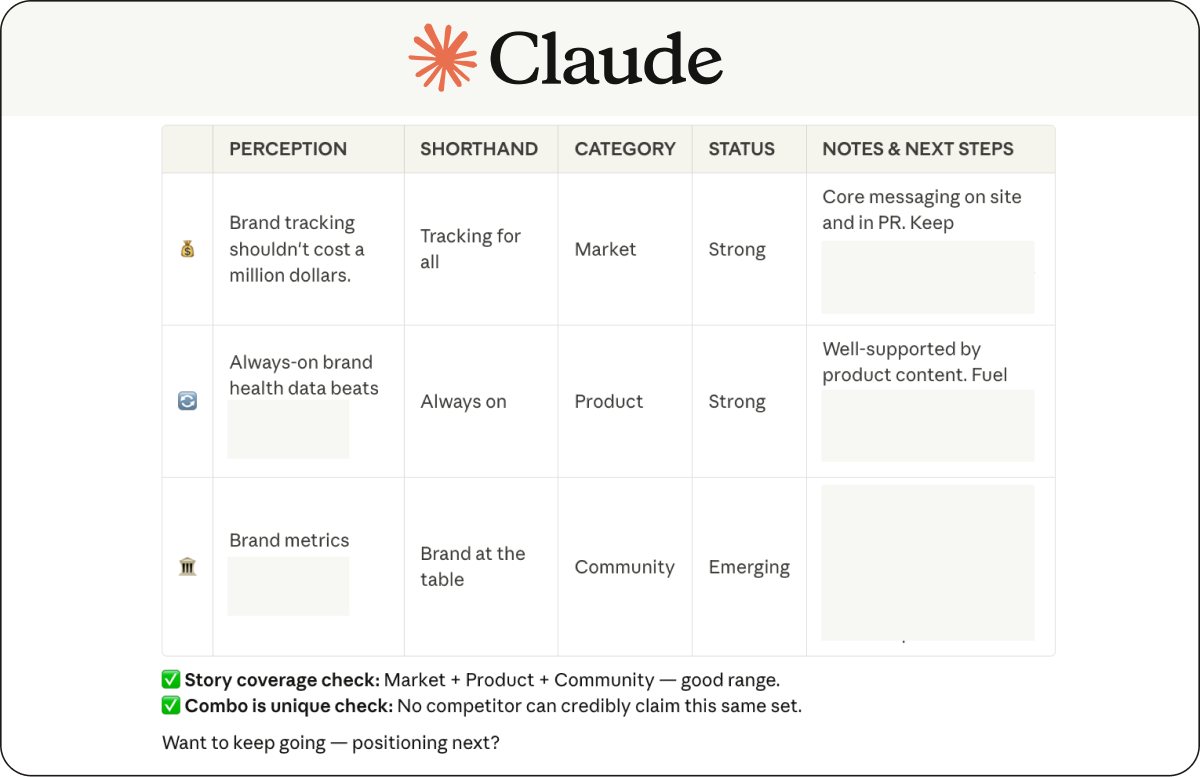
3-5 perceptions, covering your company, your market, and your product
Each written from your audience’s POV, as a belief they’d repeat back to you
A category for each: company insight, audience insight, market insight, or product insight
Status: Is this perception already established, emerging, or brand-new?
How to run the exercise:
Ask Claude to help you define your perceptions by copying and pasting the descriptions above (and by referencing your /marketing-strategy skill.) For more details to feed Claude, reference my newsletter on perceptions and this template for building.
Ask Claude to output 3-5 perceptions in a table, then add it to your /marketing-strategy skill.
Already have the MKT1 MCP Server? Tell Claude to run the mkt1-perceptions exercise. It will use your company overview, ICPs, and marketing advantages to draft perceptions, then refine them with you.
Positioning exercise
Why it matters: Positioning shapes how you talk about your product to your audience, and without it, you’re probably lacking clarity and maybe even confusing your audience. Most startups overcomplicate this, making long, soon-to-be-forgotten positioning docs that are somehow both exhaustive and unfinished. And even after all that work, they can’t clearly say who the product is for, what it is, and why it’s better than a specific alternative. Once you break positioning down simply, everything else gets easier.
What to document:
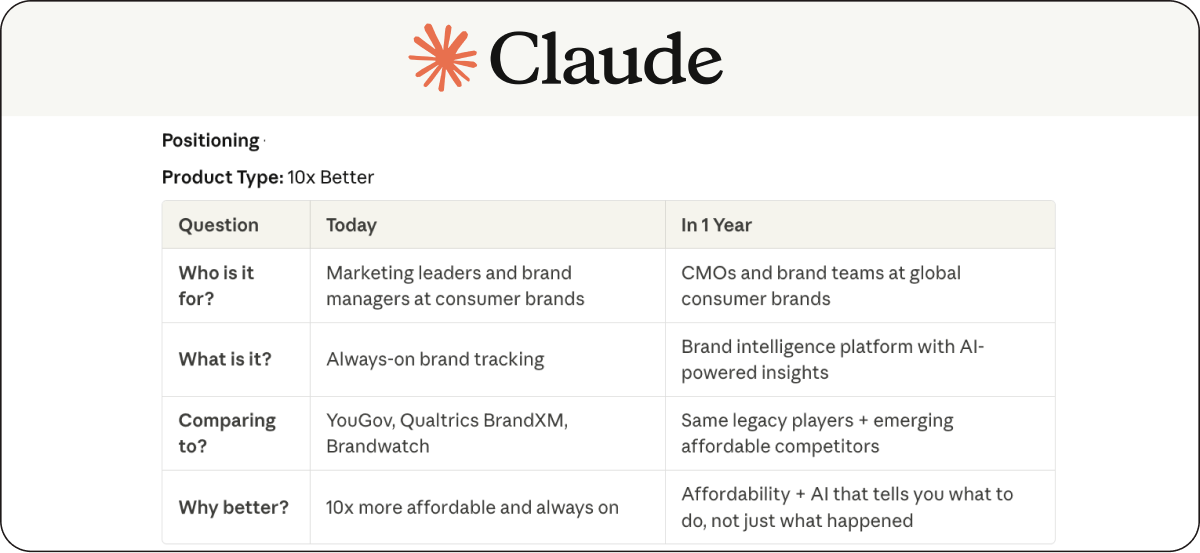
Your answers to the 4 positioning questions: Who is it for? What is it? What are you comparing it to? Why is it better?
Positioning today vs. positioning in ~1 year: These are often different, especially at fast-growing companies in fast-moving markets. Writing 2 versions solves most positioning misalignment debates.
How to run the exercise:
Ask Claude to help you define your positioning. It can check your site and anything already in your /marketing-strategy skill, or you can share any existing positioning work (that 10-page doc from 6 months ago?!) and get help refining. I’ve written about positioning extensively: Here’s my positioning newsletter and positioning statement template for more context.
Tell Claude what your product does and who you think it’s for, and let it push back on whether your comparator and “why it’s better” actually resonate with your core audience.
Ask it to output a positioning table with two columns (positioning today vs. positioning in 1 year), then add it to your /marketing-strategy skill.
Already have the MKT1 MCP Server? Tell Claude to run the mkt1-positioning exercise. It will research your company, check your ICPs and perceptions, walk you through each positioning question, and save the positioning table to your /marketing-strategy skill.
Revenue Levers exercise
Why it matters:
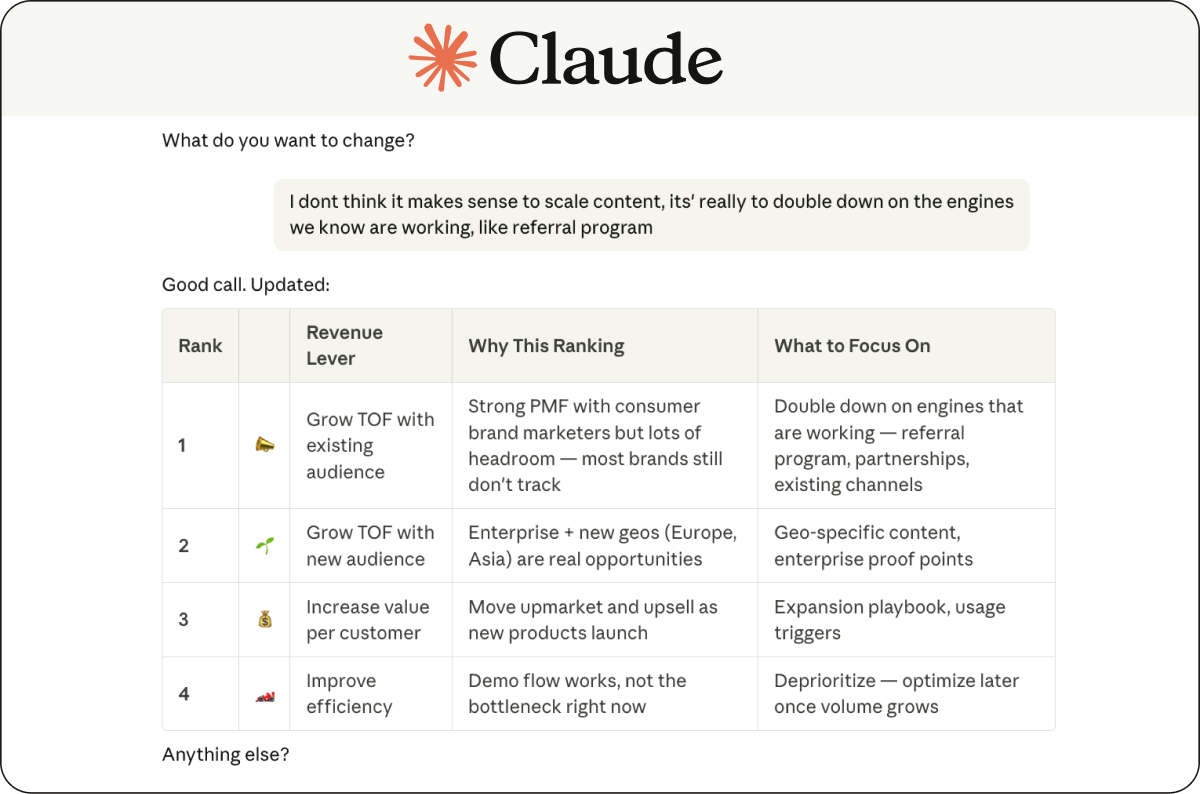
There are only 4 major ways to drive revenue: new logos, expansion, retention, and pricing. Most marketing teams try to do all four at once and end up doing none of them well. This exercise forces you to stack-rank where marketing can have the biggest impact right now, so you focus your campaigns and goals on the levers that actually move the number.
What to document:
Stack rank the four revenue levers from 1-4, based on what’s most important to your business right now:
Grow top of funnel with core audience
Grow top of funnel with new audience
Increase customer value
Increase efficiency
For each lever, note the maturity of your current motion: Are you already investing here, just getting started, or not doing anything yet?
For your top 1-2 levers, describe how marketing will specifically move them with your current team and budget
⠀How to run the exercise:
Ask Claude to help you stack-rank your revenue levers by sharing the descriptions above and telling Claude to reference your /marketing-strategy skill. Add more context from this this newsletter and template if needed.
Ask it to output a ranked list of these 4 revenue levers with reasoning, then add it to your /marketing-strategy skill.
Already have the MKT1 MCP Server? Tell Claude to run the mkt1-revenue-levers exercise. It will reference your company overview, ICP prioritization, and marketing advantages, walk you through the ranking process, and save it to your /marketing-strategy skill.
Big Bet Campaigns exercise
Why it matters:
Big bets are where strategy becomes action. These are 1–3 campaigns that combine your advantages, perceptions, and ICPs into coordinated efforts. Each one has fuel (content, creative), an engine (channel), and an audience (ICP segment). Without big bets, you end up with a scattered list of tactics. With them, your team knows exactly what you’re investing in and why.
What to document:
1-3 campaigns, each with: a name, the ICP it targets, the perception it reinforces, the advantage it leans into, the channel it runs through, and the fuel it requires
Priority level for each: high, medium, or low
What success looks like for each campaign
How to run the exercise:
Ask Claude to help you design your big bet campaigns by referencing your /marketing-strategy skill. If the above strategy exercises aren’t done and added to the skill, the big bet output ideas won’t be good.
Ask Claude to help you brainstorm ideas based on your ICPs, advantages, and perceptions, but the best big bets come from your own creative thinking with all of this context in mind. I’ve written about this more here.
Once you have campaign ideas, have Claude output a summary of each, then add them to your /marketing-strategy skill too so you make sure you stay focused on these big things that can move the needle.
Already have the MKT1 MCP Server? Tell Claude to run the mkt1-big-bets exercise. It will pull in the full strategy you’ve already added to your /marketing-strategy skill, paying close attention to your Marketing Advantages, and help you come up with big ideas that will move the needle.
Make skills with me at the MKT1 Buildathon

Come to our first-ever MKT1 Buildathon on 4/3/26 hosted by me, Emily Kramer. We’ll show how we use the MKT1 MCP server and build a /marketing-strategy skill from scratch in Claude Code. It’s the easiest way to go from understanding the concept to actually having this set up and working. Open to all, bring your friends! My dad might even show up (hi dad!)
Other things to add to your marketing-strategy skill
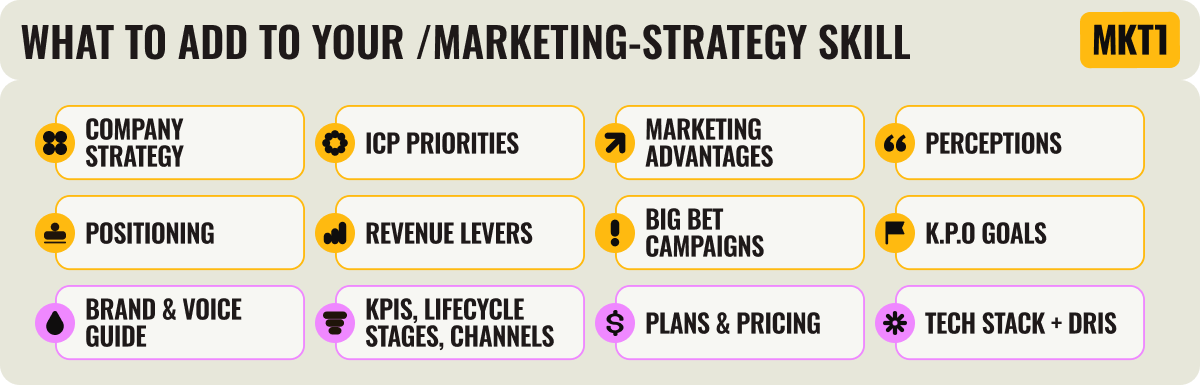
Once you’ve run through all the exercises above, there’s more worth codifying in your /marketing-strategy skill. Here are my recommendations, I can’t cover all of these exercises here, but I’ll be adding skills for each of these things to the MKT1 MCP Server soon!
KPO Goals: Add your marketing goals and don’t just include KPI or metrics goals. Instead, include goals from these 3 categories: KPI goals (metrics), Project goals (big bets), and Ops goals (foundation work + hiring) Read more in my guide to annual marketing planning and crash course in marketing goal setting.
KPIs and metrics: Include the specific numbers you track, how you define them, and your targets. Once documented, Claude can reference them when setting goals, evaluating campaigns, or building reports.
Channel strategy: Document which growth engines you're investing in, the current maturity, and why. Use the exercises above to inform this, not gut feel. Feed Claude my channel-startup fit newsletter (or run the /channel-strategy exercise with the MKT1 MCP Server).
Lifecycle and account stages: List how contacts and accounts move through your funnel, including lead stages, account stages, product-usage stages, and account tiers. Reference this signal-based campaigns newsletter and the account-driven marketing template.
Voice, tone, and style guide: Document how your brand writes and speaks. This keeps content consistent across your team, your agencies, and AI writing on your behalf. You can give Claude writing examples or access to Google Drive to get started.
Brand guide: Add your visual identity: colors, typography, logo usage, diagram style. Share a Figma file or brand PDF directly with Claude to codify.
Naming conventions, product tiers, and pricing: Adding product details like this prevents Claude from making things up or using the wrong terminology.
Tech stack and DRIs: Share a list of tools you use and who does what on your team. Makes it much easier for Claude to figure out what’s possible and suggest human and/or tech workflows.
New: Run a Claude Sprint with the MKT1 team
We’re piloting something new. We’re looking for a small number of marketing teams to work with directly to build out their strategy inside Claude. It’s what we’ve been building with our MKT1 MCP Server, now applied to your company.
If you’re a marketing leader at a B2B company and want to explore what this looks like for your team, tell us a bit about yourself. We’ll reach out to talk through it.
Use your /marketing-strategy skill daily
Run all work through it
Building your /marketing-strategy skill is only useful if you actually reference it. Now that it’s in Claude you can reference it for every marketing thing you do.
Here’s what that looks like in practice:
When creating briefs: Before any campaign or project, make a GACCS brief (Goals, Audience, Creative, Channels, Stakeholders). This is much faster when you have many of these inputs in your /marketing-strategy skill.
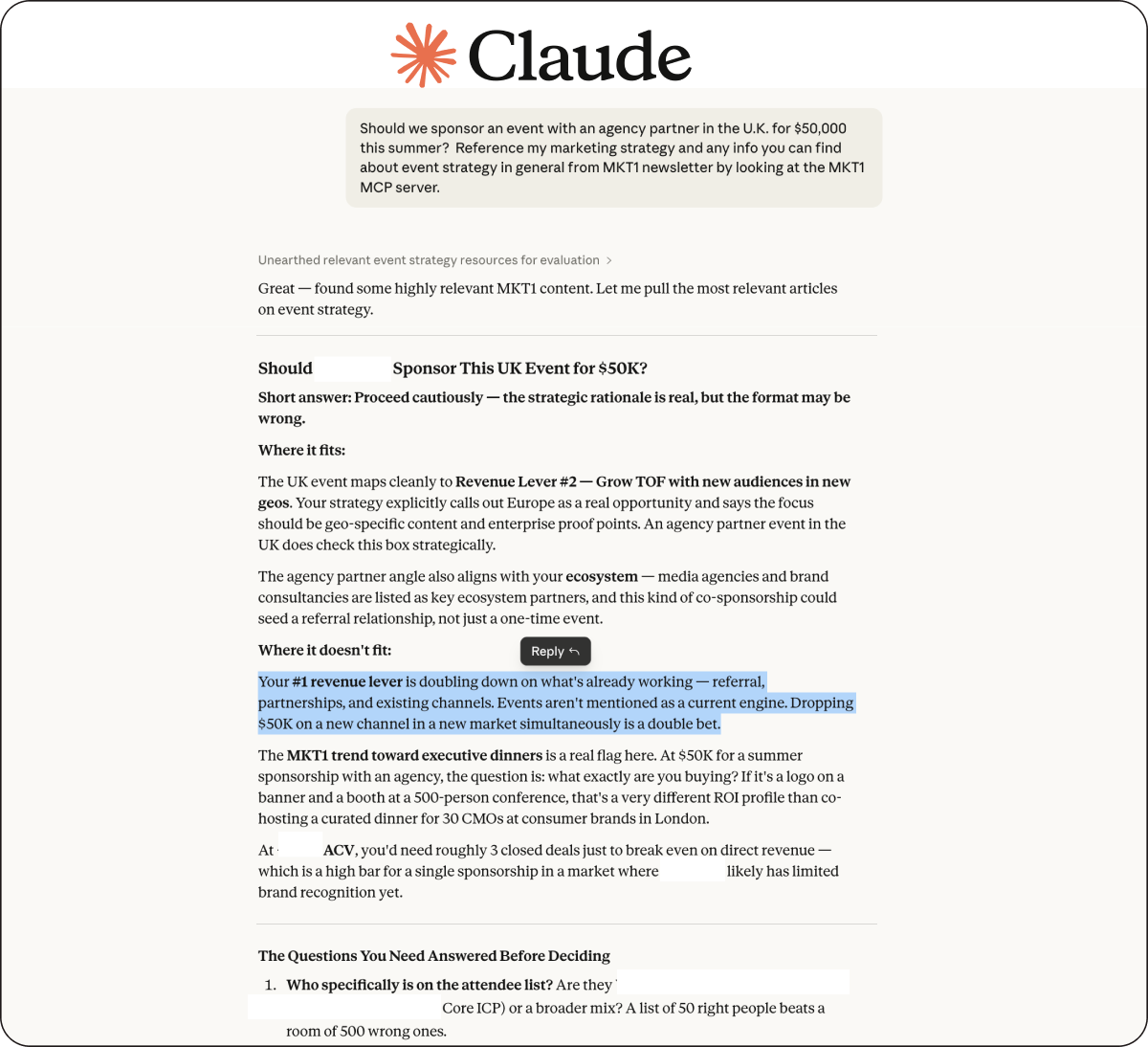
When prioritizing requests: Sales wants a new deck. A partner is proposing co-marketing. Your founder wants to sponsor an event. Before saying yes to any of it, gut-check it against your /marketing-strategy skill.
When reviewing content and copy. A generic copy edit in Claude isn’t nearly as effective as checking whether something actually ladders up to your story. Before anything goes out, say: “Review this against my /marketing-strategy” so Claude checks it against your perceptions, positioning, ICP, and brand voice all at once.
The prompt pattern is always the same: Tell Claude what you’re doing and add “reference /marketing-strategy”—that’s it.
Other things you can do when you have this “operating system” built out in Claude:
Once your /marketing-strategy skill exists and Claude is working from it daily, everything else becomes much easier, you can:
Produce a tangible output from this strategy work. Turn your strategy into a one-page summary for other teams, or a strategy deck—ask Claude to generate it directly from /marketing-strategy.
Run faster planning cycles. With your ICPs, advantages, perceptions, and revenue levers already in Claude, developing your Big Bets and KPO goals becomes a conversation instead of a process.
Build a prioritization skill for your whole team. Paste your current to-do list into Claude alongside your /marketing-strategy skill and ask it to stack-rank everything by strategic fit—surfacing the relevant ICP, perception, advantage, and goal for each item. Save that prompt as its own skill, push it to GitHub, and anyone on your team can run it at any time.
Explain any decision quickly. When a stakeholder asks why you’re doing something, Claude can articulate the strategic rationale instantly—because it’s already in the skill.
Share your strategy with partners. Need to brief an agency or co-marketing partner? Ask Claude to generate a tailored summary from /marketing-strategy and cut it down for the audience.
The more consistently you reference the skill and keep it updated, the more useful it becomes.
Share it with your team & update it regularly
You should update your /marketing-strategy skill regularly. If you run the skill and anything feels off, ask Claude to help you make updates so it avoids the same mistakes again. And then share it with your team…
Right now, most teams are sharing skills over Slack, Google Drive, or email. That works once. Once you update a skill, everyone else is on an old version with no way to know what changed.
Some teams are using Claude Projects or an Enterprise plan instead.
On Team, owners can push skills to all members by default.
On Enterprise, admins can provision skills org-wide so they appear for everyone automatically. But teammates can’t share directly with each other without going through an admin.
GitHub was the clear consensus for sharing skills when we asked on LinkedIn. When a skill lives in a shared repo, every update is versioned, every change is tracked, and teammates can always pull the latest version. GitHub gives everyone that flexibility, regardless of their plan.
Here’s how to set it up:
Create a private GitHub repo: Call it something like team-claude-skills
Add your skill files: Put each SKILL.md in a folder (e.g., /skills/marketing-strategy/SKILL.md)
Invite teammates: Settings → Collaborators, add team members
Each person adds skills to their Claude setup: In Claude Code, skills in .claude/skills/ are picked up automatically when teammates pull the repo; in Claude Chat or Cowork, they download the .md and upload it to their Skills settings
When you update, push the change: In Claude Code, teammates run git pull and they’re current; in Chat or Cowork, they download the updated file and re-upload it to their Skills settings.
You can also just ask Claude: “Help me set up a GitHub repo to share Claude skills with my team. I’m not technical — walk me through it step by step.”
Note: There are many ways to do this, including Claude’s newer plugin feature. It’s worth exploring what setup would work best for your team.
Shortcut for paid subscribers: Install the MKT1 MCP Server
More details are in this newsletter announcing the MCP Server.
What is the MKT1 MCP Server?
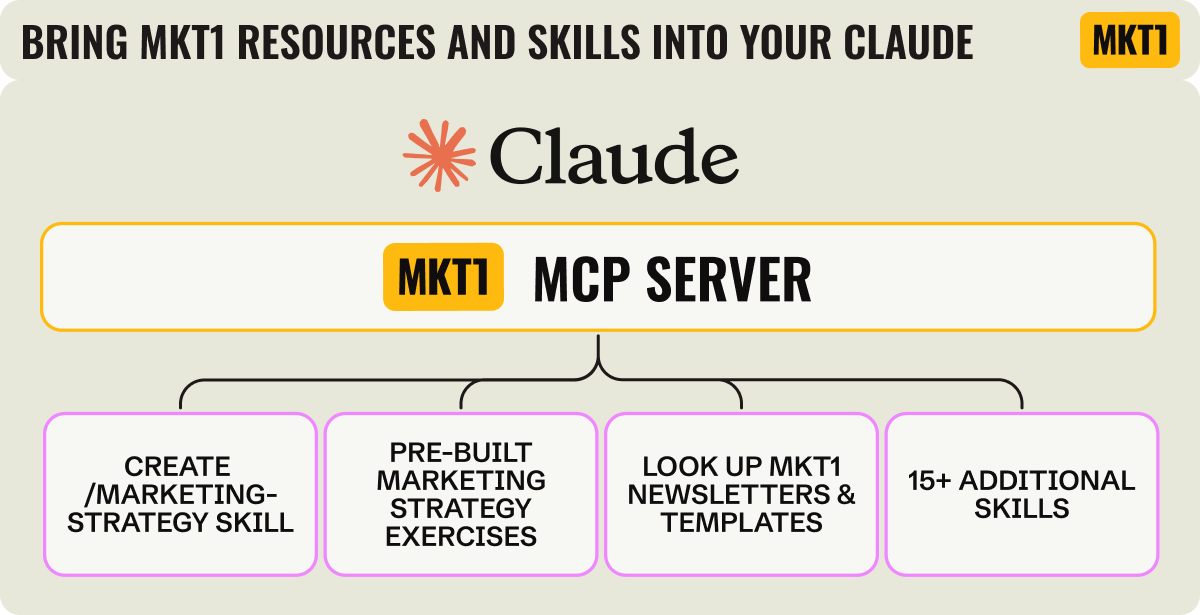
The MKT1 MCP Server is live in beta now, and paid subscribers get full access, including all the exercises above. It will help you put everything you read about in this newsletter into action—tracking progress along the way and updating your /marketing-strategy skill for you.
An MCP server (Model Context Protocol server) is a service that connects an LLM (like Claude) to external tools, knowledge, and capabilities—in this case to MKT1 processes, content, skills, etc. Think of it like an integration or API that adds the MKT1 brain to Claude.
Why we built this:
I’ve always thought about MKT1 Newsletter as more than a collection of writing. It’s meant to be a system for running marketing. Templates and resources in Sheets, Docs, Figma, and even Lovable apps were a start.
But with MCP servers, it’s now possible to run your marketing team on the MKT1 Method. You can have your own C-Level Gen Marketer operating inside Claude.
How to install:
Install the MCP server in Claude through your desktop or web app and it will work in Claude Chat, Cowork, or Code. The whole thing takes about 2 minutes. Connect it once, and new skills will show up automatically as we build and deploy them.
Find a walkthrough and by step-by-step-instructions for installing the MKT1 MCP Server here:
Note: Some versions of Claude, such as Free or Claude Enterprise, may limit access to custom connectors.
While we haven’t thoroughly tested this, it’s also possible to add the MKT1 MCP Server to ChatGPT. Find instructions here.
How to start on your strategy exercise and skill using our MCP Server:
Once you’ve installed the MKT1 MCP Server, you can ask it what skills it has and also tell it to run the “MKT1 Marketing Strategy Setup” to work through the process in this newsletter.
This will create your marketing-strategy.md file (that’s your skill) and save it locally to your computer
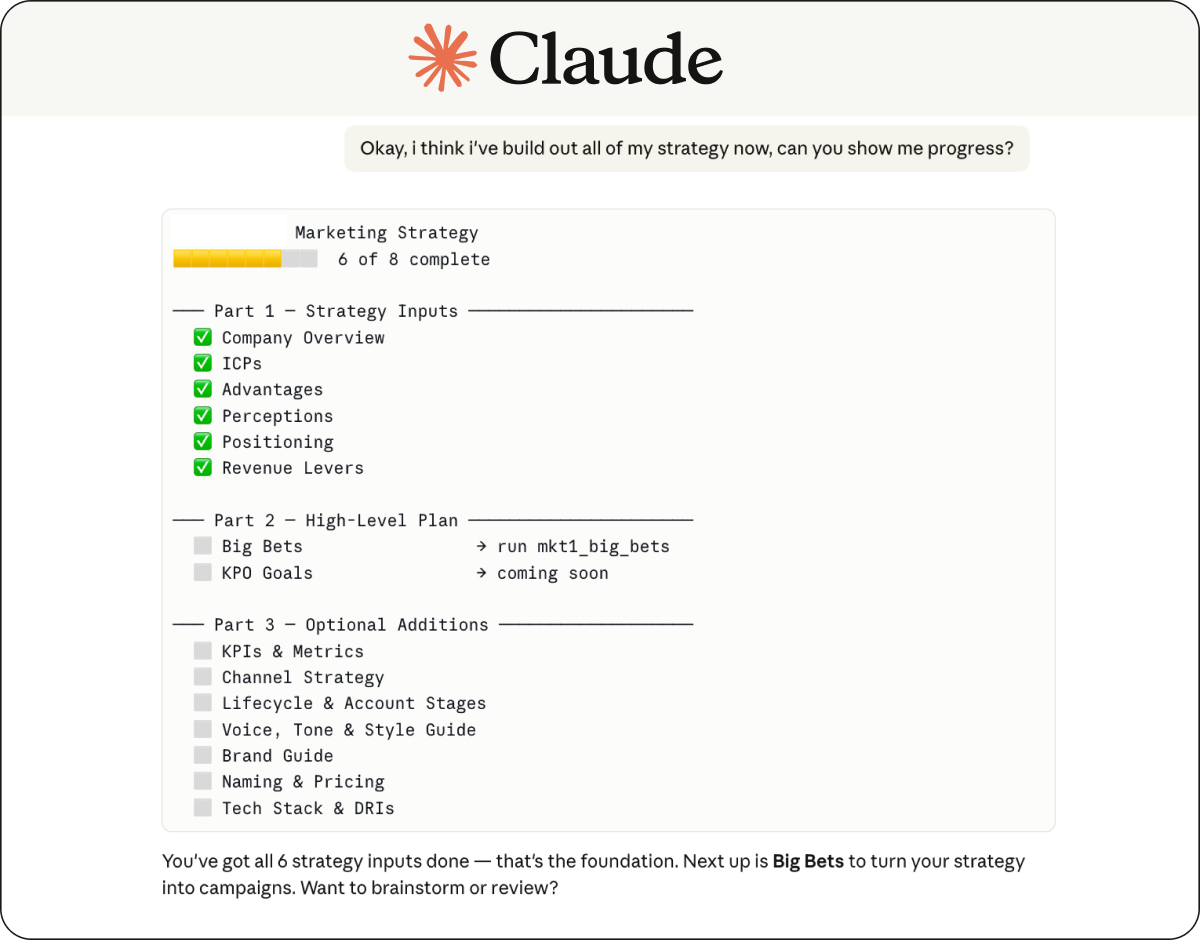
It will show you a progress dashboard and walk you through each strategy exercise detailed in this newsletter in the right order
As you complete each exercise, the output gets saved to your /marketing-strategy skill—and Claude reads it automatically in everytime you pick back up on the marketing strategy setup exercise.
If you want to skip around on exercises, you can. The setup skill will flag what you missed and suggest going back, but it won’t block you.
That means when you plan Big Bets, Claude already knows your ICPs, advantages, and perceptions, etc. The exercises compound because they’re all writing to the same place.
We also have many other skills in our MCP Server that all reference your /marketing-strategy skill if you have one saved.
The one thing the MCP Server doesn’t do is share this skill with your team, you’ll need to decide how you want to do that (we recommend Github).
Upgrade for full access to the MKT1 MCP Server
Anyone can install our new MCP Server and get access to newsletter content in Claude, but only paid subscribers unlock the full set of skills, including the exercises in this newsletter. Upgrade now to get full access.
Note: It takes a few minutes for us to register your paid subscription, so if you have any issues installing and authenticating the MCP Server, restart Claude and wait a few minutes before reaching out via our support form.
Conclusion
Right now, most teams are using Claude without a real foundation. They’re prompting into the void, getting something between AI slop and a decent-ish result, and calling it progress. Without a clear marketing strategy underneath, you’re mostly just speeding up random acts of marketing.
Building a /marketing-strategy skill forces you to do the foundational strategy work you may have been putting off, and then makes that work actually usable in your day-to-day.
Your strategy starts to compound when you use your /marketing-strategy skill in daily work, and push updates back into the skill in real time. Your /marketing-strategy skill becomes a true living document that evolves with your business and your marketing work becomes sharper.
Most teams aren’t failing because they lack ideas or effort. They’re failing because their strategy isn’t connected to the work. This is one of the first real ways to fix that.
If you do this right, Claude stops being a place you ask for help and starts becoming the operating system your team actually runs on.
More from MKT1
🙏 Brought to you by: Attio, the AI-native CRM; UserEvidence, for capturing customer proof and building advocates; and Omni Lab, an agency partner for paid media & demand gen. All 3 companies have MKT1 discounts!
👩💻 Claude Code Buildathon: Our first-ever Buildathon is on 4/3 at 9am PT / 12pm ET. I’ll show you how to build everything described in this newsletter in Claude Code—while you build along! RSVP now to save your spot.
🗓️ Meet me at Profound’s Zero Click SF event: An exclusive gathering for the world’s top AI Search experts on 4/8/26. Register here »
📦 MKT1 Unboxing: Watch our new video series to see Kramer (that’s me) unbox Mutiny, Wistia, Luma AI, & Attio.
🧰 Template & resource library: We have 100+ templates and resources available to paid subscribers in our template & tool library….
🧑🚀 Job board: Jobs from the MKT1 community (free to post as a paid subscriber). And our candidate form if you’re looking for a new role (option to remain anonymous included!).
Join our Slack Waitlist
We’re launching a Slack just for talking about using Claude Code or Cowork and/or our MCP Server. It’s invite-only for paid subscribers using the MKT1 MCP Server users. Get on the list ➜
Thanks for the in-depth walk throughs . is there a slack group still? heads up, the typeform link no longer works? "https://mkt1co.typeform.com/mkt1ai-slack"