

👋 This is a monthly free edition of MKT1 Newsletter—a deep dive into a B2B startup marketing topic, brought to you by 42 Agency, UserEvidence, and Conversion.
Upgrade to a paid subscription for: Full access to our new MKT1 MCP Server | 100+ templates & resources | Post to MKT1 Job Board | MKT1 Newsletter Archive | $40K+ in discounts in the MKT1 Perk Stack
“Paid fundamentals across targeting & messaging still work...but the 20% of teams that can execute and test faster, at higher volume and higher quality, with AI are crushing the other 80%.”
Max Hogan, Co-Founder of Closing Media
There’s always been a division in marketing: You either love “paid” or you wouldn’t touch it with a 10-foot pole.
But lately, even paid lovers can’t pretend it’s working like it used to. Search traffic is going down, LinkedIn is very saturated, and other paid channels are hard to crack.
For the record, I fall into the “I love it” camp—I started my career in it. IMO, running ads has the excitement of something like day trading, but with creative assets and company money.
So I was paying close attention when I did a MKT1 Unboxing with Keith Putnam-Delaney, Co-Founder of Primer, a couple weeks ago. Primer’s whole product is centered on the idea that with better audience data and targeting, you can scale paid efficiently across B2B and even channels considered B2C historically.
I left the conversation realizing I had to write an entire newsletter on what’s possible with paid. So to figure out what else is working now, I called in some other experts too: Max Hogan, Co-Founder of Closing Media, Lizzy Marano, Director of Growth Marketing at Justworks, and Kamil Rextin of 42 Agency.
Here’s where I landed: Paid isn’t dead. The method just needs an upgrade, and it needs to be audience-first (and of course AI-powered).
To make paid successful today, you need the same audience-driven foundation you need for all of marketing (I’ve been preaching this foundation over the last year and a half). This doesn’t mean simply defining your ICP in a Notion doc and calling it a day. It means prioritizing your TAM into tiers, enriching accounts and contacts, and loading those audiences into every channel you run. Then taking those learnings and feeding those insights back into your CRM at the account and contact level, to inform all areas of marketing, not just paid.
Here’s what makes this approach different from how most paid teams operate:
Audience is at the center: Most paid efforts start with “pick a channel.” This one starts with “build audiences” by enriching account and contact data in your CRM. (This means don’t leave ad data just sitting in ad platforms.)
Organic + paid channels work together: Most teams run paid and organic in silos and miss this entirely. In an audience-first approach, you track channel engagement at the account and contact level, so paid and organic add to the same story.
“Yes, LinkedIn is saturated. Yes, search traffic is down. Yes, AEO and eventually GEO will rival SEO. But also, yes...paid still works. The future of <any channel> is dependent on whether your marketing fundamentals and data foundation are good.”
Kari Hanson on LinkedIn
Recommended products & agencies
We only include sponsors we’d recommend personally to our community. If you are interested in sponsoring our newsletter, email us at sponsorships@mkt1.co.

42 Agency is a MOPs & paid media agency that kicks off differently. They start with a Revenue Opportunity Analysis that digs into your ad accounts, CRM, and closed-lost deals to find where revenue is leaking. Then they fix it.
🔓Offer: First 5 companies to redeem get 15% off a revenue opportunity analysis.
—
UserEvidence handles the entire customer proof process. From collecting stories and quotes, to matching references to prospects, to activating advocates. Gong, HackerOne, and Superhuman use it to build trust…because logos on a homepage aren't enough.
🔓Offer: Mention MKT1 for your first 2 months of UserEvidence free.
—
Conversion is the AI-native marketing automation platform built for 2026: customer data and lifecycle campaigns in one place, with AI agents doing the heavy lifting. And it syncs with Salesforce and your data warehouse, so no need to stitch together 6 tools.
🔓Offer: Mention MKT1 for 10% off an annual subscription.
In this newsletter:
Whether you love this stuff like me or have historically stayed away from it, this newsletter covers the new table stakes in paid, what the best teams are doing beyond that, and where things are heading. I hope it hypes everyone up about the possibilities.
Here’s who I chatted with:
Since I’m not in the weeds day to day on paid anymore. I wanted three perspectives: someone running ads at scale in-house, someone running ads for many clients at an agency, and someone building the new tech.
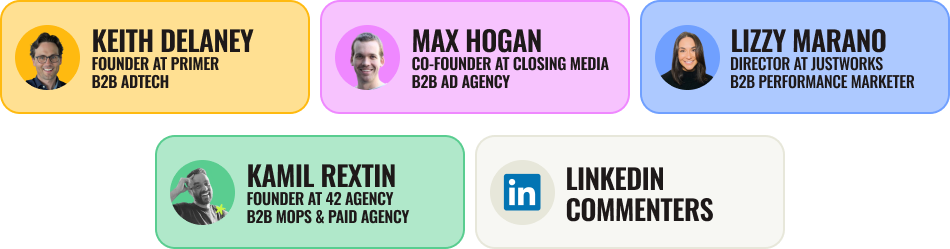
Keith Putnam-Delaney, Co-Founder & CEO of Primer: He gave me a full demo of the Primer product and how to bring your audiences to historically B2C channels during our Unboxing (full video here) and at our Gen Marketer Summit in December.
Max Hogan, Co-Founder of Closing Media: You may remember him from our Gen Marketer Summit in December and as my longtime go-to expert on all things LinkedIn ads. We jumped on a call to discuss what’s working now across his B2B clients.
Lizzy Marano, Director of Growth Marketing at Justworks: Justworks brings in a high volume of inbound as they target SMBs and Lizzy walked me through how she runs performance marketing at scale. She formerly did performance marketing at Chewy, an e-commerce platform for pet products. B2C is usually way ahead of B2B on ads, so I thought she’d add great perspective.
Kamil Rextin, Founder at 42 Agency: I also did a quick check with Kamil since he’s using AI workflows at 42 in a big way, internally and for clients (read more about his agents in this newsletter & in this LinkedIn post).
I also posted on LinkedIn about this topic and I’ll be adding quotes from your comments throughout this post too! Thanks.
And here’s what this newsletter will cover:
Part 1: BYOA: How to bring your audience data to every channel
Part 2: Build a paid flywheel: How and why to stop running ad channels as one-offs
Part 3: Creative is not the bottleneck: Use AI & steal B2C creative playbooks
Final thoughts on the future of paid: ChatGPT ads and ads for agents (I’m tabling these to the end on purpose!)
Bonus for paid subscribers: We added a new “/paid-checklist” skill to the MKT1 MCP. Install our MCP and run this skill to get personalized suggestions on what to do next with paid.
A quick break to unbox Primer
Here’s the full chat and demo with Keith Putnam-Delaney, Co-Founder & CEO of Primer, which helps B2B marketers reach the right customers on more ad channels than just LinkedIn, and figure out whether those ads actually drive pipeline.
Keith walks me through:
How to build one ICP audience and run it everywhere: Keith pulls from Primer’s 292M-person database, layers in his CRM data to exclude existing customers and competitors, and syncs the same audience across Meta, Google, LinkedIn, and Reddit.
Why LinkedIn audiences cost twice what they should: LinkedIn shows ads to “related” job titles and this hurts your conversion.
How Primer’s AI catches the dumb setup mistakes that waste ad spend: Keith walks through features that flag things like bad audience expansion settings or misallocated budget.
If you want a deeper dive on topics in this newsletter, watch the video, then try Primer. Bonus: Get 10% off an annual Primer subscription with code MKT110. New customers only.
And now, on to the newsletter…
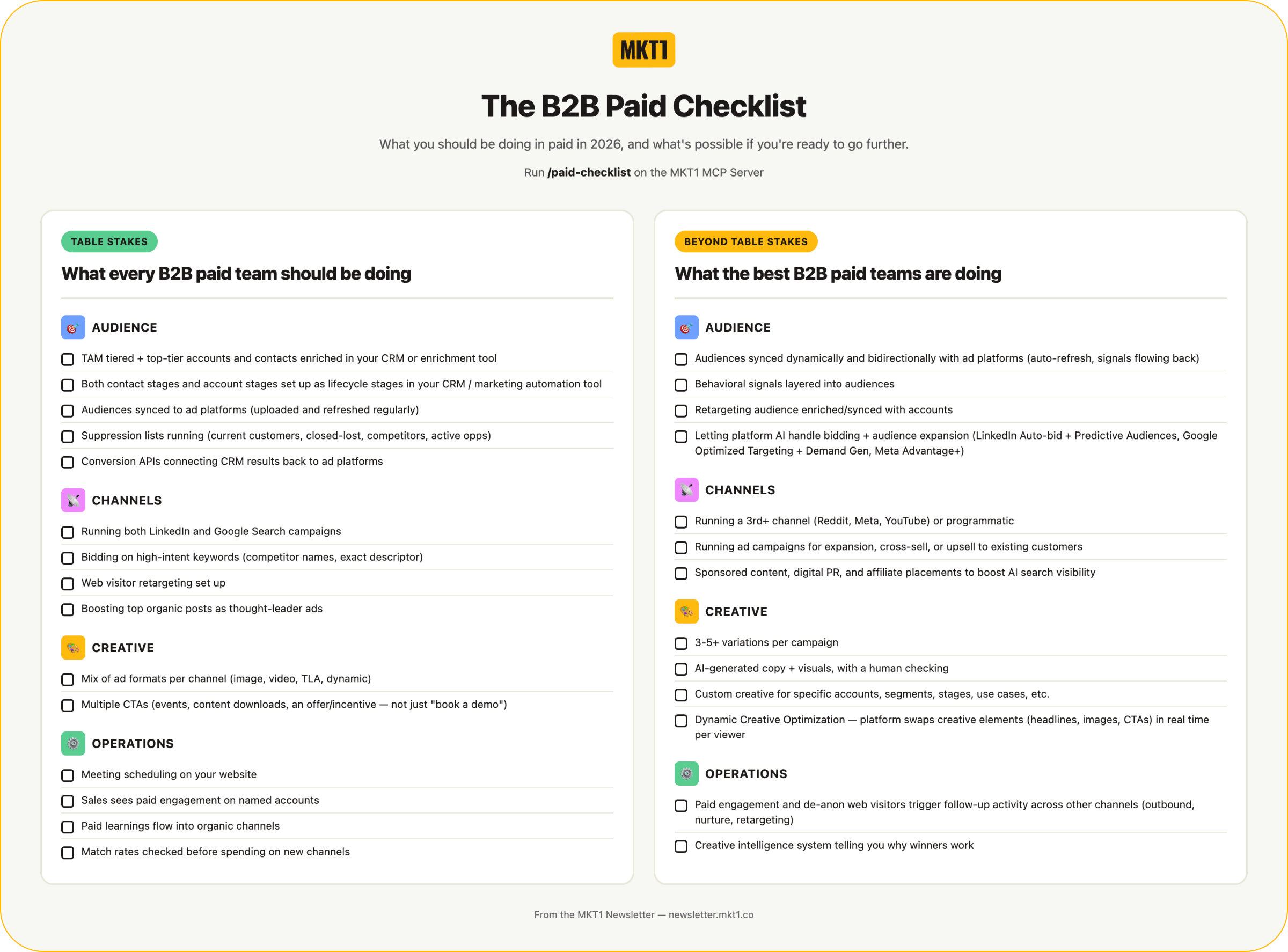
To build out your own checklist, use our /paid-checklist in our MCP Server for paid subscribers.
Part 1: BYOA: Bring your audience data to every channel
“The ad channels can only optimize for you based on the data inside their walled garden. Everything else about your buyer, how you define your ICP, the job titles of people that purchase your product, what your win loss rate is in certain categories, they only know that data if you inject it into their platforms.
The audience is actually one of the last meaningful levers you can control when AI features will literally redo all your creative for you and generate it on your behalf.”
Keith Putnam-Delaney, Co-Founder & CEO, Primer
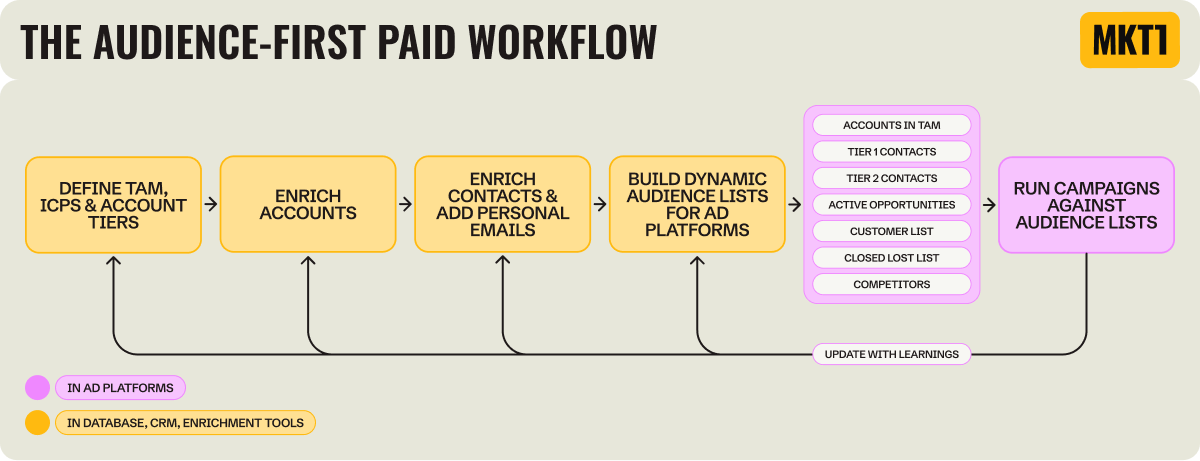
If you’re doing paid in 2026, you need to start with enriched audience data. This means having accounts and contacts in your CRM or enrichment tool (before they ever come inbound) and enriching them with the data to help with match rates and targeting. You also need to build the systems that keep your audience data fresh and regularly synced—in both directions—with your ad platforms.
This simply wasn’t feasible at scale or with this level of detail just a few years ago, but AI changed that. And ad channels and adtech products continue to roll out improved ways to keep audiences synced between your CRM and their platforms.
Today, if you don’t build audiences and load them into ad platforms, you’re wasting money and impressions, limiting how much of your real audience you’re converting, and letting competitors beat you to the punch.
And this work isn’t only important for paid. The same research, enrichment, and lists should power everything you’re doing across marketing: outbound, events, lifecycle, content. For more on this foundation work, see my Account-Driven GTM series.
The audience-first approach to paid has two modes when it comes to targeting:
Precision: hitting your top-tier accounts with tight, enriched audiences. These are the same accounts you'd target with ABM campaigns or highly personalized outbound. Think of this as spearfishing.
Reach: letting platforms find prospects you don't know about yet, using broader audiences and strong audience signal. These are the audiences you'd expect to come inbound, reach on social, or do basic outbound to. Think of this as net fishing, with a very well-made net.
Most businesses need both to scale. Don’t over-engineer one at the expense of the other.
“Work email uploads are a death trap on LinkedIn because they match so poorly. Relying on your own data alone results in a 30 to 40% match rate. That’s where third-party enrichment comes in.”
Max Hogan, Co-Founder of Closing Media
Privacy heads up: Be careful with personal info you don’t have consent to use. A lot of the tactics here involve personal data and sharing it with ad platforms, and PII and consent rules vary by jurisdiction (the EU has the strictest). Specifically, you may need to “store” matched personal emails outside your CRM. Most companies handle this through their privacy policy, standard agreements with ad platforms, and encrypting/hashing identifiers before uploading to ad platforms. Loop in your legal or privacy team before rolling out anything new.
Fine print: As you could have guessed, I’m not a lawyer.
Table stakes
“Well-funded, Series B+ startups feel pressure to pull an incomplete account list from Apollo, ZoomInfo, etc. Regular list updates then fall through the cracks, and 3 months later, your targeting foundation is already breaking. It is a must-do to create dynamic prospecting audiences on LinkedIn. It’s table stakes, bringing your targeting accuracy to 90%+.”
Max Hogan, Co-Founder of Closing Media
Here’s what it looks like to move beyond uploading a static list once and running ads targeting to your exact audience on B2B ad channels:
You understand your TAM and have prioritized it into tiers. Enrich at the very least your top tier accounts with company, personal and work email address details. The depth and detail will vary by company and by channel:
If you’re PLG and horizontal (think Notion or Anthropic), it’s nearly impossible to put all potential accounts and contacts in your CRM. In this case, enrich top tier target accounts and/or active free accounts already using your product. This scenario is when a tool like Primer is very, very helpful.
If you’re doing this for a niche vertical tools, you should load every account and contact they’re going after—this is very possible for a few thousand accounts with tools like Clay.
For more on how to do tiering, see my Account-Driven GTM series.
You’re doing retargeting, but not just blindly showing ads to all web visitors like it’s 2010. When you de-anonymize web traffic and match it to your account data, you can get sophisticated with both ad targeting and creative, way beyond the basics. That same de-anonymized account and contact data also powers outbound, event lists, and better audience understanding.
You’re building suppression lists in parallel with target audience lists: Dynamic audience lists should include current customers, closed-lost, active opps, competitors. Suppression lists should include all accounts and contacts you want to exclude. See the diagram above for a list of dynamic lists you should feed ad platforms.
You’re tracking conversions not just through pixels and UTMs, but with Conversion APIs. Conversion APIs (from ad platforms) let your CRM send conversion data directly to ad platforms, using click IDs the platform stamps on each ad click. It’s more reliable than the browser pixels that used to do this job, since those miss conversions to ad blockers, cookie limits, and cross-device journeys.
In chatting with Max and Keith, there’s a massive opportunity to get ahead of what everyone else is doing. Even though I say this is table stakes, most companies aren’t doing a good job here. Do a good job and you’ll find “alpha” on ad channels reaching your audience.
Note: I’m not going deep into conversion tracking and measurement in this newsletter—that would require another 5,000 words (or more!).
Some quick advice: Start with connecting the Conversion APIs from Google and LinkedIn, and don’t judge paid by last click alone. You’ll miss paid’s influence on other channels.
What’s possible
“Having a really strong in-house first-party data system is going to become more and more important. You need to have a really great CRM system, invest in tools that help you enrich the data that you have. So building off audiences of your customer base, enriching that, and then being able to create audiences from there is the way to ensure you’re reaching the right people.”
Lizzy Marano, Director of Growth Marketing at Justworks
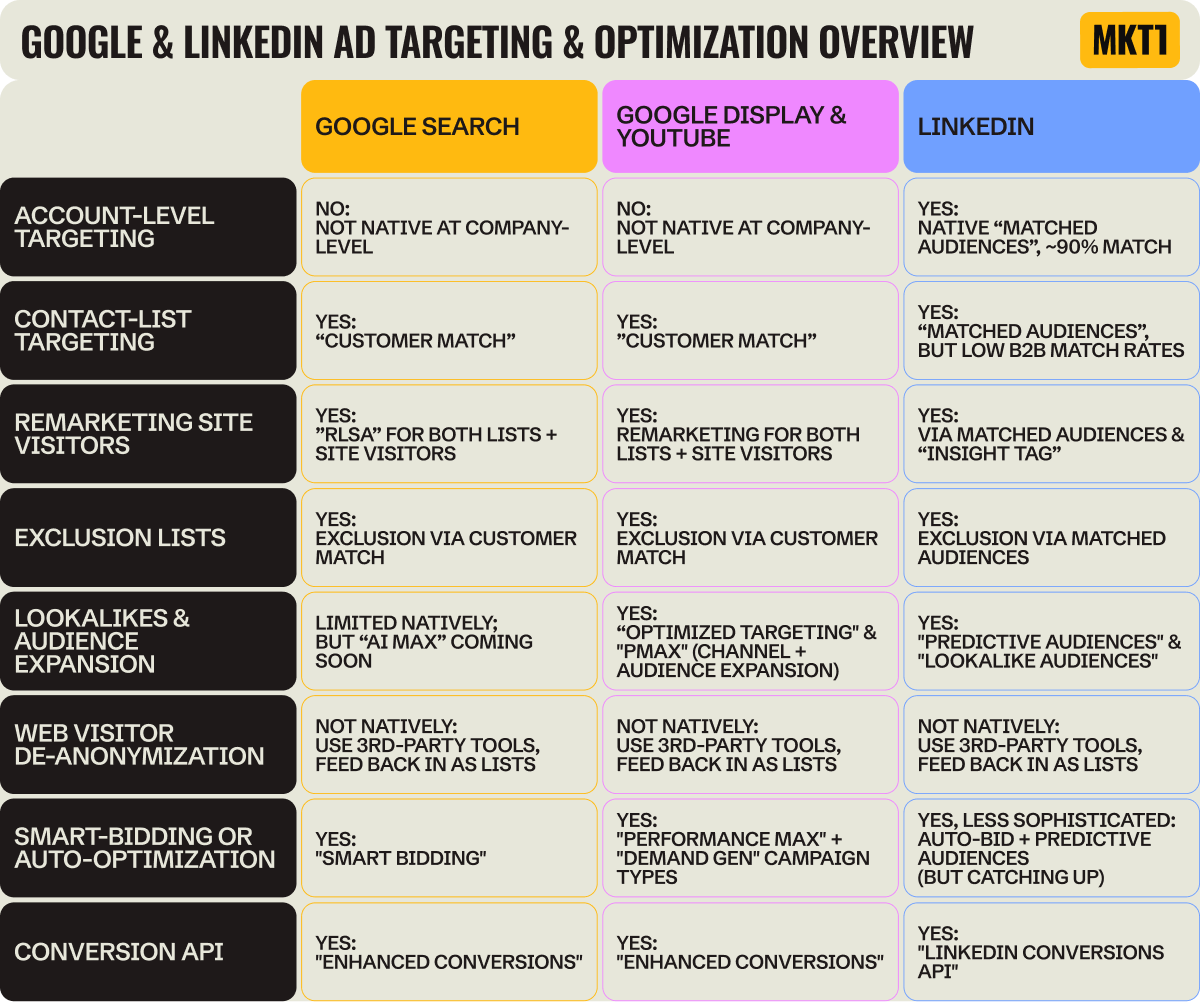
After loading in your audience, the next step is to actually let the ad platforms work for you. You can use the platforms to find new audience pockets, new targeting techniques, etc. to learn faster and scale faster without losing precision.
First, let the platforms optimize for you. Once the basics from the “table stakes” section above are in place and you have conversion data flowing, you can let the ad channels take over bidding and creative rotation on some of your campaigns. This includes:
Smart Bidding on Google Search: AI-driven automated bidding that optimizes for conversions (Google’s had some version of this forever, but now it uses AI! Said in infomercial voice.)
Performance Max on Google’s other properties (YouTube, Display, etc.): Google’s AI decides which channels and creatives to run without much visibility on your side. Works only if you have good suppression lists and conversions flowing well.
Demand Gen on Google’s other properties (YouTube, Display, etc.): Google’s AI-driven campaign type that runs social-feed-style placements across YouTube, Discover, and Gmail to hit bottom of funnel goals.
Auto-bid plus Predictive Audiences on LinkedIn: LinkedIn’s auto-bid handles bidding while Predictive Audiences uses AI to find people most likely to convert based on a starter list.
More on these options in the chart below.
Then let the platforms find more of your audience. Each ad channel has its own way of finding more people similar to your seed audience and expanding reach without losing precision. This includes:
Optimized Targeting on Google (Display, YouTube, Demand Gen): finds new audiences likely to convert by expanding beyond your starter audiences.
Predictive Audiences on LinkedIn: ML-driven audience modeling tool that finds people similar to your starter audiences (this replaced LinkedIn’s older Lookalike Audiences feature). But proceed with caution. I’ve been warned by Keith that these are risky. LinkedIn’s algorithm is improving but companies get burned here fast.
You can also add outside tools to extend these capabilities across platforms:
Primer has its own database of millions of B2B accounts and contacts, already enriched with personal and work emails. You build audiences that match your ICP, then sync them to every ad platform you run automatically. Primer’s pricing and data model support massive lists and larger audiences because it’s purpose-built for paid.
Clay Ads takes your CRM contacts, enriches them with personal emails for higher match rates, and syncs the audiences to LinkedIn and Meta with automatic refresh.
Clay’s dynamic audiences let you combine CRM data, enrichment, and behavioral signals into one audience and push it to ad platforms, your outbound sequencer, or any workbook.
Caveat: Don’t over-segment, let the platforms do their thing
“We work with our clients on finding a targeting middle-ground. We typically want to avoid really tiny audiences that won’t scale, can’t deliver, or do not map back to 1-1 or key account efforts. Let’s not go so niche that we handcuff ourselves within core prospecting campaigns. Rather, let’s find a middle ground where we’re building dynamic audiences across prospecting, retargeting, upsell, and exclusion efforts.”
Max Hogan, Co-Founder of Closing Media
The middle ground Max speaks of is that mix of precision (hyper-targeted campaigns) and reach (broad campaigns) I described way back in the intro. If you push too hard in either direction, you’ll limit your performance. Here are the two ways it breaks:
Don’t hyper-segment yourself out of scale: If you’re stacking five filters and ending up with a 2,000-person audience, the algorithm doesn’t have room to optimize, your CPMs spike, and you cut out half your real audience.
LinkedIn’s recommendation for stable prospecting performance is 50K+, and most B2B campaigns work best with 50K-150K
That said, if your audience actually is very niche and your main target is a tight account list (a few thousand named accounts), the rules change. You’re likely not asking the platform to optimize at scale, you’re trying to hit specific accounts. In that case, pair paid with things like outbound sequences, event invites, and field involvement so paid isn’t your only touch.
“Don’t get too hyper-segmented. You’re really going to miss out on a lot of people that are in your target audience if you’re adding too many filters.”
Lizzy Marano, Director of Growth Marketing at Justworks
Don’t let the algorithms run wild either: Going too broad is the other failure mode (and a more costly one at that). If you let platforms optimize without enriched audience lists and suppression rules in place, you’ll burn budget showing up in pockets that have nothing to do with your ICP. Let the platforms work for you, but only after you’ve fed them quality data.
Join our Buildathon: Learn how to use the MKT1 MCP
Next Wednesday, May 27th, at 9 AM PT to 10:30 AM PT, I’m hosting a live Buildathon just for paid subscribers. I’ll show you how to find and use the 25+ skills on the MKT1 MCP Server, run through a few of my favorites with real company examples, give you time to test some of them, and answer questions.
Part 2: Build out a paid flywheel
“Enterprise paid only works if it’s integrated with outbound, field, and the rest of your GTM. Fortune 1000 buyers don’t click an ad and convert. But ads are part of how they get to yes.”
Kamil Rextin, Founder at 42 Agency
“How do you create a beautiful conversion feedback loop between your own data and these platforms? If your conversion feedback loop is great, you can step on the gas.”
Max Hogan, Co-Founder of Closing Media
The starting point for almost every B2B company on paid is Google search and LinkedIn ads. Within these channels, you should have some basic plays going, including bidding on a set of high-intent keywords (like competitor names, your exact company descriptor, etc.), retargeting web visitors, and boosting your best performing LinkedIn posts as thought-leader ads. Doing this at a bare minimum ensures you are covering your bases and not letting high-value prospects slip through the cracks.
But we all know those channels are getting harder and we’re all scrambling to make up inbound volume on new channels. The opportunity is that you no longer have to stop at Google and LinkedIn. As Keith describes so well (and built the whole Primer product around, because he believes in it that much), you can bring your B2B audience to other channels and reach those people where they actually spend time.
People have shied away from this because they don’t think the creative matches the channel. That can be true for certain audiences, but it’s typically a worthwhile way to expand because of the improved data quality.
But, it’s not just about expanding the channel list to make up the gaps and make paid a viable investment (of time + money!). Paid should be part of your overall marketing plan, not an isolated channel. Siloed marketers and siloed marketing don’t work; it’s the era of the Gen Marketer, remember! Paid can inform what you’re doing in other areas of marketing, and other areas can inform what you should do in paid.
“Programmatic and video are severely underused in B2B. The open web is huge, and you want to maximize the surface area where prospects see you.”
Kamil Rextin, Founder at 42 Agency
Table stakes
“LinkedIn historically requires a lot of manual control because the algorithm lags so far behind Google/Meta. But now it’s starting to get better (much better). If you create the right feedback loop between LinkedIn and your CRM, you can start to trust some of LinkedIn’s features more—auto-bid, predictive audiences, high ad volume (i.e. 30 creatives instead of 4).”
Max Hogan, Co-Founder of Closing Media
When you start making a real investment in paid, you want to be building toward a flywheel. Here are the basics to have in place first:
You’re running both Google search and LinkedIn as your two-channel baseline. Almost no B2B company should be skipping either one, even on a small budget with limited tactics.
You’re checking your match rates before spending on a channel. If your tier 1 list barely matches the audience on a given platform, that’s a signal not to invest there yet.
Paid is connected to the rest of your marketing, and not just by targeting the same audience everywhere.
Example: Retargeting pulls from your organic visitors and newsletter subscriber list.
Example: Your ad creative is informed by what’s already working on organic social—you can do this quite literally by boosting successful organic posts on LinkedIn as thought leader ads. (I call this the LinkedIn flywheel)
Sales sees paid engagement (if they want to). When a VIP from a named account comments on a thought-leader ad, sales should know.
Paid learnings flow back into other channels. Act on these questions: What ad copy is converting? What keywords or topics are worth investing in for SEO and AEO (not exactly the same as paid, but a useful starting signal)? What audiences are responding on what channels? What language works best, and can it be applied to your website?
“Reddit can be great if you’re going after a population that actually spends time on Reddit. Like developers, engineers, IT, we’ve seen match rates as high as 70%. We’ve also seen match rates as low as 4% if you’re going after VPs of finance because they don’t hang out on Reddit.”
Keith Putnam-Delaney, Co-Founder of Primer
What’s possible
“A lot of things get missed on the same channels across organic and paid often because at scale they’re run by different people.”
Keith Putnam-Delaney, Co-Founder of Primer
“Too many B2B teams measure paid by last touch alone. That ignores the halo effect paid has on every other channel. With the right audiences, someone seeing your YouTube ad today might sign up through search or organic next month.”
Kamil Rextin, Founder at 42 Agency
If you go beyond the basics and build out a feedback loop between organic and paid channels, paid can really start paying dividends. But these dividends won’t always show up in last-click reports. You’re going for “incrementality”: Paid lifts your other efforts in ways that aren’t directly attributable.
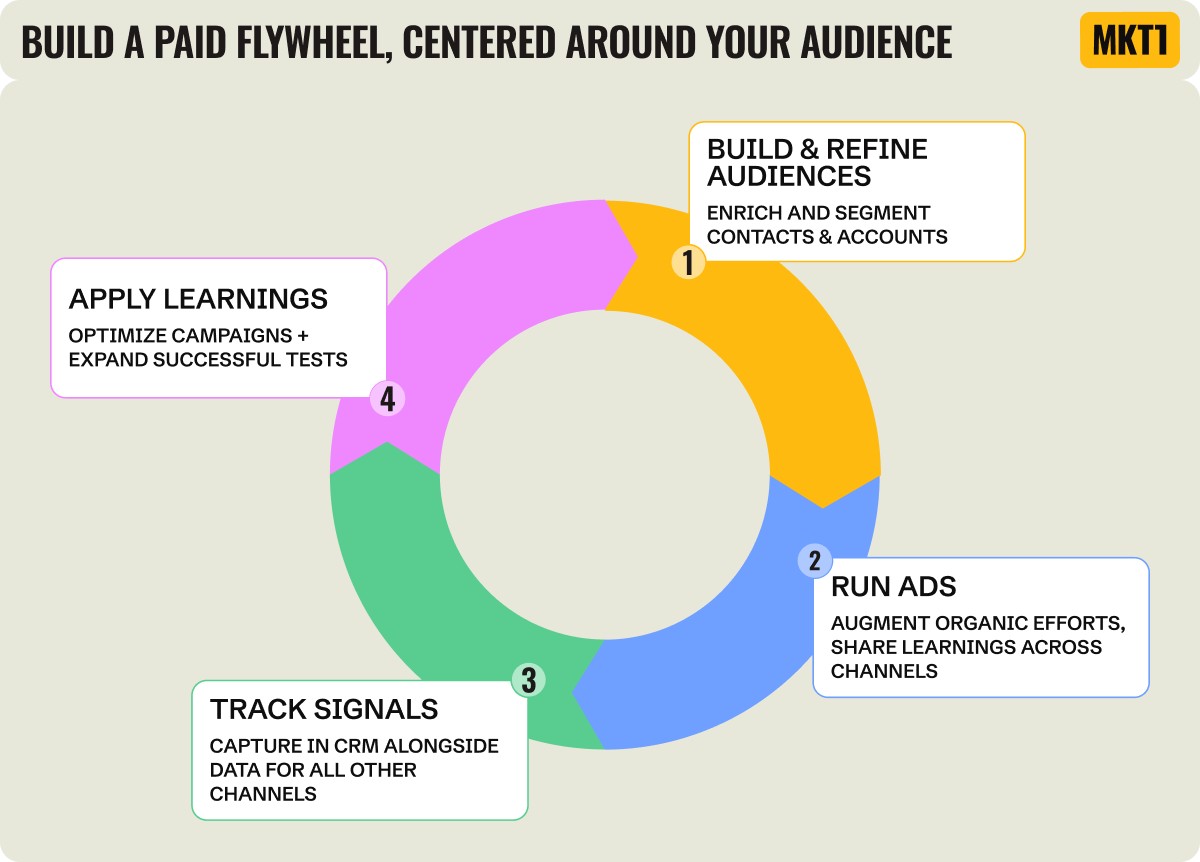
To get this effect, you need to build a flywheel that connects paid and organic, centered around your audience data. This is a summary of the high-level concept of this flywheel, as shown in the diagram above:
Build and refine audiences: Define ICPs, enrich contacts and accounts, create exclusion lists.
Run ads across paid channels, alongside your organic efforts: Use your existing audience insights to shape who you reach, how you reach them, and what you say.
Track engagement & signals (site visitors, conversions, ad engagement, organic interactions): Capture this into a database alongside your organic signals (usually your CRM). And don’t forget to set up both account and contact stages to show progression.
Apply learnings to campaigns: Sharpen audience lists based on what performed well, add new targeting and campaign types, layer in new channels, and sequence organic-and-paid nurtures.
“If you think you’re going to reach 100% of your target accounts on LinkedIn alone, that’s dreaming. People don’t all spend time on LinkedIn. And even if they do, they’re also spending time elsewhere. ABM is much more effective if it’s omnichannel.”
Keith Putnam-Delaney, Co-Founder of Primer
Build loops between paid and organic
There are also a lot of channel combinations that will build their own compounding loops, both within paid channels and across paid and organic. Think of these as mini paid-organic flywheels. Some I’ve seen work:
Paid tests → organic learnings → increased paid and organic effectiveness
Ads are a fast, cheap way to test if keywords are worth investing in on the SEO and AEO side, if messaging lands, and if new audience segments are worth pursuing.
De-anonymized visitors → outbound and retargeting → return visits
When someone hits your site and doesn’t convert, identify them, enrich the record, and route them into retargeting, outbound, or both. You can also sequence the two in the right order for nurture if you need to. If they come back, or their teammates do, they cycle through again.Audience list → deployed across channels → more performance data → better lists
Take the same enriched list and use it everywhere: paid platforms that accept uploads (LinkedIn, Google, Meta), outbound sequences, and event invite lists. Use the engagement data each channel sends back to trigger the next nurture touch and to make your audience lists better over time.Paid and organic mentions → AEO citations → more mentions
It can pay off to pay for some mentions, especially with strong-brand affiliates (Justworks works with Forbes, for instance). Combined with your own organic content, the more places you appear, the more authoritative LLMs think you are, and the more often you show up in answers. LLMs don’t reliably distinguish paid from editorial, which is why this works.
“A large portion of what we’re spending on affiliate isn’t going to drive that last-click lead or last-click purchase. But it is so important that we’re still there because it’s going to inform LLMs. And as more people are looking to AI in their purchase journey, the more important it is to show up there.”
Lizzy Marano, Director of Growth Marketing at Justworks
Closed-won accounts → lookalike campaigns → effective audience expansion
Build lookalikes off your actual closed-won accounts, not your MQLs or your ICP doc. Run them across LinkedIn Predictive Audiences, Meta lookalikes, and any other platform that builds them. As new deals close, feed them back in so the model gets smarter on what your real customers look like.Customer list → cross-sell campaigns → who-buys-what data → more multi-product customers over time
Everyone talks about this but so few companies actually do any sort of lifecycle ads!
Run cross-sell and upsell ads to your existing customers. You’ll learn which kinds of customers buy (or are at least interested in) multiple products. Use that pattern to go acquire more of those high-value customers, inform what sales proposes in initial deals, and shape CS cross-sell efforts.
“We see these patterns emerge among our customers. Rippling pioneered the upsell, cross-sell motion. They’d pull customers of their IT product but not their HR product in from Salesforce, then layer on department targeting for HR, and advertise to them: ’Your team’s already in Rippling. Why don’t you switch your payroll over to us?’”
Keith Putnam-Delaney, Co-Founder of Primer
Caveat: Bigger swings before smaller loops
“Get the right feedback loop on the conversion side and forget the fancy targeting. Let the trillion-dollar platform go find conversions for you.”
Max Hogan, Co-Founder of Closing Media
I love talking about these fancy flywheels and channel expansion ideas, and this is an ideal state to strive for, but you need to nail the basics first. Don’t spend time on micro-optimizations or small-volume tactics when you haven’t nailed the bigger swings.
The other mistake I see is people thinking organic learnings should feed paid and not the other way around. Paid learnings feed your other channels just as much as organic learnings feed paid. If you’re treating paid as a one-direction signal, you’re missing half the value. Since you can learn faster and force volume with paid, sometimes paid is the way to start.
Add MKT1 to Claude Code with our MCP Server
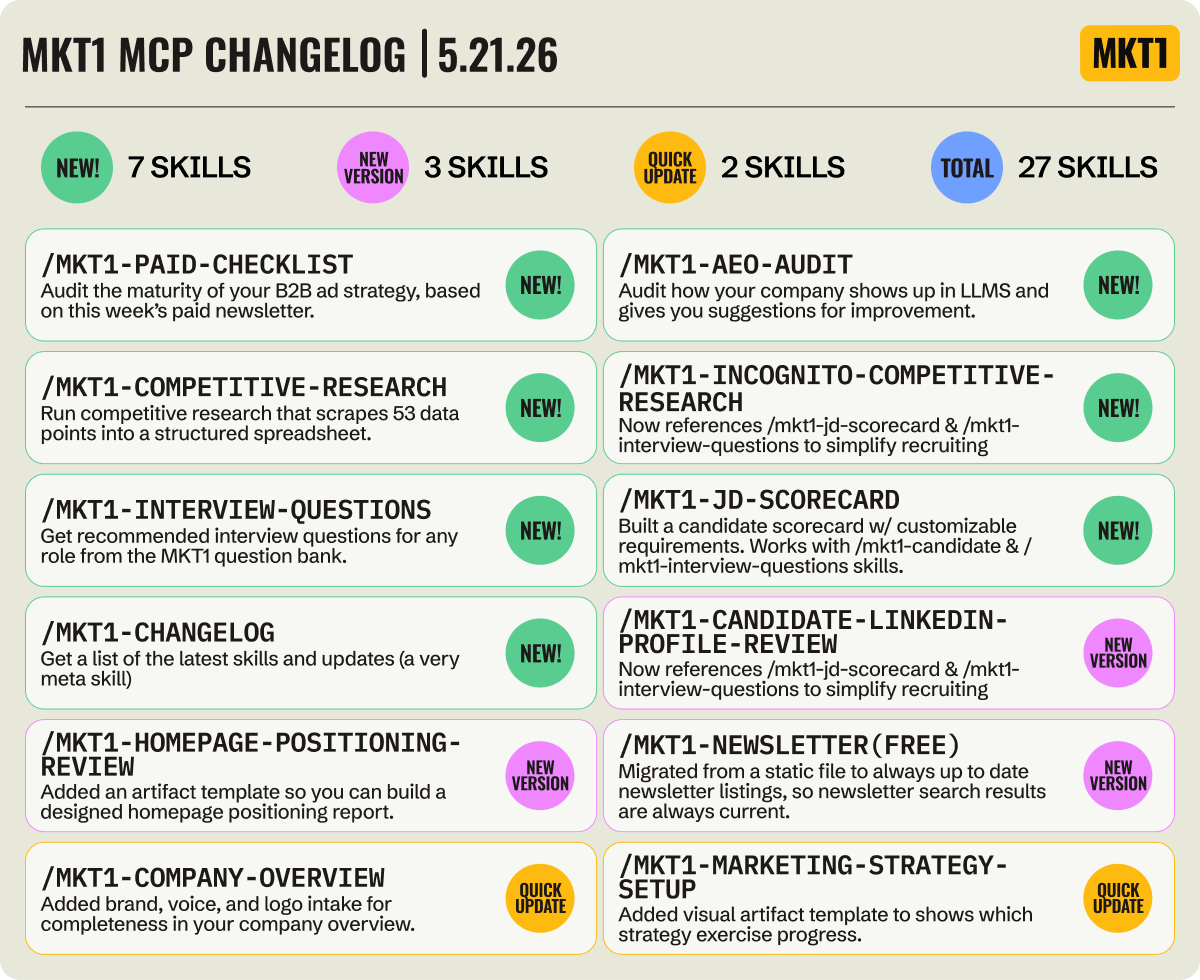
NEW SKILL: AUDIT B2B AD EFFORTS
Answer a few questions about what you’re doing with paid now, and the /paid-checklist skill will suggest opportunities.
PLUS 25+ MORE SKILLS!
Paid subscribers can run our new AEO audit, competitive research, and recruiting skills, among many others.
Part 3: Creative is no longer the bottleneck
“Scaling creative is huge. With all of the AI tools and the ability to create a ton of iterations, that’s a competitive advantage. You’re going to fall behind if you don’t.”
Lizzy Marano, Director of Growth Marketing at Justworks
Ad creative may be the most obvious place within paid to be impacted by AI, yet I still see so few teams actually iterating on creative in meaningful ways. And I’m not just referring to iterating on copy or design, but also on offers, the organic LinkedIn posts you boost (and from whom), and landing pages.
And if you’re wondering what great looks like here, look to B2C. We’ve all seen ecommerce ads showing the exact products you just browsed, plus related products, almost instantly.
Many B2C companies have hundreds of creative variations rotating against thousands of audience segments, and they have the adtech and agencies to support this. B2B has been slower to catch up. But new AI-driven tools are starting to land in our space, and the companies that take advantage of them may have a leg up at least until everyone else catches on.
You can think about building creative this way: For every audience data point you’re tracking, you could have a matching creative variation.
Tier 1 enterprise account in fintech gets a different ad than tier 2 SMB in healthcare.
Someone who visited your pricing page twice but didn’t convert gets a different message than a first-time visitor.
Different contacts at the same account get different ads.
This doesn’t mean every variation is worth producing, but this is a good mental model to expand how you approach creative. And always use humans to ensure quality, but use AI to expand and mix and match options.
“Don’t be afraid to break the mold. Every B2B ad looks the same, and you’re not just competing with other B2B ads. You’re competing with B2C ads on the feed too. Lean into video and storytelling. AI can help you scale creative once you have a good baseline, but it can’t replace taste.”
Kamil Rextin, Founder at 42 Agency
Table stakes
“Scroll through your LinkedIn feed—most ad creative sucks and it’s been the same story for a decade. But, the teams putting time into creating pattern interrupt and a great offer are doing extremely well. It’s not complicated, but it’s difficult to bring the pieces together (i.e. a killer offer may require leadership approval/buy-in).”
Max Hogan, Co-Founder of Closing Media
As Max says, it’s not that complicated. But you’d be surprised how many B2B companies still don’t have these basics in place:
You’re using a mix of ad formats on every channel you’re running. On LinkedIn, that includes thought leader ads from internal execs, external voices, and customers.
You have multiple CTAs running, including events and other offers, not just “schedule a meeting.”
Your creative also needs links to a form with meeting scheduling built in. (This isn’t really a creative thing, but please stop making people book meetings over email. RevenueHero can help! You’re killing the conversion and I’ll say this every chance I get!)
Where the platform supports it, experiment with letting the ad platforms generate dynamic variants from your assets (LinkedIn Dynamic Ads, Meta Advantage+, Google PMax).
“I can have 20 ads rotating at the same time, hitting different audiences based on what we know about them. In the past, that would have been a massive bottleneck because we just wouldn’t have the capacity. I could make those in 10 minutes now.”
Lizzy Marano, Director of Growth Marketing at Justworks
What’s possible
“In ecomm, you can use retargeting to show someone who looked at a particular product, similar products in a carousel. It’s table stakes in B2C now. But now that I’m in B2B, that feels so advanced. I can only imagine what AI is doing for B2C now.”
Lizzy Marano, Director of Growth Marketing, Justworks
Once ad variations are running, the next layer is personalization and automation at scale: different creative for different audience tiers, AI handling rotation and budget, and systems that tell you why winners work:
Do what B2C does, but with use cases, products, and offers (instead of SKUs). If you aren’t selling to one niche audience with one simple product, you can start doing this!
Make personalized creative for tier 1 accounts. Then give tier 2 industry-specific or use-case specific versions and give your broader TAM a few rotating default versions. For each tier, test the personalized creative against a generic creative to see if this even matters!
Experiment with DCO (Dynamic Creative Optimization). You give individual creative elements (headline, image, CTA) to the ad platform and they swap in the right creative in real-time, based on the viewer. Mostly a B2C move historically, but more B2B tools now support it.
Let AI agents pause losers and reallocate budget within 24-48 hours. Some agencies are already building this out for clients and will set this up for you today.
Build creative intelligence systems. Make workflows that tell you why a winning ad worked, so you can replicate the pattern, and feed those learnings into the next round of AI creative generation. You can do a basic version by just feeding creative performance reports to Claude!
Note: For a lot of these tactics, working with an agency that does this for many clients is easier than building it out yourself.
Some examples of ad variations
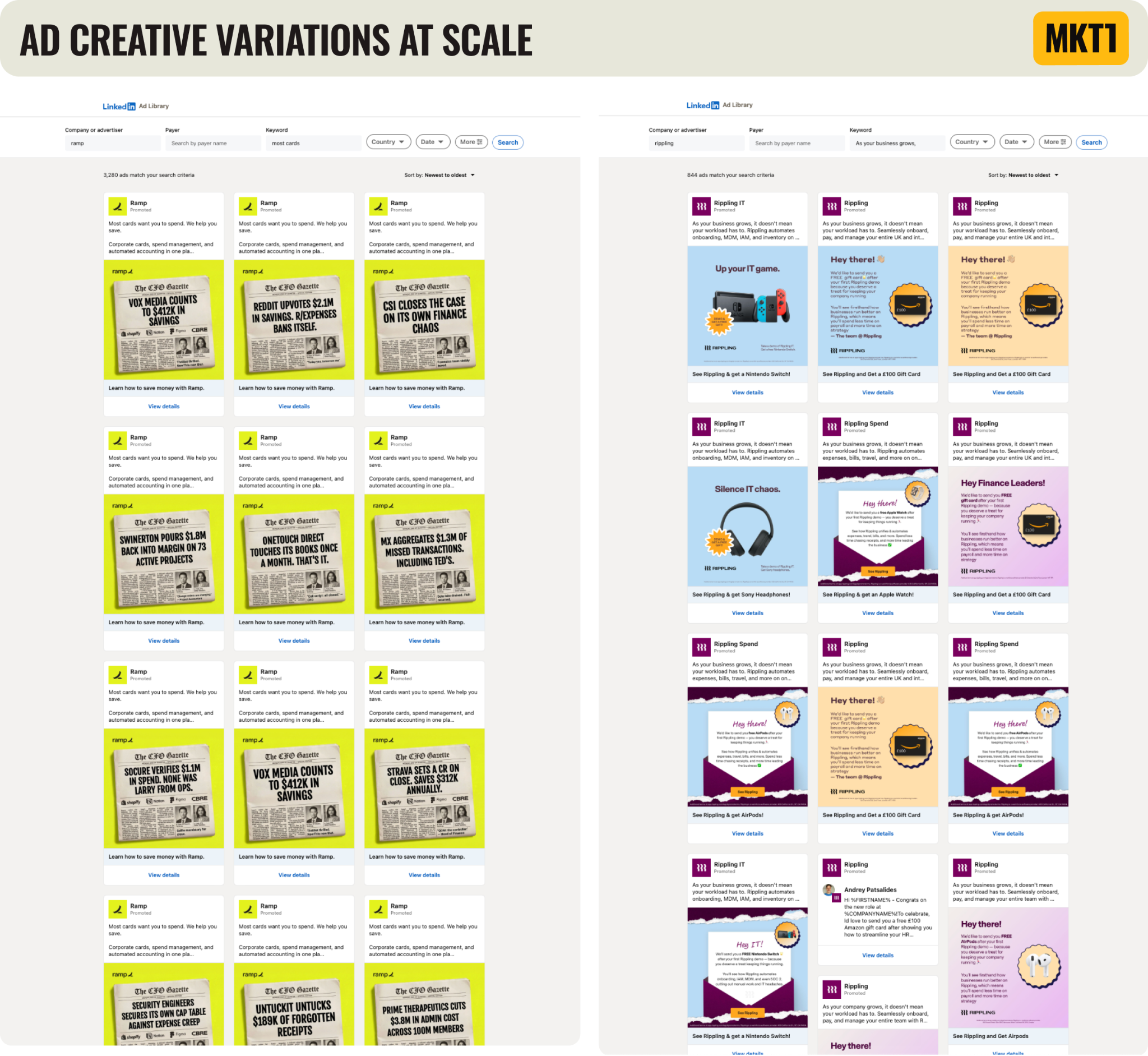
Ramp and Rippling are two companies already doing a bunch of ad creative variation in B2B. You can see here (if you squint) that they are varying offer, copy, layout, and color scheme (and of course Rippling is giving away headphones):
“Paid media execution will be much easier from writing the ad copy, landing pages, and a campaign ops perspective. The deep strategy and the creative strategy is what sets your company apart.”
Jeremy C. on LinkedIn
Caveats: Stop the slop and do the math
“There has to be a QA in place. I’ve seen small scrappy teams try to automate things, and then all of a sudden things are live and it is just a disaster.”
Lizzy Marano, Director of Growth Marketing, Justworks
“On LinkedIn, most offers, most ads, most creatives are so bad. So when a company comes through with great ads, they can outperform to such an extent that it’s really exciting.”
Max Hogan, Co-Founder of Closing Media
Don’t put out crappy AI design or copy: AI can crank out copy and visuals at scale, but the foundational creative needs human input. Take LI thought leader ads: If the initial organic post is AI slop that would never perform, don’t put money behind it. Build the first template (or template family) with a human, then iterate from there with AI. Don’t sacrifice your brand for a few extra creative variations. (See my LinkedIn Flywheel post for what “good” looks like with thought-leader-ad creative.)
And also watch out for statistical significance: You can produce 100 variations now, but you can’t actually test 100 variations on most B2B budgets. Each variation needs enough impressions and clicks to tell you anything reliable. If you split a $10K LinkedIn budget across 30 ads, none of them will get enough volume to teach you what’s working. Better to run fewer variations at a time, and rotate in new variations as the data tells you which dimensions matter. Volume of variations is not the same thing as good testing.
Future of paid: ChatGPT ads and ads for agents
“The future of paid in part is ads aimed at agents instead of humans.”
Steven Dunston on LinkedIn
ChatGPT ads
I wrote a whole newsletter about paid in 2026 and haven’t mentioned ChatGPT ads yet (well, except in the table of contents). That was on purpose. But here’s where things are at:
OpenAI officially confirmed ChatGPT ads on January 16, and launched them February 9 for U.S. users on the Free and Go tiers. Paid users (Plus, Team, Enterprise) don’t see ads. The format is contextual text ads at the bottom of chat responses, labeled “Sponsored.” Pretty standard, uninspiring design so far!
On May 5, OpenAI launched a self-serve Ads Manager in beta, added CPC bidding to the existing CPM model, dropped the previous $50K minimum spend, and rolled out a measurement pixel plus a Conversions API. OpenAI’s stated revenue goal is $2.5 billion this year and $100 billion by 2030 (that’s a lot of money).
Maybe you want to experiment here, but I wouldn’t spend too many cycles trying to crack the code yet. The opportunities are still much bigger elsewhere. Now maybe you’ll be the B2B OpenAI Ads trailblazer and set the standard, but probably not? Only try for that if your marketing advantages really set you up for this, like Zapier and SEO or peanut butter and jelly.
“My paid search manager put together a point of view on, ‘we should launch ads on ChatGPT.’ I, as the leader, have to take that back and be like, okay, does that align with brand credibility, brand perception?”
Lizzy Marano, Director of Growth Marketing at Justworks
Ads for agents
Beyond ChatGPT ads, the longer-term shift coming is ads that are “read” by agents instead of (or in addition to) humans. And eventually, agents will talk to other agents about products with the human nowhere in the loop. This part hurts my brain a little.
Picture this:
A buyer tells their AI agent “find me an HR platform that integrates with our payroll and costs under $X per employee.”
The agent does the research, runs the comparison, and makes the purchase. But like most things, this wasn’t just based on which was the better product. “Ads” also factored in.
Your ad copy was read by the agent. Your demo was watched by the agent. And the human may never see your ad or your website—or even use the product.
This isn’t fully happening yet, but foundations are being laid. Most of the protocols being developed here are oriented toward e-commerce and retail (Shopify, Etsy, Target, Walmart) rather than B2B SaaS. B2B will follow, as it always does with ads.
Google’s Universal Commerce Protocol (UCP), announced in January, is an open standard that lets AI agents discover products, pull real-time pricing and inventory, and complete purchases directly with merchants. Shopify, Etsy, Target, Walmart, Stripe, Visa, and Mastercard are already on board.
And OpenAI and Stripe’s Agentic Commerce Protocol (ACP) has been live in ChatGPT since September 2025, letting agents complete purchases on behalf of users.
Watch this space, but don’t throw it all away to chase this. The audience-first paid strategy we covered in the rest of this newsletter is where to focus today, and the foundation you build for humans translates when agents arrive. Lots of data points about your audience in a structured format will only help. Just like good content practices help with SEO, and good SEO practices help with AEO.
Now go buy some ads. And not just for the quick wins, but for the learnings that will last a lifetime (or until agents take over).
Even more from MKT1
🙏 Brought to you by: 42 Agency, a Demand Gen and MOPs agency; UserEvidence, the customer evidence and advocacy platform; and Conversion, the agentic marketing automation platform. All three have offers for MKT1 subscribers!
🤖 MKT1 MCP Server: Add MKT1 skills to your LLMs. Paid subscribers get our full library of skills and templates—we’re up to 27 now!
🧱 MKT1 Buildathons: Save your spot for our next Buildathon on May 27th, where I’ll show you how to use the MKT1 MCP Server in Claude Code. For paid subscribers only! Missed our first Buildathon? Watch the replay to see how to build a /marketing-strategy-skill in Claude Code.
🪢 Get on our Slack waitlist: We launched a Slack community just for talking about using Claude Code or Cowork and/or our MCP Server. It’s invite-only for paid subscribers using the MKT1 MCP Server. Get on the list ➜
🧑🚀 MKT1 job board - new & improved: Jobs from the MKT1 community (it’s free to post as a paid subscriber). And our candidate form if you’re looking for a new role (option to remain anonymous included!).
🥞 MKT1 Perk Stack - New Perk: Exclusive discounts worth $40K+ on our favorite GTM tools. For annual & superfan paid subscribers only. We just added 3 months free of Granola, check it out!
🧰 Template & resource library: We have 100+ templates and resources available to paid subscribers in our template & tool library.
We use Hubspot which does not allow LinkedIn thought-leader ad tracking and reporting. You mentioned in this newsletter that it's def something we should be showing to sales, but did you learn of an automated way to do that? In the past I've exported the demographic data and manually uploaded the companies to a campaign in Salesforce, but would love to not have to do that anymore