

Build a LinkedIn Flywheel, not a disconnected social strategy
How to combine your influencer, executive thought leadership, paid social, and signal-based campaign efforts into a compounding growth machine
👋 This is a monthly free edition of MKT1 Newsletter—a deep dive into a B2B startup marketing topic, brought to you by 42 Agency, Attio, and Default.
Upgrade to a paid subscription to get 100+ templates & resources, a vetted contractor & agency list, exclusive discounts on marketing tools, free posts on the MKT1 job board, and full access to the MKT1 archive, including bonus newsletters.
You’re doing LinkedIn wrong. No, this isn’t a rant about the algorithm or a personal manifesto on quitting LinkedIn. LinkedIn is still one of the best places for B2B startups and marketers to spend time right now (that’s why I basically live there).
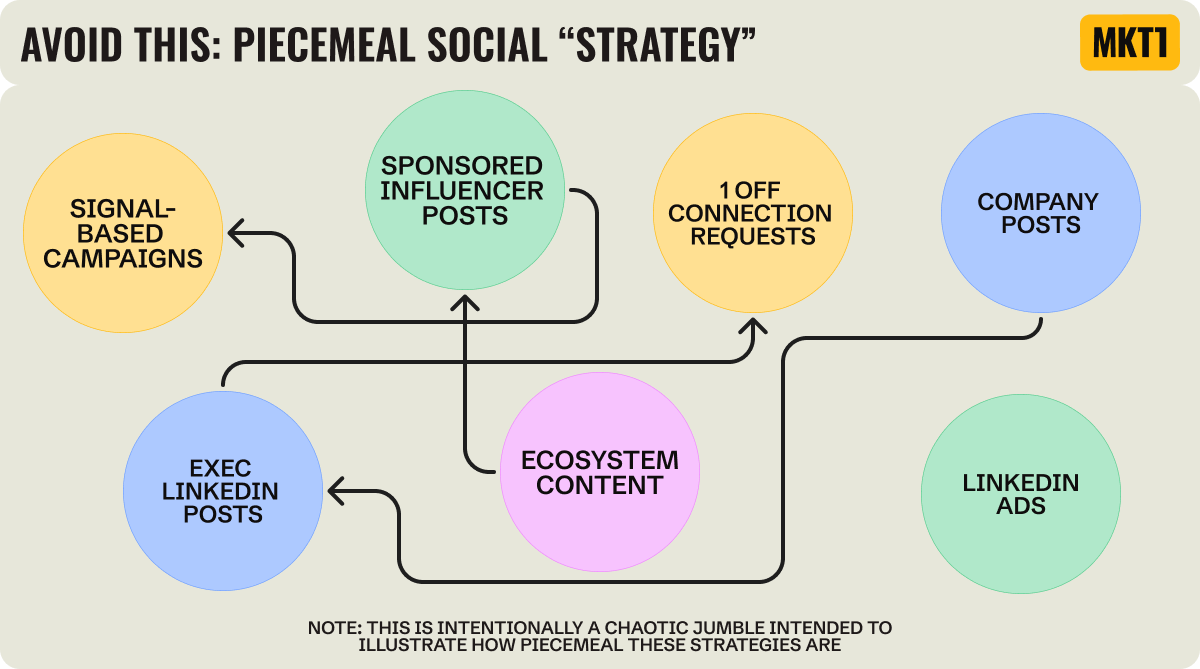
The problem is your LinkedIn strategy isn’t really a strategy—it’s a collection of disconnected efforts.
You might have the right ingredients: an influencer program, an exec thought leadership calendar, a few ads running through an agency, and occasional follow-up DMs to social commenters. Adding insult to injury, these efforts are usually handled by multiple marketers. But this is not a strategy, it is random acts of marketing, as I love to say.
If you combine these ad hoc efforts, rework the recipe, and streamline ownership, you can build a LinkedIn Flywheel that actually spins out pure gold. Okay, I’ve gotten carried away. But it is not an exaggeration to say that most startups doing any of these individual activities are truly sitting on a LinkedIn goldmine; they just have the wrong tools and workflows to mine it.
The fix isn’t to post more, spend more, or switch agencies. It’s to build a LinkedIn Flywheel™ that makes these pieces work together, helping you avoid wasted effort and allowing your results to compound. There’s no one-size-fits-all approach to LinkedIn, but there is a method to the madness you can adapt for your startup.
In this newsletter:
What is the LinkedIn Flywheel?
Step 1: Executives and influencers post on LinkedIn
Step 2: Boost organic posts with Thought Leader ads
Step 3: Qualify LinkedIn post “engagers”
Step 4: Send follow-up campaigns to LinkedIn “engagers”
Why you need a Gen Marketer to own your LinkedIn Flywheel
Templates & resources (for paid subscribers): Influencer campaign brief, Walkthroughs: How to run Thought Leader ads and extract “leads” on LinkedIn
Recommended products & agencies
We only include sponsors we’d recommend personally to our community. If you are interested in sponsoring our newsletter, email us at sponsorships@mkt1.co.
42 Agency: Let 42 Agency handle the MOPS work your team avoids. From routing logic and fixing scoring, to aligning HubSpot + Salesforce, to setting up new GTM tooling, 42 Agency is ready to help your B2B startup clean up and scale your ops.
🎁 Offer: Mention MKT1 to get 10% off a HubSpot Audit or HubSpot Sprint.
—
Attio is the AI-native CRM. With automatic enrichment, call intelligence, AI agents, customizable record pages, flexible workflows, and detailed reporting, it just works better and doesn’t require months of set-up. We even use it at MKT1.
🎁 Offer: MKT1 subscribers get 15% off your first year.
—
Default: Automate inbound with enrichment, meeting scheduling, AI workflows, and alerts when target accounts browse your company’s website.
Heads up: Default and Attio go together like peanut butter and jelly. Default is the highest converting scheduler for startups using Attio.
🎁 Offer: Mention MKT1 to get 2 months free on any plan for up to 10 seats ($1500+ value).
Part 1: What is the LinkedIn Flywheel™?
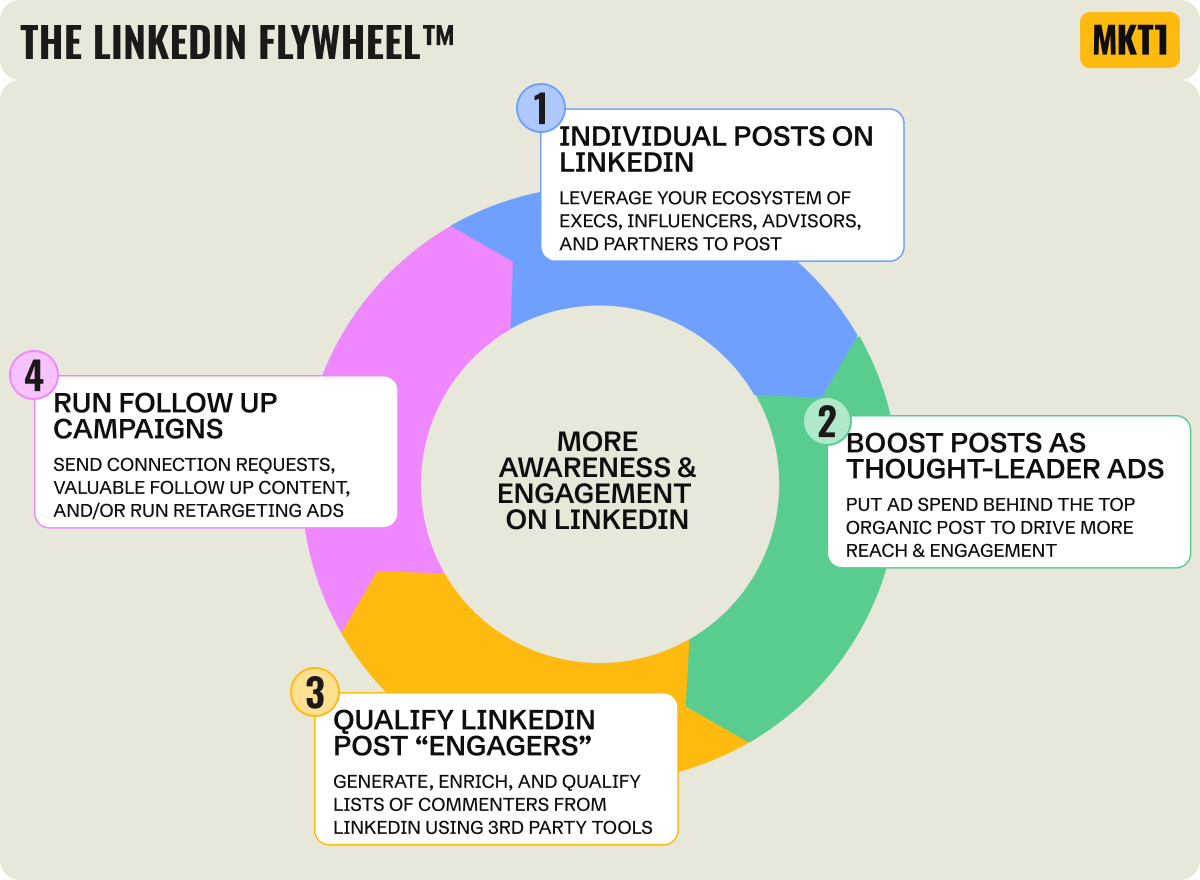
The LinkedIn Flywheel combines ecosystem marketing and executive thought leadership, with organic and paid LinkedIn posts, and signal-based campaign efforts into a single program. I’ll break down each piece in detail.
When done in this specific order, you’ll get high-quality “fuel” from people who know your space best to kick-off the process, boost distribution on the best posts, and finally follow up with engagers. This engagement will drive more social followers, both the individuals who posted and your company, and you’ll be able to rinse and repeat.
Before I go any further, I know what some of you might be thinking: SPAM! In my previous LinkedIn post teasing this topic, I heard these concerns about building this flywheel.
So let me just get this out of the way: Don’t spam people. Every LinkedIn “like” shouldn’t trigger a 12-step outbound sequence. The trick is to identify people who may be interested in more content, community, and products your company offers and engage with them in meaningful and valuable ways.
Step 1: Executives and influencers post on LinkedIn
🌀 Overview: To feed the flywheel, you need content that actually performs on LinkedIn, which means thought leadership posts from humans, not your company account. You need to prioritize real voices with real credibility: in-house experts, founders, or people in your ecosystem who already have a following or influence with your audience. Because why start from scratch when you can amplify what’s already working?
🎯 Goals: Get individuals posting in their authentic voices about the ideas, POVs, news, and products that matter most to your company right now.
⚠️ Pitfalls: Spoon-feeding execs or influencers content to post when they have zero interest in the subject matter. And relatedly, prioritizing quantity over quality—posting generic, uninteresting content just to “check the box.” This leads to uninspired, low-engagement content that clutters feeds instead of sparking conversation.
⚙️ Step 1 details: How to get the best-fit people to post on LinkedIn
Start with the right people: The best LinkedIn voices might be your own executives, or they might sit outside your company. Look for ecosystem partners or trusted 3rd-party creators who already have credibility and relationships with your audience.
Note: you can complement individuals’ posts with posts from your company account, but these typically won’t perform as well.
Keep posts aligned to your story: Whether the person posting is internal or external, make sure content ladders up to your high-level narratives and topics that define your company’s story (write content Perceptions™ & Pillars).
Remember: Even though you’ll provide guidance on what to say, make sure posts still sound like they come from the individual and don’t force them to use specific copy!
Mix up the formats: Encourage variety and pick the best format for the content itself—carousels, text-based, reels, polls, and more. The LinkedIn algorithm shifts constantly, so keep cycling through.
Engage in the comments: I can’t overemphasize the value of the poster engaging with commenters. This drives more reach, and drives more comments, which means more engagement “signals”—plus you can learn a lot about your ICP this way.
Adapt your approach: The workflow will differ depending on whether you’re working with internal execs, external advisors or investors (that you aren’t paying) or external creators and influencers (that you are paying), so adjust your process accordingly in the next steps.
How to get execs posting
Find the right execs: Look for people who meet three criteria: (1) they have credible, opinionated POVs, (2) their audience overlaps with your ICP, and (3) they have the time and motivation to engage consistently.
Capture ideas in bulk: Kick off by aligning on themes, perceptions and topics in advance. Then give execs an easy way to share ideas and capture thoughts: use a private Slack channel, voice notes, or monthly recorded convos, etc. You can repurpose these thoughts or recordings into multiple posts.
Batch and plan: Based on the ideas captured, create draft content and send to the exec to approve in batches. 1–2 batches per month should help you maintain a steady 2+ posts per week cadence (which is the minimum cadence necessary to start building a following and driving real engagement on LinkedIn).
Make posting frictionless (but don’t post and ghost): Get the exec’s login (there’s no way around this!), use a scheduler like Assembled, and post at consistent times. Make sure the exec spends 30–60 minutes replying to comments and engaging in their own voice.
I did a whole podcast episode and newsletter on this topic, check it out:
And I will now re-use my favorite self-made meme to remind you that if your founder really doesn’t want to be a thought leader on LinkedIn, you will likely never be able to make them. But good news…if they aren’t the right choice, you can use other execs or leaders and/or look to your ecosystem.
How to run sponsored LinkedIn campaigns with ecosystem partners
Pick the right partners: Look for creators or “LinkedInfluencers” who already have credibility and trust with your target audience. The key is relevance and audience overlap, not just follower count.
Share a brief: Be clear about the campaign background, storylines you want to drive, and any other big initiatives happening at your company. Then let creators express them in their authentic voice. (Yes, we have a template brief to share with creators)
Run campaigns in batches: Treat influencer posts like a coordinated campaign. Cluster posts around a strong theme or launch within a ~2-week window (or 4–6 weeks if each influencer is posting multiple times). This creates momentum and makes your message feel everywhere for your audience.
Keep the content native: The best posts don’t feel like ads. Encourage partners to share their own POV, lessons, or workflows, experiences—content that reads like their usual posts, not a brand press release. Remember: They likely know how to speak to your audience better than you do!
Tools that make it easier: Platforms like Passionfroot and Limelight help you source and manage influencer collaborations, track results, and pay creators—though going direct can also work well. You can also use Clay or other enrichment tools to pull LinkedIn followings for your audience.
➜ Influencer brief template (for paid subscribers): Use this template to run an influencer campaign on LinkedIn. It helps you share the right details, keep messaging aligned, and help influencers stay authentic while speaking to your audience. For paid subscribers.
Step 2: Boost organic posts with Thought Leader ads
🌀 Overview: Once you have high-quality organic posts, the next move is amplification. Instead of coming up with ads in a vacuum, Thought Leader ads let you take the best-performing organic, human content and put paid spend behind it so more of the right people actually see it. Done right, this combines the authenticity of organic posts with the reach and targeting power of paid.
🎯 Goals: Use paid Thought Leader ads to extend the reach of your top 10–20% organic posts from individuals.
⚠️ Pitfalls: Promoting posts that didn’t work organically, using poor targeting, and over-spending before testing—start small, scale what works.
⚙️ Step 2 details: How Thought Leader ads work
Expanded interactive walkthrough for paid subscribers (like the one above but better!) here »
Start with proven organic hits: Wait at least 24 hours after an organic post, then pick your top 10–20% of posts by engagement rate and boost that as a Thought Leader ad.
Get author buy-in early: You can only promote posts from people who approve your request to make that post a Thought Leader ad, so make sure this is in your sponsorship agreement if working with external creators (it’s called paid usage rights). It’s pretty common to include 3 months of paid usage in a deal with your external creators.
Go to LinkedIn Campaign Manager: It’s a bit confusing in there (thanks LinkedIn for the beautiful UI as always!). Here are some big things to note:
There’s no option labeled “Thought Leader ad.” Choose Engagement or Brand Awareness as your campaign objective, and it will let you make this type of ad a few steps later.
After you set a budget and targeting, you can then find the post from the individual you want to promote, select it, and request approval from the author. You might think the ability to select the post should happen earlier in the set-up process…but it doesn’t!
Once the author approves your request to use the post as an ad, go back into Campaign Manager, add the post to your campaign, and launch it.
When setting your budget, start small (around $50–100/day) and scale what works.
Reminder: I’ve got a full walkthrough for you on how to do this for paid subs (a better version of the GIF above!)
Optimize and refresh: Don’t just watch impressions, track engagement quality, comments, and reactions. Promote new high-performing posts, pause anything stale, and use these insights to fuel the next step of your LinkedIn Flywheel.
Pro-tip from Jonathan Bland (Co-founder, Omni Lab): “The big mistake is treating thought leader ads like brand ads. They need a conversational hook, not a headline. Otherwise, they scroll right past.”
More from MKT1
📖 Keep reading: Paid subscribers get access to the rest of this newsletter—how to qualify people who engage on your posts, run follow-up campaigns to them, and who should manage your company’s LinkedIn flywheel.
🧰 Templates & resource library: We have 100+ templates and resources available to paid subscribers in our brand-new template library.
💰 Deep discounts on our favorite modern GTM tools. The MKT1 Perk Stack has 10+ exclusive deep discounts for annual subscribers. Plus 10 more standard discounts for all paid subscribers.
🛠️ MKT1 GTM tools library: An organized, sortable list of recommended products on MKT1.co.
🧑🚀 Job board: Jobs from the MKT1 community (free to post as a paid subscriber)
🍽️ MKT1 Supper Club: Small IRL dinners with smart people, good food, and conversations on topics that actually matter in your role—made possible by some of my favorite GTM tools. Join the list.


