


👋 This is a monthly free edition of MKT1 Newsletter—a deep dive into a B2B startup marketing topic, brought to you by Framer, Closing Media, and RevenueHero.
Upgrade to a paid subscription for: Full access to our new MKT1 MCP Server | 100+ templates & resources | Post to MKT1 Job Board | MKT1 Newsletter Archive | $40K+ in discounts in the MKT1 Perk Stack
“We should buy some billboards.”
If you’ve been a marketer for long enough, or maybe even not long at all, you’ve gotten this request.
Some of us have gotten more absurd versions of this request: “Can we put a Beyoncé quote on a billboard?” or “Can we buy all the remaining Bay Area billboard inventory for the rest of the year (even though that’s 100x our annual marketing budget)?” Just hypothetically.
Which begs the question: Can out-of-home (OOH), or more specifically billboards of the San Francisco freeway variety, coming in at $20–50K a month, ever actually be worth it?
About a year ago, I was at lunch with Maya Spivak, one of my go-to brand and billboard experts (among other things). I told Maya she needed to make a TikTok of her commenting on billboards.
This spring, we finally hit the road with her go-to videographer, Gusto Lopez, and an Uber driver who was a great sport (we tipped him well, of course). We paraded around SF and the South Bay, with a u-turn on Treasure Island, providing billboard commentary. These aren’t going on TikTok, but they are going in this newsletter series and on YouTube. We think they’re entertaining, but you can be the judge.
After going on what OOH vendors call a “market ride” with Maya, here’s where I landed: I think these pricey billboards and bus wraps can be worth it, but a lot has to go right, and usually a lot goes wrong.
Here’s a sizzle reel of our Billboard Drive-By series:
Watch this episode & the rest of the Billboard Drive-By series on YouTube. ➜
Recommended products & agencies
We only include sponsors we’d recommend personally to our community. If you are interested in sponsoring our newsletter, email us at sponsorships@mkt1.co.

Framer: DoorDash, Perplexity, Mixpanel, and Mutiny’s websites are all built on Framer. From early-stage startups to Fortune 500s, Framer is the website builder I personally recommend. It works like your team’s favorite design tool, with AI-powered building, integrated A/B testing, and one-click publishing.
🔓 Offer: Get 15% off a Yearly Pro plan with code MKT15. Annual MKT1 Subscribers get 30% off a Yearly Pro plan in our Perk Stack.
—
Closing Media is a boutique agency that runs LinkedIn and Google campaigns for growth-stage startups. They know the best ways to build and scale ad campaigns in 2026 (hint: thought leader ads and video!) and have years of expertise (I worked with them in 2018!).
🔓 Offer: Reach out to Closing Media here & mention MKT1 to get $5,000 of free ad spend for your next campaign.
—
RevenueHero is how companies like Clay, Customer.io and Freshworks auto-enrich, route, and book meetings in seconds. And they have great data too, a recent report on 1M+ form submits showed their top customers book 88% of qualified leads - report is here!
🔓 Offer: Get the report and mention MKT1 to get 15% off if you buy before 7/31.
In this newsletter:
In addition to sharing 11 mini-episodes from our “Billboard Drive-By” video series*, this 2-part newsletter will arm you with rubrics to have an actually thoughtful response when you get or make a billboard request.
*Quick note: This was really an OOH drive-by, not just a billboard one. OOH covers all the out-of-home media you can buy, from digital billboards to bus sides and wraps to hand-painted walls to subway ads.
Part 1 (this newsletter): Should you do an OOH buy?
Whether that’s NYC subway takeovers or billboards along the Bay Area “Skyway” this newsletter helps you figure it out.
Section 1: Do you have billboard <> startup fit?
Section 2: What’s your goal for being on a billboard right now?
Section 3: OOH planning & buying FAQ
Part 2 (later this month): What should you put on a billboard?
This will cover all things creative, plus my reviews of real SF billboards and more video clips!
Bonus: Chat with this newsletter in Claude with this pre-built prompt ➜
About Maya: Maya Spivak loves building and supporting beloved tech brands. After 15 years of full-time, in-house brand marketing leadership, Maya started an independent microagency called Marketing.fan where she and a small team of creatives build and execute brand marketing campaigns and promotional media strategy. Although Maya enjoys all types of brand marketing, positioning, storytelling, and experiential projects…about 80% of her business is out-of-home media buying and management. It’s what the people want!
And now, on to the newsletter…
Do you have billboard <> startup fit?
AKA: Just because you can buy a billboard, doesn’t mean you should buy a billboard
“A lot of times the earlier-stage companies try to copy the big companies. They have a bunch of awareness. For example, Figma. Most people in tech know what that is, so they can take more risks. They’ve earned the right to be a little obscure.” –Maya Spivak
Billboards (and all expensive out of home buys) often go wrong from the start at startups. Someone requests a billboard because they saw one from some other company and think it’ll work for yours. You don’t have the same audience, company stage, business model, or strengths as that company; nor do you know if it even “worked” for them. So don’t just copy a competitor or much later stage company!
OOH, like any other channel, needs to be a fit for your company across multiple variables. A billboard can be right for your audience and wrong for your business model, right for your company stage and wrong for your budget. So before you buy, check all four.
Want an example of a company that has all 4? PostHog.
Watch this episode & the rest of the Billboard Drive-By series on YouTube. ➜
“It makes you ask this question: Who would do that? And the answer is PostHog would do that. That level of gumption and daring is super cool… It’s not going to work for every company, but it works uniquely well for PostHog. And they’ve been doing this for years. It’s not something you pick up in a quarter.” –Maya Spivak
How to check if OOH makes sense for your company
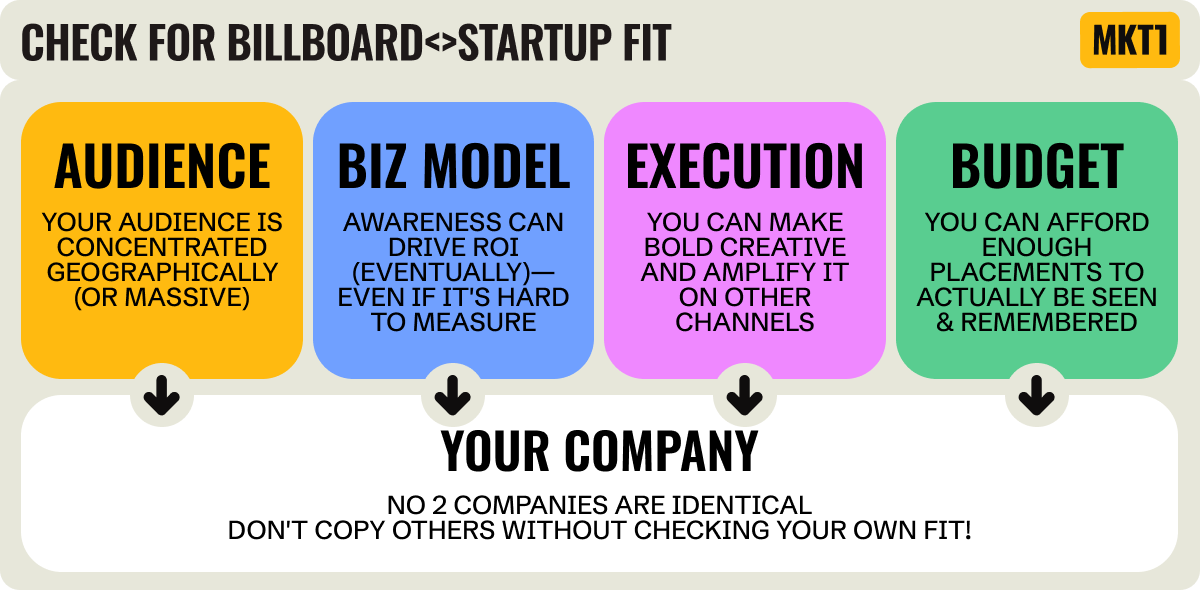
1. Audience fit
You have audience fit if…
You know who your audience is, specifically. And likely your audience is either massive (e.g., Notion, where a huge chunk of people are potential users) or tightly concentrated geographically. Either way, you need the impact of this format to be worth all the money you’ll spend reaching people who don’t matter.
What else to consider:
While you can get increasingly more targeted with enrichment and signals on other channels (like paid ads, which I covered in my last newsletter), out-of-home is the same as it ever was: a blunt instrument for reaching your audience. Reps from OOH vendors will give you impression data so you know how many people drive or walk by, but that’s about it (More on how this works in the FAQ section below). The CPM for the people you actually want to reach is nearly impossible to determine.
Start by understanding who your audience is and evaluate all channels and all varieties of OOH (we have a skill for this in our MCP!). OOH isn’t just billboards, after all—you can be on the radio and on TV, and your ability to target audiences hinges on crisply knowing who they are.
Now you might think, just buy when the conference for your audience comes to town. And you can. Or you can get creative and send trucks with your logo driving around town. But this isn’t a secret, so that inventory is in very short supply.
Bottom line: If your audience is too scattered or too small, OOH probably isn’t your channel, and there are better ways to reach them.
2. Business model fit
You have business model fit if…
A short, high-impact message can effectively drive awareness among your buyers.
What else to consider:
Whether it makes sense for your business right now depends on your stage, product-market fit (PMF), how people buy (and how many stakeholders are involved), and how many accounts sit at each stage of your funnel.
OOH isn’t just an awareness play, it’s a very specific kind of awareness. A billboard only buys short, high-impact, shallow awareness, so if what you really need is deeper education, experiences, or relationship-driven recommendations, it won’t work. And if you’re pre-PMF, it’s likely not the way to figure that out. You need to be able to convert the people you make aware, after all!
As mentioned, you need to be comfortable without direct attribution from billboard to closed deal. Measurement will never be clean, but I think some back of envelope math is still worth the thought exercise. How many deals would you need to influence or close? How does that pencil out against your contract value and target CAC (customer acquisition cost)?
Here’s what to think about specifically for your GTM motion:
PLG: It’s a fit because you likely have a broad audience and therefore fewer wasted impressions, but contract value and CAC are usually lower with PLG motions, so the math may not math out when all’s said and done.
Sales-led: It’s a fit because sales-led businesses often target enterprises and have higher contract values, so you can make the whole billboard cost back on a single deal. But you likely have a more niche target audience, so you’re paying for more waste hitting a broad crowd.
Remember (I can’t say this enough): “Our competitor bought billboards” doesn’t mean you have business model fit too. They might not have had it either or evaluated the buy carefully.
3. Execution fit
You have execution fit if…
Your company can deliver a billboard that turns heads (well, hopefully not while driving), and run campaign work on other channels to amplify the impact.
What else to consider:
Two major things here. First, OOH rewards companies whose strength is bold, memorable, opinionated creative (both from a design and messaging perspective). PostHog, Notion, and Ramp pull it off because brand and creative are core to how they market.
If that’s not a strength of yours, a billboard is an expensive place to learn it. And yes you can hire an agency to help, but if your company doesn’t know who it is and what it wants to say, no agency or contractor can fix that (not even Maya and she’s great at this!). You’ll just end up with the lowest common denominator that everyone can agree on.
Second, a billboard or larger OOH buy doesn’t work alone. It’s about concentrating impressions so you seem like you’re everywhere (to the right people) for that moment. So before you buy, plan how the rest of your marketing will piggyback off OOH for a halo effect (or the other way around).
If you’re doing a big SF buy, are you hosting an event or conference there soon that your website can promote?
Will you run LinkedIn ads targeted at Bay Area accounts with the same creative and messaging?
Will your founders be in town taking meetings during that window? Do you have a new product or offering to announce on your website?
Here are a couple of examples of extending an out-of-home campaign: Clay brought theirs from the billboard to social with a brand campaign launch video. And LlamaIndex used a “meet us at these events” as CTA for their SF OOH buy.
4. Budget fit
You have budget fit if…
You can afford enough placements to actually be seen and hit the goal and audience you are trying to reach. You also need to be able to cover both the media and creative.
What else to consider:
I don’t think marketers think enough about opportunity cost, and that’s especially true with OOH. It’s not just do you have the money, it’s whether this is the best place to spend it. If you just respond to every request, you’ll not only end up doing random acts of marketing, you’ll burn through your budget without placing big bets on the things that play to your company’s advantages.
Also, being “seen” in a city takes a mix of placements, not one unit (more details in the FAQ at the end). Given this, OOH also has a way of sneaking up on your budget.
Creative costs also vary a lot by format:
A hand-painted billboard costs way more than a vinyl one. Does that matter if your creative wasn’t designed to be hand-painted? Probably not.
Digital billboards (DOOH, an acronym I just learned for digital out of home) can be cheaper to produce, but your ad might rotate with other companies’ creative you can’t control.
Buying a bunch of units in different sizes and formats can become a real time suck and design expense.
As mentioned, you can’t measure OOH the way you can your other channels. Some companies try to compare a mid-size market where they ran a big buy against one where they didn’t (e.g. Boston with OOH and Seattle without). And some of this comes down to budget specifically. Larger, public companies can often afford brand awareness studies, but most growth-stage B2B startups can’t. For some companies, that measurement gap just isn’t a risk they’re comfortable taking. Don’t force it!
Final fit check: Company alignment
Even if you have billboard <> startup fit across every angle described above (and have a clear goal, which I cover in the next section), that still doesn’t mean you should do the OOH buy.
OOH is very visible to the people who work at your company, especially if you’re headquartered in the same city. You’ll get critiques no matter what, so it’s important to have buy-in from leadership.
Note: I don’t mean buy-in on the creative itself, since getting everyone to sign off on the creative kills the boldness. I just mean buy-in on the idea of spending on billboards at all.
Why do you need to be on a billboard right now?
AKA: Nail down the goal when your founder requests a billboard (or 100)
“It’s a stunt. It’s a flex. A lot of this regional billboard phenomenon is some amount of flexing. So many of these billboards are locked down for years in permanent contracts. In times like this, every company is trying to get out there, but there’s such limited inventory.” –Maya Spivak
So you’ve got billboard <> startup fit, which tells you a billboard could work for your company, not that you should lock a few in for next quarter. For that, you need a proper goal.
Usually that goal lives in the billboard requester’s head, and part of your job is to get it out so you can establish if you can meet that goal with the resources available. That may mean forcing them to get really honest about the reason they really want this.
I’ve identified 4 high-level goals or reasons for an OOH buy, and specifically for buying a big billboard on a Bay Area freeway (for the cost of a house in many areas of the country). Some of these goals can be combined, but make sure you know the primary goal.
How to choose your goal (be honest!)
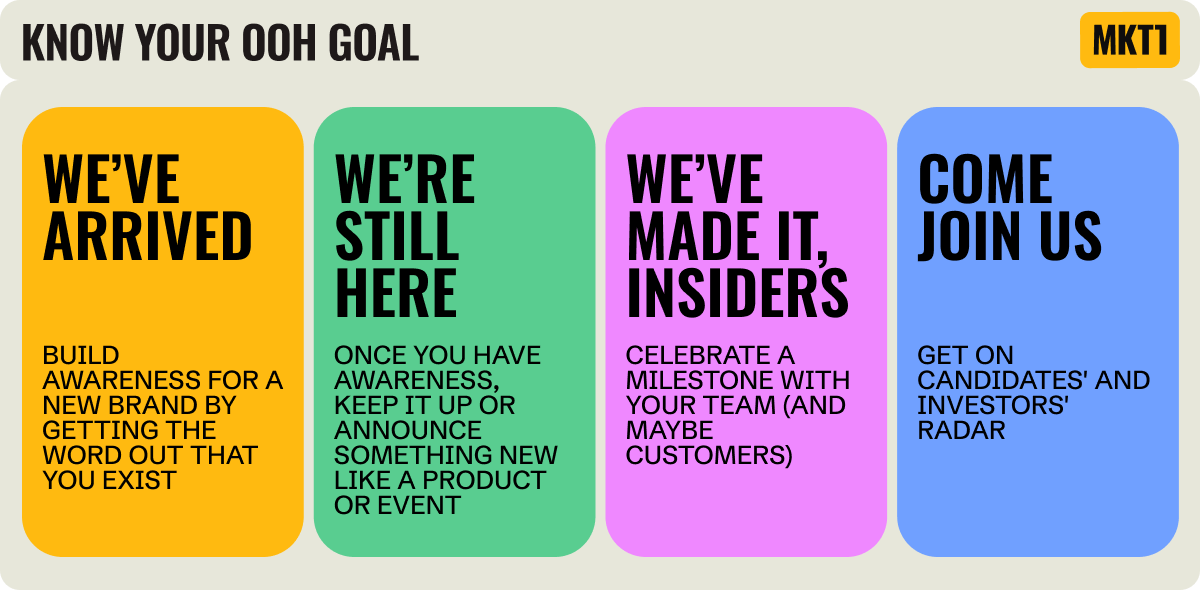
1. “We’ve arrived”
In this case, the goal is to build awareness for your brand or product, meaning to get the word out that you exist. Maybe you’re fresh off a big Series B and decide a billboard is how you buy your way into recognition.
⚠️ Watch out: If this is your goal, you may be strapped for cash, struggle to nail creative, or have other “lower hanging fruit” opportunities. It might not be worth doing if you can barely do it.
2. “We’re still here”
The goal is to continue your brand awareness and recall, often with a sub-goal of getting the word out about something new, like a product or even an event.
⚠️ Watch out: It’s hard to know if you’ve really graduated from “we’ve arrived” to “we’re still here.” When in doubt, assume some of the people you’re trying to reach don’t know who you are. That’s especially true when you’re hitting non-Bay Area cities.
3. “We’ve made it, insiders”
The goal is to celebrate with your team. This has become common with the Nasdaq or Times Square digital billboards you get for literally seconds in rotation with other ads: Your team is delighted, goes and takes a photo, shares it on social, and you may get a little halo effect. You can do a similar thing for customers, even including them on the billboard (but please, no one ever put my face at 10x size in Times Square).
⚠️ Watch out: Sometimes teams agree on this goal up front, then wonder why “nothing happened” after they bought the billboard. This is why you always need a GACCS Brief and need to write down the goals!
4. “Come join us”
In this case, the goal is name recognition with people you want on your “team”: candidates or investors. The idea is that when you reach out to a candidate or an investor, they think “oh, I’ve seen that name before.” I usually think this is a scapegoat reason, meaning they are trying to justify a billboard they just want. But it can work in specific scenarios, say you are opening a new office in Salt Lake City and want to announce yourselves in that market where costs are a bit lower.
⚠️ Watch out: The jury’s out on whether this is the best way to build awareness with such a concrete audience.
And then there’s always the non-reason reason: “We just want to”
This is the worst reason, obviously, but sometimes it’s the most honest. Maybe your founder just really wants to put up another billboard that says “We’ve got agents” next to all the others. If it’s what your founder really wants and it doesn’t affect other budget line items you really need to fight for, sometimes you just gotta do it anyway. But at least make a brief and try to get concrete on what success looks like.
But do you absolutely need a billboard to announce you now have AI and agents?!
Watch this episode & the rest of the Billboard Drive-By series on YouTube. ➜
Maya: “Must you get the word out that you’re doing something with AI or agents, or can we just promote what you built and what you’re selling, and assume it has AI in it?”
Kramer: “When do we get to the point where it’s just assumed?”
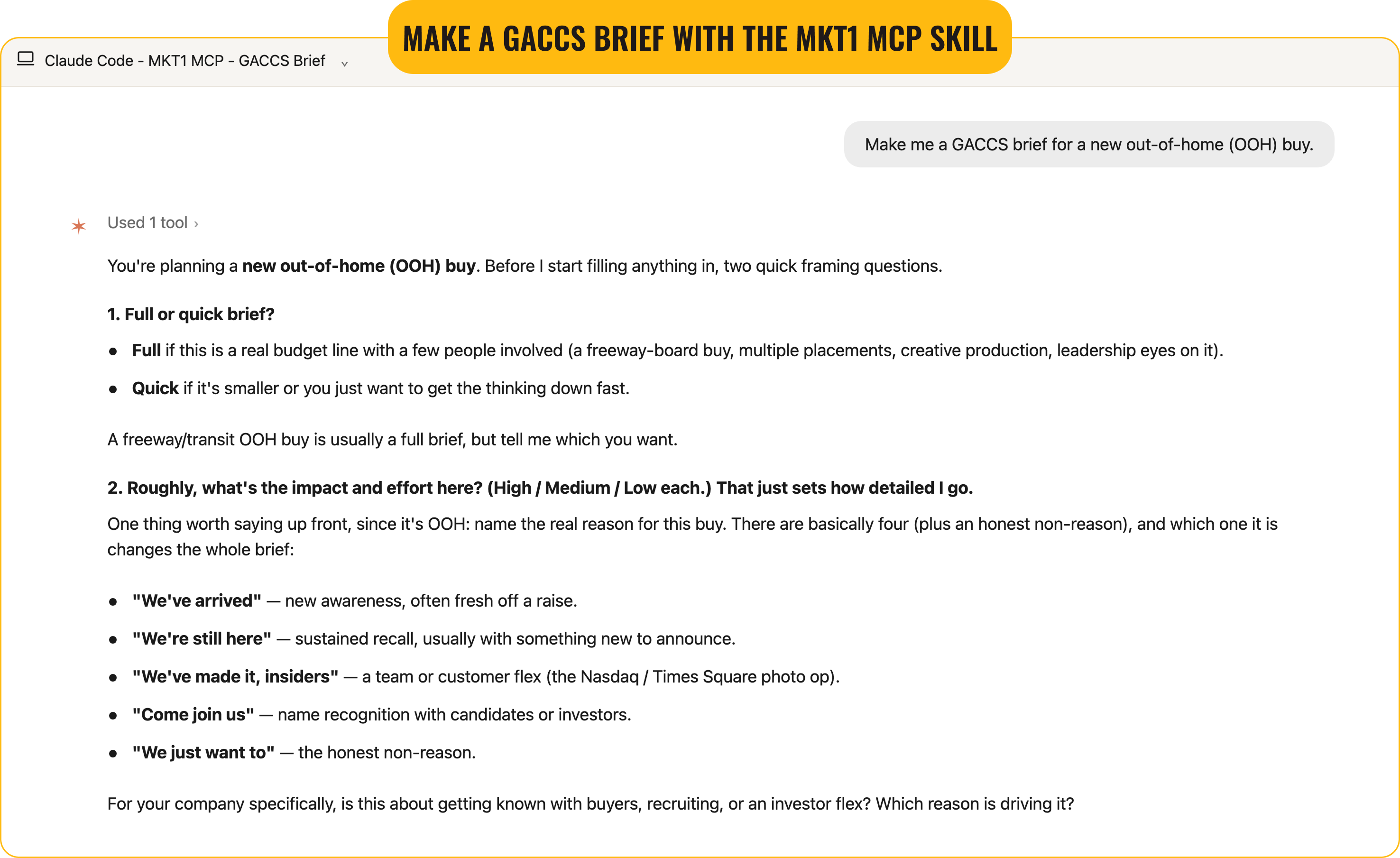
You checked both boxes, now make a GACCS Brief
If you have billboard<>startup fit and a reasonable goal for an OOH buy, you still need a plan. And I recommend planning in the form of a GACCS Brief, as always. If you’ve answered the two questions above well, your GACCS Brief should mostly write itself:
Goal: Covered above! There are really only four options.
Audience: Get specific about who you want to reach, and honest about where they are. A target account list makes this easier.
Creative: Start with a high-level concept, then add the specific requirements later.
Channel: Ideal locations and OOH types.
Stakeholders: Who signs off before you spend the money, who approves the creative, etc.
Reminder: We’ll get into the creative part in more detail in the next newsletter
We’ll show you how to decide what goes on a billboard, reviews of real OOH in San Francisco, and more videos in this series.
In the meantime, you don’t want to spend millions only to realize the format and the concept don’t fit. The bold, opinionated billboard is the thing that makes the buy worth it (and the thing most likely to get watered down by committee and make you fall flat on the freeway). So start thinking through your creative before you buy, because the concept should shape which format you choose. Maybe a freeway billboard isn’t even right, because the best version of your idea is a bus-side pun. After you do the buy, iron out the creative details with the exact dimensions and requirements in mind.
Preview of newsletter part 2: Make creative that turns heads and fits your company
Watch this episode & the rest of the Billboard Drive-By series on YouTube. ➜
“It’s like a homepage… I’m always looking for: What is it? Who’s it for? Why is it better than the alternative?” –Me during the Billboard Drive-By
FAQ: OOH planning & buying
This video covers some of the amazing things Maya taught me about billboards and here are more questions we get frequently (and more in this LinkedIn post).
Watch this episode & the rest of the Billboard Drive-By series on YouTube. ➜
“You can do a ride-along per vendor. They’ll do it for free, so you might as well. Especially if you’re unfamiliar with a city, it’s worth the plane flight to see the spots.” –Emily Kramer
Beyond billboards: What are all my OOH format options?
OOH is a whole family of formats, not just the freeway billboards and bus wraps I focused on in this newsletter and our videos.
It includes all of the below and more:
Billboards: Bulletins (the big 14’x48’ highway ones), wallscapes and murals (on the sides of buildings, sometimes hand-painted), and digital billboards (LED screens that rotate creative). The classic B2B tech play on the SF freeways—and in many other cities the home to infinite injury lawyer billboards.
Airports: Backlit dioramas, concourse “spectaculars” (yes they are called that), video walls, lounge sponsorships. You can reach business travelers when they are in their worst moods!
Transit: Bus wraps, subway and rail cards, station takeovers, taxi tops, and truck-side mobile billboards. Reaches commuting professionals in dense metros, and can make a lot of sense around conferences.
Place-based: Screens in offices, elevators, gyms, stadiums, and movie theaters. Good for reaching some niche audiences, but it doesn’t deliver the big brand moment so many startups are after.
Street furniture: No, not the couch left on the street, but bus shelters, benches, kiosks, newsstands. Eye-level and seen at walking speed not driving speed.
Spectaculars: The giant custom illuminated displays in iconic spots like Times Square and Sunset Strip. Mostly a flex, requires a lot of different creative, and very expensive.
Wild postings and experiential: Wheatpaste posters on construction barricades and walls, pop-ups, projections, and the 3D anamorphic “fake OOH” made to go viral on social. More popular in B2C than B2B.
What does a billboard actually cost?
Just covering literal, massive billboards here, no other out of home because this newsletter would be way too long. Claude will give you a pretty good summary, and you can start by asking Claude about this newsletter with this pre-built prompt.
In the Bay Area, where we drove, a premium 101 freeway static board runs $20K–$50K+ for 4 weeks, and in the city a SoMa wallscape is around $40K.
Manhattan is very similar for a standard billboard, with Times Square spectaculars (the giant custom-built illuminated displays that wrap a whole building face) hitting six figures a month.
But you can get one of those 15-second spots you see people post photos with on Linkedin (like the Nasdaq tower) for a few thousand bucks for a number of showings throughout the day if you just want the photo op.
Other cities are cheaper for a monthly billboard. Chicago and Boston run from $3K–$15K. Boston reportedly has tight inventory because MA billboard laws are strict. That said, I was driving in and around Boston this weekend and I don’t think I saw a single tech billboard. Opportunity?
Nashville, Denver, and Austin are around $2K–$5K, and small or rural markets are $500–$2K for a month of a billboard.
But the price of one billboard isn’t really the question to ask. Most people want to know what it costs to be “felt” or “seen” in a city and that requires multiple placements usually across mediums. To be felt in San Francisco, Maya recommends a mix of placements to her clients: something on the highway, a few billboards in the city, some bus shelters in key neighborhoods, and a handful of buses. That’s Maya’s minimum recommended mix to give a startup a real shot at recognition and in turn seeing the feedback come through on social (LinkedIn, X, Reddit).
A note on supply and demand: One of the reasons billboards are so expensive in San Francisco: Proposition G, passed in 2002, made it impossible to add more. The supply is now fixed, whatever existed when the city froze permits (about 1500) is all there will ever be.
“No new signs are allowed in the city of San Francisco, period, full stop. Every sign in place at the time got its permit, and no new permits are given out.” –Maya Spivak
Who are the major OOH vendors I’d actually buy from?
There are only 4 big players in the US. It’s a highly consolidated market, which also drives prices up (at least that’s what I learned as a college econ major). But since no single vendor owns everything, a multi-market campaign means stitching together vendors (an agency can help).
The four that matter most, in order of US size:
Lamar: The biggest. Strongest in smaller markets in the middle of the country, especially roadside placements.
Outfront: They dominate transit, including the NYC MTA, plus most major-metro urban placements.
Clear Channel Outdoor: Known for high-impact roadside billboards in major markets, and currently being taken private in a $6.2B deal.
JCDecaux: The global leader in street furniture, though small in the US. They sign long, exclusive deals with cities to build and maintain the bus shelters, kiosks, and public toilets in exchange for the ad rights. SF’s street furniture is a 20-year JCDecaux contract. I had never thought about buying ads on toilets before now…
Who are the key players in an OOH buy?
Vendor sales reps: Who you’ll talk to at the 4 major OOH vendors (like Lamar and Outfront). Each rep sells inventory for a given market, and they’re the ones who run the market rides and send you the inventory of what’s available. You pretty much have to go through them to do a big buy.
Marketplaces (like AdQuick and Fliphound): let you browse, book, and measure OOH online instead of going vendor by vendor, though it’s often remnant inventory.
Specialist OOH agencies: Because OOH is so fragmented, a lot of brands just route the whole thing through an agency. They handle the planning, buying, and vendor relationships, and because they’re buying for lots of clients at once, they often get better rates than you would alone.
Media planner and buyer: At ad agencies, these are the people who choose and buy ad space. I started my career as a media planner at McCann! At startups we don’t have this role, but we definitely play this role!
How do I figure out which units to buy?
“One particular unit will be one quarter or even one tenth of the price of all the units around it. It’s because it has a bad approach. It’s because it has a tree. It’s because it has something obstructing the view.” –Maya Spivak
Your vendor rep (from Clear Channel Outdoor, Outfront, Lamar, etc) sends over everything they have available (usually as a spreadsheet). It will include a mix of formats (billboards, walls, transit, digital) in different sizes, locations, and prices, with the estimated impressions for each. And then it is a bit of a puzzle—it’s the same prioritization you’d do for any channel, just with worse data.
I’d also go look at your top picks with your own eyes before committing, especially in a city you don’t know well. The numbers on a spreadsheet can’t tell you everything, and the cheapest unit on the list is almost always cheap for a reason. Sometimes you can only see that reason if you turn your neck a full 90 degrees while driving, like that wallscape coming from Oakland into SF on 80. IYKYK.
How far in advance do I have to buy these, and how long do I buy them for?
It depends on whether the unit is a “perm” or flexible. A perm (permanent placement) is locked into a long exclusive contract, often 12 months or more, by a single advertiser. That’s why the Airbnb or Apple board you drive past is always in the same spot, just with new creative. Flexible inventory is sold in shorter cycles, usually four weeks at a time.
The catch in premium markets is that the best inventory keeps going perm-only, so there’s less and less to buy flexibly. So plan far ahead. If you want a specific premium spot, you’re often waiting for a contract to open up and then committing to a long-term buy.
Who handles production, the vendor or me?
In most cases, the vendor you buy from also handles the creative production (or subcontracts it out). So you hand over the artwork to their very specific specs, and they make sure it gets printed and installed through their own crew. They’ll give you deadlines for all the moving pieces.
How long that takes depends on the format: Digital is near-instant, static takes a few days to print and a few more to install; hand-painted walls take the longest.
How do you measure OOH effectiveness?
Short answer: Not the way you measure your digital channels, and never cleanly. But there are a handful of imperfect ways people try:
Impression estimates: Vendors give you impression counts, how many people pass each unit (the industry standard is a system called Geopath). That’s total traffic, though, not your actual audience, so the CPM for the people you care about stays basically unknowable.
The ”how did you hear about us” form field, with a billboard option: I’ve never been a fan of this field, everyone picks the first one or a random one, but some people swear by it.
Branded search and direct traffic: Watch for a lift in branded search, direct site visits, or signups in the markets where you ran OOH versus where you didn’t. This is increasingly imperfect with the decline of search traffic.
Matched-market testing: Compare a market where you ran a big buy against a similar one where you didn’t (e.g., Boston with OOH, Seattle without). It needs comparable markets and enough volume to get any real signal.
Measure the impact of the overall campaign: If you are doing other things around the same time, like geo-targeted or account-specific LinkedIn ads, you can compare the effectiveness of those in one city (with OOH) vs another (without OOH).
Put a link on it: Put a unique discount code or vanity URL on the creative, so anything that comes through it traces back to the buy. But this will be a very small subset and unless it’s very clever, it probably won’t do much—especially on a single big billboard.
Brand lift studies: Survey people in exposed versus unexposed markets to measure awareness and recall, before and after.
As mentioned, if you need every dollar tied to a result, OOH will frustrate you. You have to be comfortable with directional, back-of-the-envelope measurement.
The end of the road…until part 2
We are adding all of our videos from our Billboard Drive-By to our YouTube over the next week, follow along here.
Are SF billboards worth it? Sometimes, but only if you do the work before you buy, and most companies skip all of this. They see a favorite company’s billboard, rush the creative, and end up as one more undifferentiated “agent” billboard on 101 that nobody can decode.
Is OOH a good channel for your company? It often can be, especially if you do it in tandem with other channels and make your audience feel like you’re everywhere. But that usually means going beyond the billboard and buying more than one spot.
Someone should really put this on a billboard: If you can’t give a good answer for why you’re buying something, don’t buy it.
And don’t miss Part 2 of this newsletter (and video) series: what actually goes on the billboard. I’ll get into the creative rubric for deciding what yours should say and look like, plus grade some of the real OOH we saw on our drive-by (and walk-by).
Even more from MKT1
🙏 Brought to you by: Framer, a no code website builder; Closing Media, a LinkedIn & Paid Media Agency; and RevenueHero for B2B scheduling, routing, and automation. All three have offers for MKT1 subscribers!
💬 Bring this newsletter to Claude: Chat with this newsletter with this pre-built prompt (free) or use the GACCS brief skill for OOH in our MKT1 MCP (paid subscribers).
🤖 MKT1 MCP Server: Add MKT1 skills to your LLMs. Paid subscribers get our full library of 25+ skills and templates.
🧱 MKT1 Buildathons: Watch our 5/27 Buildathon to learn more about the MKT1 MCP Server (the event was just for paid subscribers, but anyone can catch up on the replay). You can also watch the replay of our first Buildathon to see how to build a /marketing-strategy-skill in Claude Code.
🪢 Get on our Slack waitlist: We launched a Slack community just for talking about using Claude Code or Cowork and/or our MCP Server. It’s invite-only for paid subscribers using the MKT1 MCP Server. Get on the list ➜
🧑🚀 MKT1 job board - new & improved: Jobs from the MKT1 community (it’s free to post as a paid subscriber). And our candidate form if you’re looking for a new role (option to remain anonymous included!).
🥞 MKT1 Perk Stack - New Perk: Exclusive discounts worth $40K+ on our favorite GTM tools. For annual & superfan paid subscribers only. We just added 3 months free of Granola, check it out!
🧰 Template & resource library: We have 100+ templates and resources available to paid subscribers in our template & tool library.
I love this series! Hurray for Maya+Kramer ride-a-longs! The point about opportunity costs is spot on… what else could you do with this money??
Also, reminds me of this banger: 🎶”Should we get a billboard? Let’s get a billboard!” 🎶
https://www.linkedin.com/posts/tadavidson41_napster-playlist-coming-soon-but-seriously-ugcPost-7462852457988009984-8EDR