
👋 This is a bi-monthly edition of MKT1 Newsletter, a deep dive into a B2B startup marketing topic. Today I’m giving my best advice on working with creators, based on my experience working with 60+ MKT1 sponsors. I’ll cover:
Why you should work with creators: Creators are a “hot” strategy right now, and for good reason: They get you a halo effect, speak your audience’s language, and extend your team.
When you should work with creators: Don’t work with creators if you can achieve the same outcome without them. Do work with creators to amplify messages, test something new, and fill in “dead” periods.
How to work with creators: Pick creators who actually love your company and product, treat outreach like a mini-interview process, and write briefs that inspire, not prescribe.
Products & agencies we recommend

Profound: Understand and control your brand’s presence in AI Search. Track how your brand shows up across LLMs, then have its background agent—Aim—surface and execute on high-impact opportunities.
🔓 Offer: Get a free AI Visibility Report to see how your brand is showing up.
Primer just got a big update to help you run paid campaigns! Primer already helps companies like Rippling, Confluent & PandaDoc target their ICPs across LinkedIn, Meta, Google & Reddit, and now their AI tells you what to test, fix, or invest in next.
🔓 Offer: Get 10% off an annual subscription with code MKT110.
Omni Lab helps growth-stage startups scale their paid media & demand gen strategy. They focus on building early brand awareness, expanding reach, and optimizing for revenue, not just top-of-funnel metrics.
🔓 Offer: Mention MKT1 to get a $2500 paid media assessment free (10 available)
Everyone’s talking about creator programs…
Including me I guess?!
"The best and biggest brands know that without your creators, you're nothing. The more you give to them, the more you get back."
–Hector Serrano, Head of Content at Wispr Flow, in a LinkedIn post, Oct 2026
A few weeks back, Hector Serrano, Head of Content at Wispr Flow, got quite a lot of attention for how he built their creator program, which launches 500 to 700 UGC (user-generated content) ads a month. His X post alone has 2M views, and this past weekend he was on an episode of Lenny’s Podcast talking about what he did. Since then, you may have even considered rapidly scaling a UGC creator program.
So should you copy Hector and Wispr? Probably not. Wispr's approach is a very specific version for a product with a very broad TAM (Wispr is both B2C and B2B and can be used by anyone who types, literally). That's quite different from most B2B companies, so this exact strategy won't be viable for most of them, which might be a relief to hear because it sounds hectic!
But should you work with creators? Probably. Some sort of creator program, or at least an ecosystem program, will likely be viable for your B2B company. As with anything in marketing, you just need to find the program that works for your specific market, audience, company, and product.
"I'm on both sides as a creator and sponsor. Gotta say best advice is: just start working with b2b creators. still so early and lots of alpha left in partnering with the right folks on linkedin/newsletters"
–LinkedIn comment from Jonathan Martinez, founder of GrowthPair
I've personally been bullish on ecosystem marketing for a while—growing through third parties who already have distribution and trust with your audience. It's especially effective right now because of all the AI slop and sameness in positioning. And as the views on Hector's posts indicate, perhaps the hottest type of ecosystem partnership is working with creators: Influencers, thought leaders, and anyone else with a following who you pay to make something and share it with their audience.
And I happen to know a lot about this, as a creator who's worked with many companies of all sizes across LinkedIn, Substack, my podcast, and events. We are lucky to get 75+ inbound pitches per month, and creator sponsorships are my primary revenue stream (not advising and not paid Substack subscriber revenue as you might think). Whether I want to call myself a creator is another topic altogether, but for the sake of this newsletter, I'll lean in!
As usual, I also asked for other marketers’ input on LinkedIn, and included some of their best advice throughout this newsletter. See the post and all the comments on LinkedIn ➜

6 pieces of advice for working with creators
My #1 piece of advice: A creator partnership needs to be a win-win-win for your company, your audience, and the creator.
Win for your company: It says something you can't really say yourself, and it amplifies your message.
Win for your audience: It's specific to the creator and their audience, and it feels genuine.
Win for the creator: It makes them look more credible, gives them new things to talk about, and gets them more impressions with thought leader ads.
More in Why you should work with creators ➜
Avoid random acts of creator marketing. Plan each effort as a campaign with a handful of creators around a theme.
More in When you should work with creators ➜Pick creators who actually use (or at least like) your product or company. Otherwise, it'll be a struggle to get the right content, and the audience will be able to tell.
More in Choose creators who won't fake it ➜Give inspiration, not a script. Share your main theme or topic and examples of what's worked, then let creators do their thing.
More in Let them make creative their way ➜Plan ahead: Creators are booked up. It's typically not possible to fast-track a bunch of buys for a launch next week, at least not if you want good results.
More in Treat outreach like a mini-interview ➜Don't stop when it goes live. Engage, amplify, or share what the creator made. Yes, they bring reach, but you should help maximize impact.
More in Treat every post like an event ➜
Paid MKT1 subscribers get all 50+ skills in the MKT1 MCP, 100+ templates & resources, free posts on the MKT1 Job Board, $40K+ in discounts in the MKT1 Perk Stack, and the full MKT1 Newsletter archive.
Why you should work with creators
In theory, working with creators is simple: Find the people talking to your audience already and get them to talk about your company or product.
But it's logistically challenging and time-consuming. It's a lot of back and forth, even with dedicated resources or when you have agents helping with the logistics (which you should!).
To make creator programs worth the effort on the company side, you need your work to compound. The minimum viable result is reach and a basic level of engagement from your ICP. The best possible result is a creator whose content you can amplify long after it goes live, and who over time becomes an evangelist that plays a key role in helping you reach your audience.
"Most important thing is that you want to work with creators that are ready to be full brand evangelists, which means they are talking you up no matter what room they are in. Sure they can make posts and send out newsletters and create content but are they also hyping you up at the meetups they go to, speaking about you on stage, and talking about you in the online communities that they're in? That's what you really want in a creator: a brand evangelist."
–LinkedIn comment from Brendan Hufford, founder of Growth Sprints
Creator programs can be complex to manage, but they can work wonders when you find the right set up for your company and audience. Here’s why you should consider investing here:
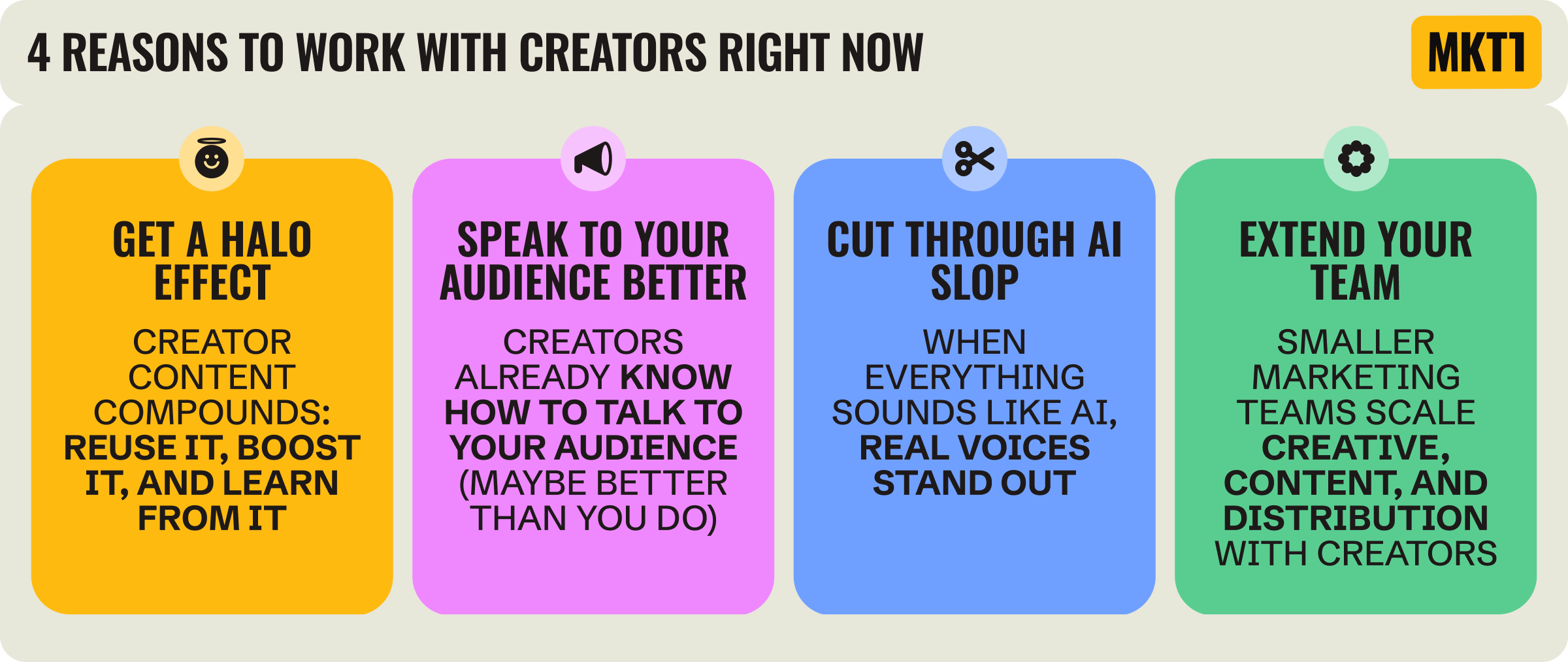
1. Creator sponsorships have a "halo effect"
The best creator sponsorships don't end after the main deliverable is posted, whether that's a sponsored post on LinkedIn, a 2-line ad in a newsletter, or a video on YouTube. That's just the start.
You can and should get more mileage out of each creator sponsorship. Here are some ways to make the sponsorships compound:
Reuse the creative on another channel: Promote a clip from a co-hosted event in YouTube Studio, or post your take on a newsletter you sponsored on your social channel of choice.
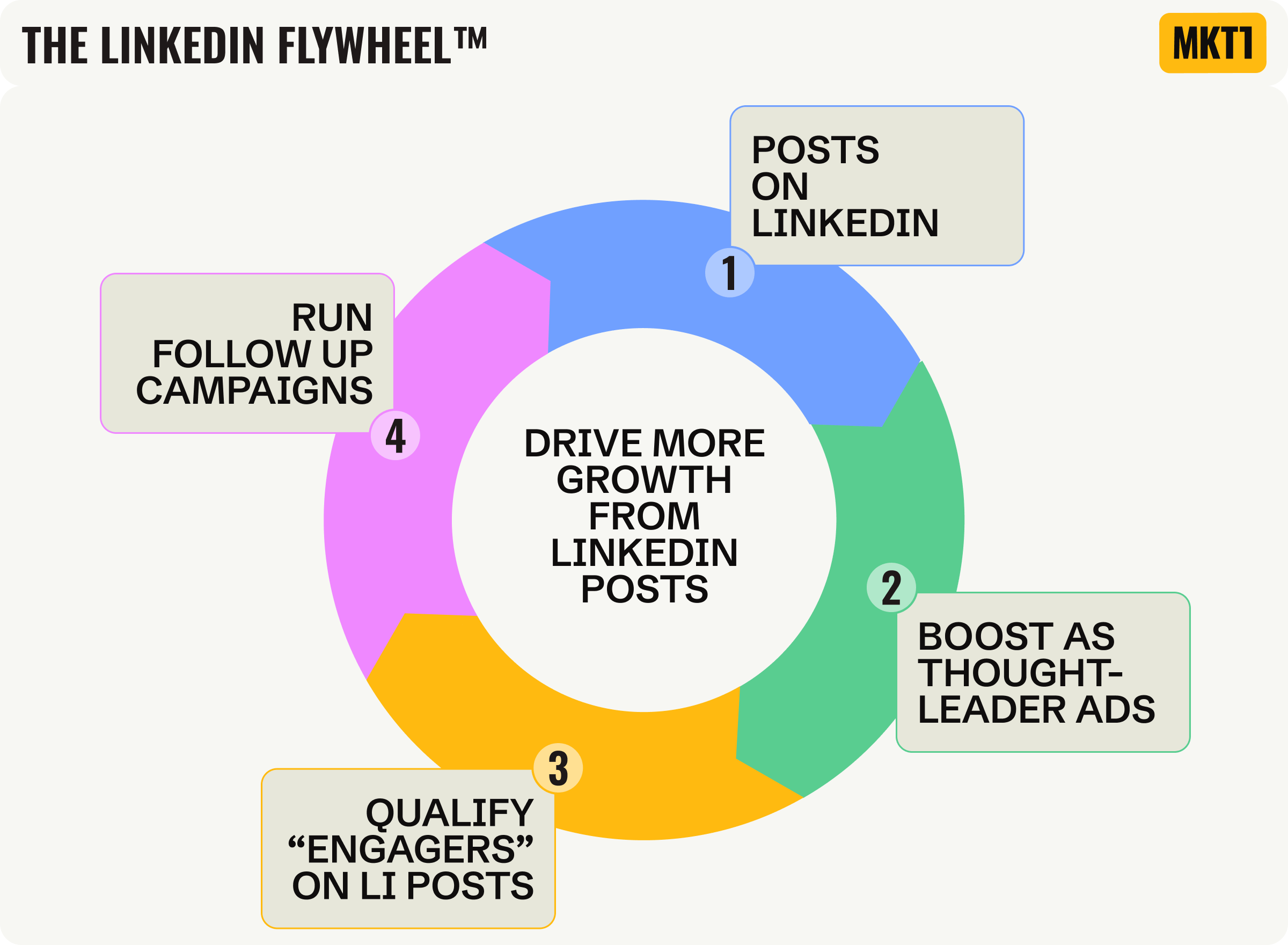
Boost a creator's post as a thought leader ad on LinkedIn.
I wrote a newsletter about the LinkedIn Flywheel here. It’s one of my faves ➜Learn from what creators made and apply the learnings to your own marketing.
Follow up with people who engaged on a post or attended a creator-co-hosted event.
Bonus: AEO? The jury’s still out on how frequently sponsored creator posts get cited by AI search. Some early data and opinions from Meltwater and Profound.
"Cited videos show how a product works, how it compares, and where it delivers value. We call it a teardown mindset: break the product apart and show how it behaves instead of just saying how great it is."
–Eleanor Hooker at Profound, sharing their early research on what creator content gets cited in AI answers
🧑🎨 My best advice: Before you sign with a creator, decide how you'll reuse the post (boosting it, clipping it, or sharing it on your own channels), and put that in the terms up front. For LinkedIn specifically, boosting your best creator posts gets you more mileage out of the post, usually at a lower cost than doing another sponsored post, and helps you overcome the unpredictability of the algorithm. It gives the creator more reach too, win-win!
It's a pet peeve when brands don’t do this with my best posts. It helps everyone.
2. Creators know how to speak to your audience (maybe better than you do)
"Let them coooooook 🧑🍳"
–LinkedIn comment from Kyle Poyar, founder of Growth Unhinged
One of the top reasons to work with a creator is that they already know how to create content that resonates with your audience. They have a voice. This is fairly obvious, but marketers don't use creators enough to get ideas for content, validate ideas, and test various angles. There's more leeway to test new angles with a creator because the post isn't coming from your company directly.
🧑🎨 My best advice: If a creator tells you they don't want to use a line of copy, listen to them! If they think how you describe your product sounds awkward or generic, it probably does. If they think your core message is cheesy, it might be! You can even ask them why they pushed back and learn from it. But better yet, don't prescribe copy and see what they come up with!
3. Everything sounds fake and AI-generated; the right creators sound "real"
Trusted voices that don’t sound like everyone else (read: Don’t sound like AI slop) stand out. This is somewhat counterintuitive because creators are paid. And yes, many creators produce slop too. But if you take the time to find creators that have interesting things to say to your audience, don’t put out slop, and can genuinely recommend your product and company, the fact that you pay them won’t matter to anyone. (No one thinks twice when an employee posts something great, and they get paid too!) This is the way to sound unique: Get various voices talking about you in their own words.
"Distribution is as important as always, personality is what makes the message stick rn"
–LinkedIn comment from Dafna Arad, who leads comms at Lusha
🧑🎨 My best advice: If you hand creators an AI-generated brief or creative angle, you can't expect original content back. Have AI handle the logistics, but write out the stuff that matters!
4. GTM teams are smaller now and need leverage
The best creators generate the creative angle, create the content, and already have distribution...damn, we creators are pulling our weight over here! This can really extend what your team can do. If you treat creators as a true extension of your team, you'll get back what you put in.
Note: You still need internal resources to manage creators, but successful programs are additive to your team in ways in-house hires alone likely won't be.
There’s a whole other post lurking in here about whether to bring creators in house. My short answer: It’s an “and” situation, not an “or.” If you have the budget, bring a creator in house to help you create the right kinds of content for your audience, and still use other creators for more creative iterations and more reach.
🧑🎨 My best advice: Use creators to extend your team and expand your capabilities. If you find a format and channel that works really well, then you can consider following the trend of bringing a creator in house—preferably one you've already worked with!
When you should work with creators
I've just made the case for working with creators loud and clear. But you shouldn't just work with creators because everyone else is. If you can achieve the exact same outcome without creators, it's not worth adding another cog in the wheel.
Here's how to decide if it's a good idea for your company right now:
Make sure you're set up for success
You don't want your first creator sponsorships to look like flops on paper and steer you away from a potentially good thing. This can happen if you don't have the time to put in, or if you have the wrong expectations for what you'll measure:
Make time to manage the sponsorships: Seems obvious, but there's more to this than just the time needed to handle the back and forth. It takes effort to build the relationships, keep the best creators eager to work with you, and amplify their efforts.
Avoid random acts of creator marketing: To do this, treat sponsorships as "campaigns," not as a set of disparate activities.
MKT1 Campaign definition: Campaigns combine fuel and engine for a specific audience, typically with multiple creatives and/or channels. For creator marketing, this means do buys with a handful of creators around a specific idea or theme. More on this in How to run effective campaigns.
Test, then scale: As with any campaign, you should run small tests first, then scale and double down. When working with creators, if you only have budget for a small test or you want to jump to a scaled campaign in time for a launch in 2 weeks, you won't get strong results.
Be comfortable with results that aren't 100% attributable: Recognize that tracking clicks from these channels through to conversion is difficult.
Understand why you are working with creators
Reason 1: You can amplify your existing efforts through creators
Use creators to tell your story alongside you, whether it's for a product launch, a fundraising announcement, a big event, or a message.
The idea here is to use creators to build groundswell and make your message seem like it's everywhere all at once for your specific audience.
Fundraising and product launches are the most common reasons companies reach out to me. I'd love to get more requests to just amplify a message.
For example, in this sponsored post for Closing Media, I shared why thought leader ads are the best way to reach your audience on LinkedIn. We weren't selling anything directly. If people buy into the idea, Max's business grows and Closing Media stays top of mind.
Reason 2: You can test something new with creators' help
Marketers overlook this reason. Use creators to try new things your brand isn't capable of yet. And I don't mean "use creators to test if creators work." I mean use creators to test if something else works. Some examples:
Test a new channel you don't have a foothold in, e.g. test whether LinkedIn works for you, even if you have no thought-leaders at your company who can test this themselves.
Test a new message, or a few messages around an idea, e.g. give creators access to a product you can't quite figure out how to position, and let them go!
Test a new creative type, e.g. video. If you don't have the muscle internally to make great videos, turn that over to creators who do, and see if it's worth an in-house investment.
Test the waters with a new or emerging audience you don't have awareness or credibility with. Use creators who already have trust and reach there (just don't expect the same ROI as with audiences that already know you).
Work with creators when you have gaps in other campaigns, not just when you have something big going on. Use creators as a lever to fill in "dead" periods. If you have gaps in fundraising, launches, or big events, this is a perfect time to plan a campaign centered around creator content.
How to work with creators
So you’ve decided creators make sense for your company right now. Here’s how to do it.
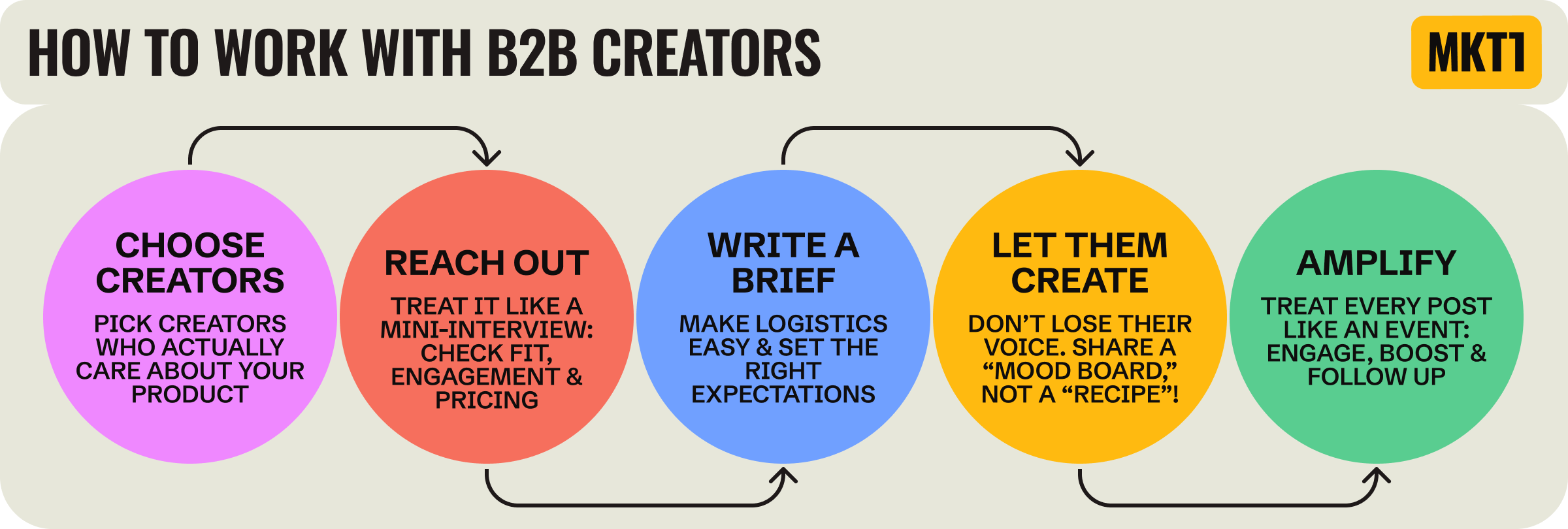
1. Choose creators who won't fake it
Pick creators that give a sh*t about your product or company (preferably both). These are distinct things: Someone can align with your overall narrative but not know your product intimately, or vice versa. Know the difference and use them for the thing they align on. The creator's audience (who should also be your audience!) will see right through it if the creator doesn't care about the idea or thing they are promoting.
How to find them:
If you are well immersed in your audience and having the right customer conversations, you will already know the big names. But if you are new on the job, or just not there yet, it's okay. You'll get there!
Look who has already mentioned you organically in newsletters, on LinkedIn, or on YouTube. This is an especially great way to find micro-influencers or creators with small followings who are really passionate.
Use tools or agents to help. Use Passionfroot, a B2B creator marketplace, to search for creators; use social tools to track top posts on topics related to your company and product; and make a Claude or ChatGPT skill to identify which newsletters other companies that target the same audience are sponsoring.
Don't default to the biggest names. Micro-influencers with small followings might be a better fit, and even individuals who have not yet worked with sponsors could be great partners. And I say this as someone with a pretty big B2B startup marketing following...I'm not the best for every GTM tech company by any means.
How many creators to work with: Cop out answer, but there’s no magic number. It depends on the campaign. Work with enough creators that you can compare performance, but not so many that you can’t manage them well. I’ve been in campaigns that were just me, campaigns with 10 other creators, and everything in between, with similar levels of “success” (and “failure”).
🧑🎨 My best advice: If a creator doesn’t love your product or company, don't force it.
2. Treat outreach like a mini-interview
When you reach out to creators and before you sign a deal, think of it like a mini-interview process (well, hopefully a bit faster). You are selling working with you, but also still assessing if the creator is a fit. You need to make sure the creator has the right audience, the audience is engaged, the prices are right for your company, and your terms and expectations align. So often this upfront work is skipped, and when a creator gets a contract or brief that doesn't meet expectations, things can go sideways.
What to ask the creator to determine fit:
Ask for engagement numbers and examples, not just basic reach. Who's in their audience, how engaged they are with posts, and links to past live sponsorships. Focus on engagement from your ICP.
“Work with creators with high engagement rate not high follower count. You need to calculate this. Don’t trust the numbers they send blindly.”
–LinkedIn comment from Umme Uzma Haveri, marketing leader at SnaptrudeAsk if the creator already uses your product or is interested in trying it. I can't reiterate this enough: Offer free access and see if they take you up on it. If they don't, that's definitely a sign of what's to come from the creator! You can't really expect deep product engagement for a one-off sponsorship, but if you're testing the waters for a larger deal, you want to see a lot of effort.
Note: That said, creators who are truly solo likely won't have your enterprise plan or be able to get the full benefit of a team product (I run into this sometimes). In that case, give them a really solid demo, or share videos and content to help them get up to speed.
Get pricing info. Both sides should want to get to this fast, to make sure there's a fit. For standard placements like newsletter ads, sponsored LinkedIn posts or a single video, this is a quick ask from either side. But it will probably take a minor negotiation dance to get a custom sponsorship or a co-hosted event over the line—that's just the way it goes!
Ask creators their preferred formats if not immediately obvious. Formats can include: Newsletter sponsorships, podcast ads, co-hosted events or webinars, sponsored LinkedIn posts the creator writes in their own voice, and UGC videos the brand runs as ads, which is what Wispr does. Deals can range from one-off buys to long-term exclusive partnerships with many placements across channels, and everything in between.
Kyle Poyar has a good breakdown of the types of B2B creator sponsorships you can do in his recent newsletter ➜“We tried to strike a balance between a few long-term partnerships and many short-term contracts. We noticed the content quality & performance tended to suffer with a lot of creators if they were guaranteed payouts with a longer term contract. We were beginning to explore performance based payouts for this reason.”
–LinkedIn comment from Raina Saboo, former marketing leader at Replit
What to share with the creator to set expectations (and make them want to work with you):
Tell creators what your goals are up front. Most B2B creators expect to drive awareness, not instant results, and marketers (and founders!) working with creators should too. If your expectations go beyond awareness to directly attributable pipeline, tell creators. And if they don't bite, that's a sign that your goals might be unreasonable.
If your contract and terms aren't standard, let creators know. If you don't know, ask legal or ask AI!
Non-standard terms include things like: A non-compete on a one-off sponsorship, usage rights forever (30 days to 12 months is normal), or unlimited edits. For payment, most creators will expect to be able to invoice at booking (I do!), at least for one-off buys. For longer-term deals, they'll expect partial payment before everything is delivered. Skip clunky payment platforms too: If it takes me 2 hours to figure out how to get paid, I'll think twice!
“Negotiate usage rights upfront, including paid amplification, whitelisting/partnership ads, and reuse across your own channels. The value doesn’t have to end with the organic post”
–LinkedIn comment from Justine Sakowicz, founder of Compound LoopShare the general gist of the content up front. You’d be surprised how many companies reach out without saying a word about the campaign or message. A creator can’t say yes if they don’t know what they’re saying yes to! For a one-off buy, share the campaign theme (e.g. a product launch or funding announcement) as soon as you can, even if it's not fully built out. It gets the right creators excited and rules out the ones who don't have the passion for it. For a longer-term partnership, offer a call about your goals, product plans and key messages for the coming months. More on this in Let them make creative their way ➜
Set up a shared Slack channel with the creator. Ideally, you're in Slack with the creator so they can share the post and you can help amplify it right away.
Especially with the top creators, it's a 2-way street (remember, you are going for a win-win-win!). You should get a media kit from them, and you should give them a similarly exciting "brief" (more on that in a minute).
🧑🎨 My best advice: Don't ask for a 7-day turnaround with a new partner. The best creators are booked out on finite inventory (like newsletter sponsorships), typically 3+ months in advance. For more flexible spots like LinkedIn, they'll often make room for brands they know and want to work with. For a brand new partnership or test, it's very hard to make a 7-day turnaround happen. If you want this level of flexibility, consider a long-term partnership where you lock in spots in advance or have the creator on speed dial.
Not my best advice (that’s above!), but still something to consider: If you use an agency to manage creator relationships, have them cc someone in house in initial outreach, or at least reference the contact, so creators know the outreach is real. (Yes, we've gotten fake outreach before and it's all very bizarre from a creator perspective.)
"I'd rather work with a few creators who are proven than a bunch that are not. If you are a creator, come to the table with stats and examples of how companies have used you in the past. If you don't have them, come with a list of the best people who interact with your content."
–LinkedIn comment from Liam Barnes, growth leader at Aurasell
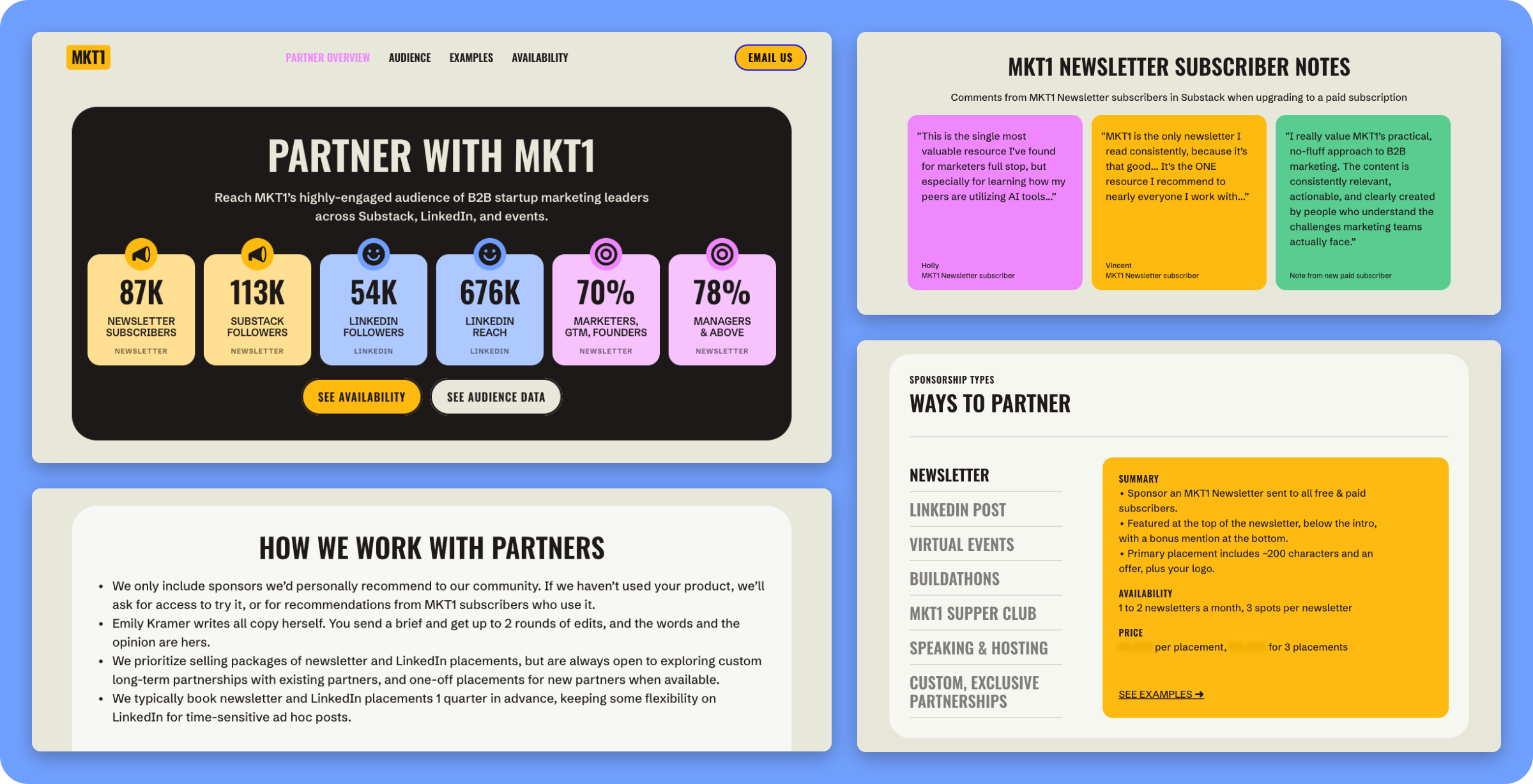
Here’s what’s in MKT1’s “media kit”
We recently launched a partner site we share with sponsors. It’s a little over the top, and you won’t get this from every creator. But I love building things like this and I used a lot of skills I already run in Claude Code, like my research, enrichment, and Framer site building skills. Remember you can use my skills too, they’re in the MKT1 MCP!
I think our site is a good rubric for what can and should be included. Mine includes:
Stats
Who subscribes: By role, title and seniority.
Where they work: By industry and company stage.
Engagement: Newsletter open rate, LinkedIn reach and impressions, and event registrations and attendees.
Why choose us
Past sponsors and examples: Logos of past newsletter, LinkedIn and event partners, plus examples of sponsorships of each type with live links.
Real quotes: Notes from subscribers, plus recommendations from other Substack writers. This is the best way to explain why we are different.
How to work with us
Ways to partner: Details on each format we offer, plus price, and real-time-ish availability.
Our process: How we run content creation and reviews, from brief to live post to analytics.
Our terms: From non-negotiables on our side to things like our impression guarantee.
3. Write a brief with the right level of context (not too much!)
There are tons of B2B creator campaigns running right now, but there's still no standard brief to get creators up to speed and help them create the right things.
The starting place for your brief is the same as any campaign brief: The MKT1 GACCS framework (Goals, Audience, Creative, Channels, and Stakeholders). A great check for your brief, no matter how you decide to structure it, is that you include all of this info.
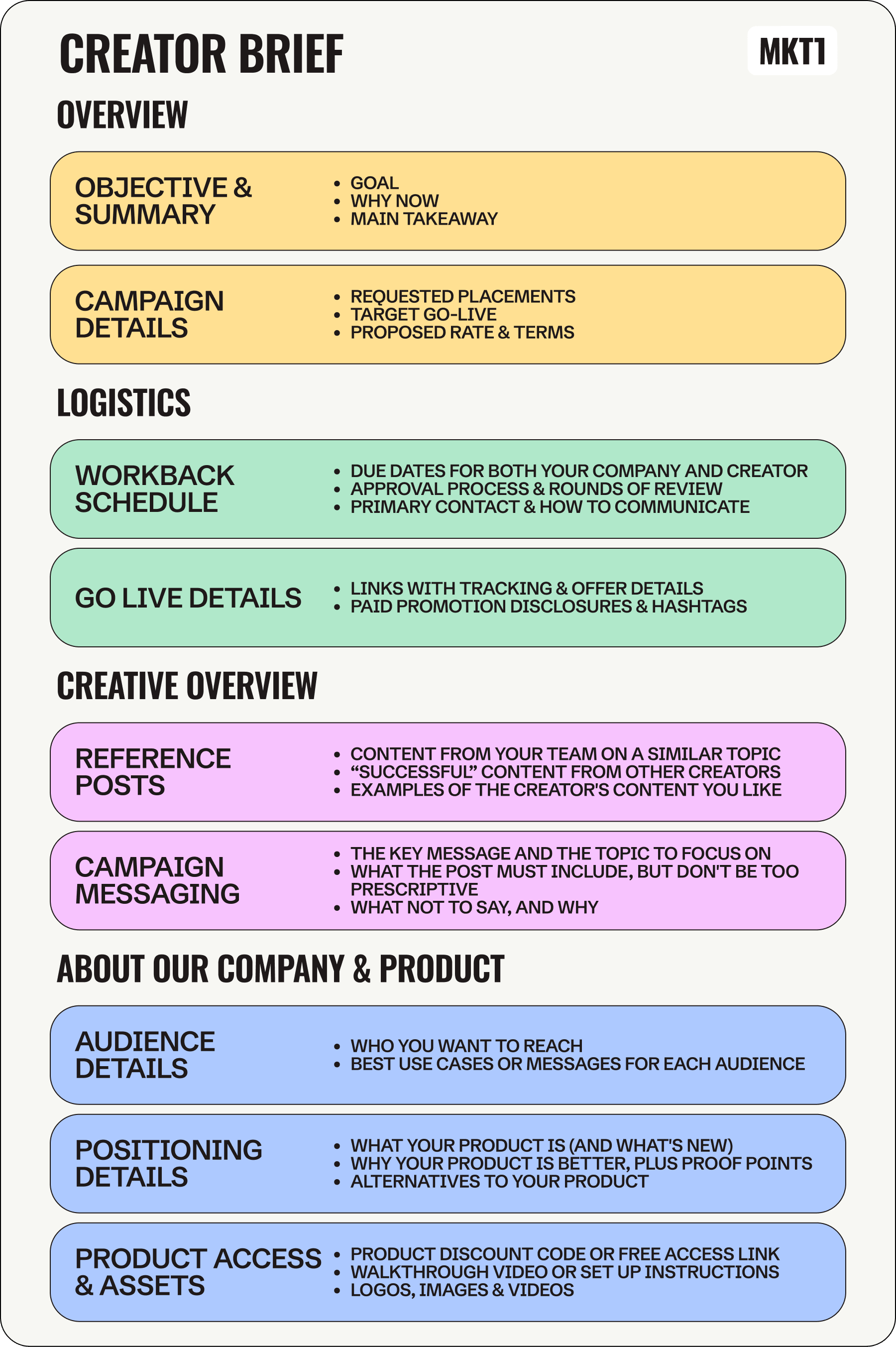
Rather than writing a long section here, I figured I'd make a diagram. I recommend having 4 main parts of your brief: An overview that shares the objective and a summary of the details, a breakdown of the logistics and small details needed to go live, a creative overview to guide (but not dictate!) what to say, and details about your company & product.
Here's the anatomy of what's in a creator brief:
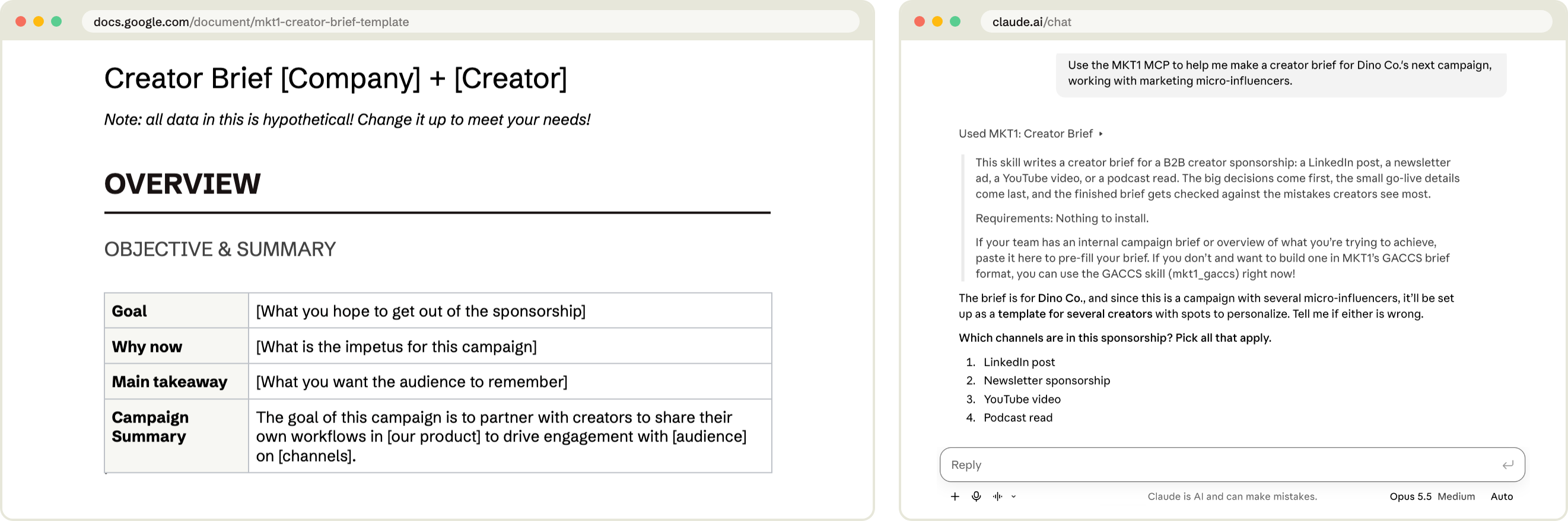
New for paid subscribers: Creator brief template & Claude/ChatGPT skill
We made a creator brief so you don’t have to start from scratch or repeat the mistakes brands make. There’s a Google Doc template, and a skill you can use in Claude or ChatGPT from the MKT1 MCP.
Beyond what’s in the diagram, here are some other brief-writing tips:
Write a brief for each channel, and potentially personalize it for each creator. Sometimes we get briefs that are clearly written for YouTube or Instagram, but the deliverable is a newsletter sponsorship or LinkedIn post. This is confusing, don't do this!
Different details also matter for each platform. For a newsletter, the offer matters a lot. For LinkedIn, small things like whether the creator needs to turn on paid promotion need to be stated up front (because LinkedIn doesn't let you edit this after the fact, I learned that the hard way!).Make your brief agent friendly. This is where the requirements, don'ts and small details really matter. They become a rubric for agents to check creator content. Creators can and should use AI to brainstorm and to check a post against it. You (the sponsor) can check the posts against the same rubric when reviewing—but please don’t give creators AI-generated feedback on the creative or copy stuff!
Include dates, and say how firm they are. If a date can't move, like a launch announcement, flag it so the creator can tell you right away whether it works. Otherwise, leave room for some flexibility for the creator.
Make the offer worth clicking. Newsletter sponsorships with offers almost always get more clicks in my newsletter, and I don't think I'm alone here. Make it feel really special to the specific audience, and use a custom code.
Fill out the tiny details required for a post. This is in the diagram, but I'm calling it out again because these details get skipped often, and creators like me are left scrambling day of. Include link with tracking (if you don't have a custom tracking link, why?!), who to tag, how to mark the post as paid, and any offer code.
Don't hold back. Give creators free product access from day 1, share news with them early, and offer access to your team (even your founder) so they understand your company's philosophy.
Show creators how to use the product, don't just give them access. As a creator, I've spent so much time fumbling around a product to figure out a new feature, even when I know how to use the core product. Make it easier on everyone, and explain the flow step by step, or better yet, send a quick walkthrough video. It's not for them to copy exactly, but to help them get the lay of the land.
Bonus: This is also a huge opportunity to get real product feedback. Most companies don't ask, but when they do, it's a great sign they're really thinking about working with creators as partners.
🧑🎨 My best advice: Make the logistics really easy. If the creator has to email you day of for anything other than "it's live, please engage, thanks!" you are making it too hard!
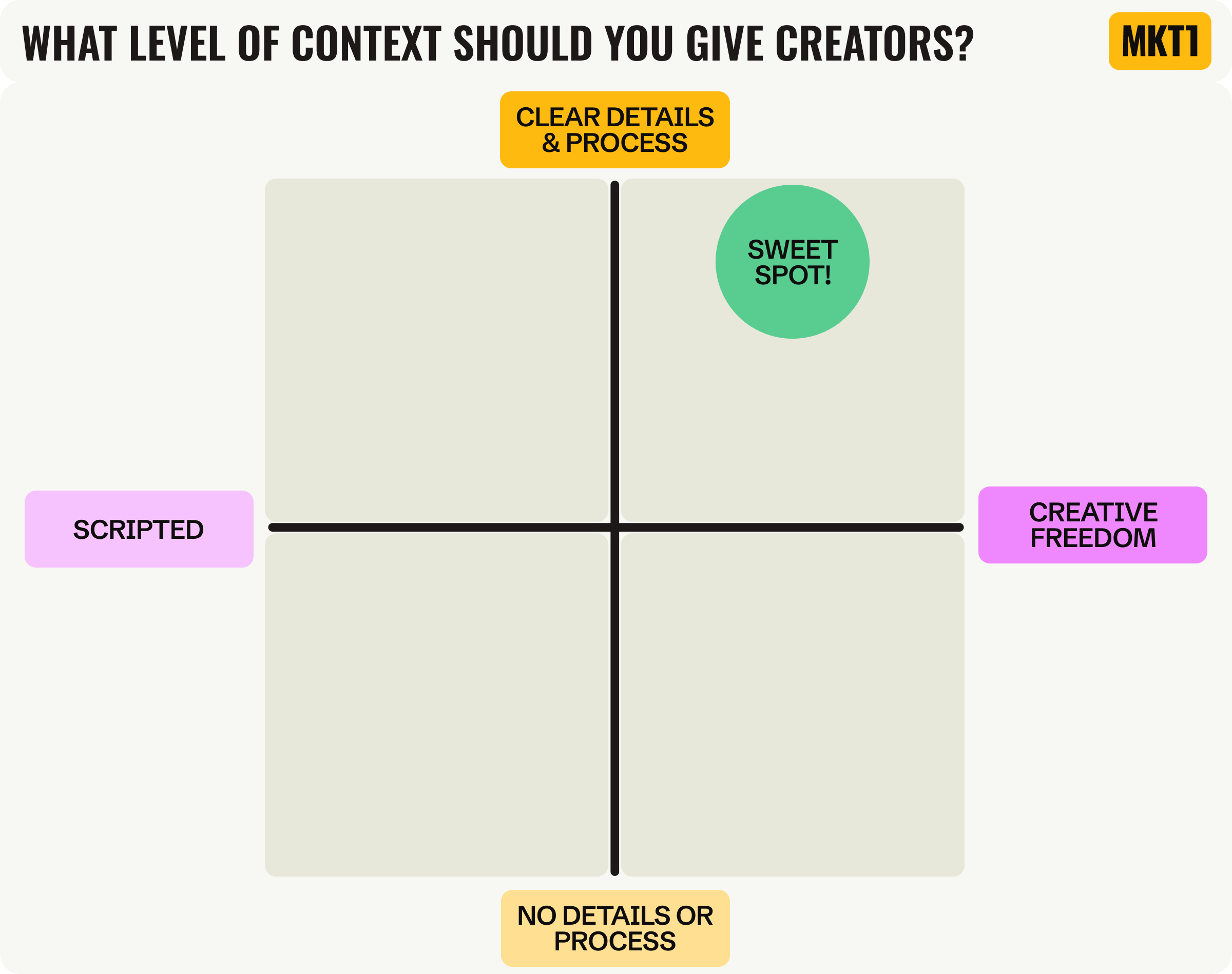
The creator brief Goldilocks zone
If you're struggling to strike the balance between giving creators enough context but not too much, it helps to think about what to include on 2 axes: The logistical details and the creative guidance.
On the first axis, make it ridiculously easy for them to create and post, with every link, handle and setting right in the brief, on a silver platter!
On the second axis, do the opposite. Give as much creative freedom on what to say as possible, without making it so open-ended that the creator has to start on a blank page and resort to AI.
For your first few go-rounds, ask the creator if they need more or feel too limited—we'll be happy to tell you!
4. Let them make creative their way
"Hot take: control is what kills creator content. Hiring a creator and then scripting them is like hiring a chef and then making them microwave your Lean Cuisine."
–LinkedIn comment from Rebecca Johnston-Gilbert, marketing leader at Postman
Even with a good brief, things often go wrong creatively in the review process. Personality gets edited out, and things a brand wouldn't exactly say themselves get slashed. So when you write the brief and review the work, keep in mind: Creating is the creator's job. If you want to create content in a very specific way, just have your company create it.
Remember: The point of working with creators is to get a different spin. This is your chance to not follow your voice and tone to a T and see what sticks!
Don't script it
Skip required hooks, taglines, and phrases. If you want someone to say something that feels like web copy on social or video, it's not going to work!
Don't lists are useful, but keep them short. Give the reason behind each don't, so it doesn't feel random. Good things to put on it:
Things that aren't true or public yet, like a feature still in beta or news you haven't announced
Positioning or phrases you really don't want used, like the category you don't want to be lumped into
Claims you can't back up, like "build your whole app in minutes"
Customers you can't name, even if they're listed elsewhere
Keep reviews to fact-checking and minor suggestions, and leave the voice and tone to the creator. Quick copy edits and minor suggestions for flow are helpful, especially when creators are truly solo and can really benefit from an extra set of eyes. Beyond that, if they've followed the brief, let it go. See if it works!
Don't leave creators empty-handed
Give a focus area or a key point to hit. Don't make it generic. If it's the same key point a competitor would want you to hit, it's not interesting enough to work off. Then trust that the creator knows how to make content from this jumping-off point.
Share example posts you love. If there are previous posts from that channel or relevant creators that worked well, share those. Make it clear you don't want the creator to copy these, you just want to help them understand what's worked and what good looks like to you. If you like past posts from that creator for different brands, share those too.
Share dream copy (if you can’t help yourself). Include ideal copy specific to that creator if you have something in mind, but don't be upset if they don't use it.
Offer a quick call to help them find their angle. My best creator content typically happens after a call with the team, after a very easy or delightful product experience, or after months of working with a partner when it's just natural. So especially in the early days, give them an option to book 15 minutes.
Be responsive. If you’re asking a creator to go live by a certain date, answer their questions and approvals within 24 hours. This is also why fast turnarounds are so hard. It matters even more with an agency involved, since you’re going back and forth between 3 parties: The creator, your team and the agency.
🧑🎨 My best advice: Think mood board, not recipe, when creating the creative overview section of the brief!
5. Treat every post like an event
And "the event" shouldn’t stop when it's over. That means you need to plan up front so your team is around the day (or even the hour) the post goes live—this matters most on LinkedIn. A shared Slack channel with the creator helps, since you can amplify the post right away.
Here are some ideas to give a post more life after go-live (and remember to negotiate usage rights up front for the relevant placements):
Sponsored newsletter post or podcast: Share the newsletter or podcast on your own platforms to drive views. Include your take on the content itself. You can throw in that you were a partner or why you were excited to partner as a bonus.
Sponsored video: Cross-post the video on your YouTube channel and promote it through YouTube Studio. You can add the video to your site too and share the clip on your social channels. Use that asset!
Sponsored LinkedIn post: Like, comment, repost, and save the post from the company account (yes, all of them if possible), and ask employees to like, comment, and save too. Follow up on comments and questions throughout the day. It always bums me out when someone asks a specific product question and it's crickets from the company, what a missed opportunity!
Note: This can get hard at scale. But if you aren’t amplifying at least the best creator posts, maybe you’ve scaled too big? Maybe you could have fewer buys if you actually amplified each one?
Get the most out of sponsored LinkedIn posts
Use sponsored creator posts to kick off the LinkedIn Flywheel. Boost the best ones as thought leader ads, find the commenters who work at your target accounts, and follow up with them.
More in the LinkedIn Flywheel newsletter ➜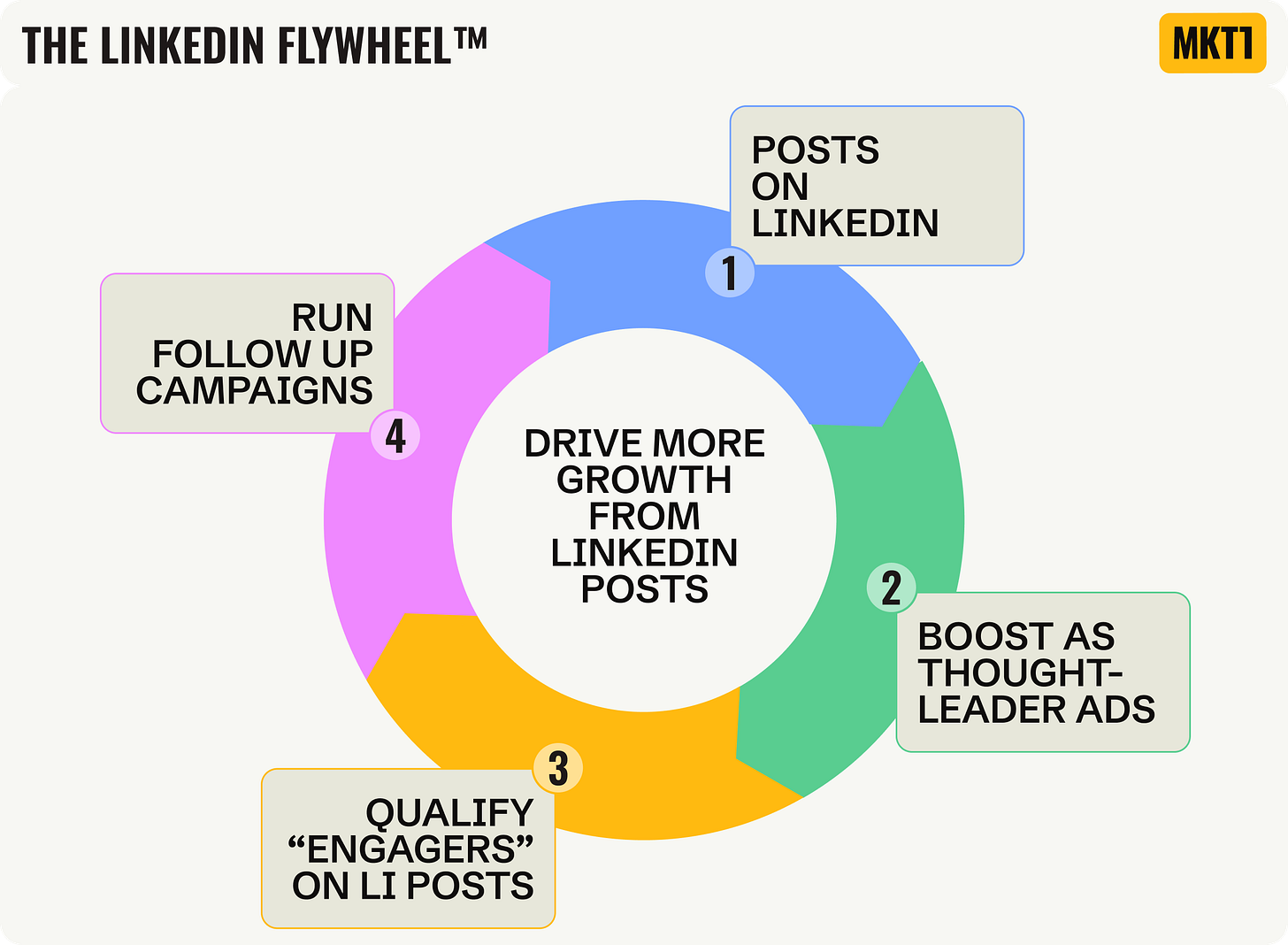
How to measure results: First off, you need to share tracking links with creators. It's always bizarre to me when companies let me supply these—you should have a format you use! Also ask creators to supply their own analytics 1 to 2 weeks after the post runs.
🧑🎨 My best advice: The creator is expected to bring reach and get views, but don't leave it all up to them. You can help get more juice out of their content! Play your part to amplify.
Final thoughts
Find the right partners for your company and audience, and let them cook
Let's end this newsletter like I started it, with advice from Hector Serrano from Wispr, who took X by storm with his approach to creator UGC: "The more you give to them, the more you get back."
This reminds me of the New Radicals song "You Get What You Give." If you aren't a millennial, move along and don't worry about this dated reference to a one-hit wonder.
Partnerships with creators, or any ecosystem partner, work when you use their voice and audience to extend your own brand and reach. When you find creators who become true extensions of your team and who your audience resonates with, keep it going! This can be a massive lever for your business. Consider expanding into long-term partnerships, having them co-host events with you, or even hiring them in house (note: I'm not personally available for in-house hiring, but I’m always flattered when people ask).
The best advice from all of you on my LinkedIn post this week was to let creators do their thing (assuming their thing isn’t AI slop). I agree, and thanks for all your comments!
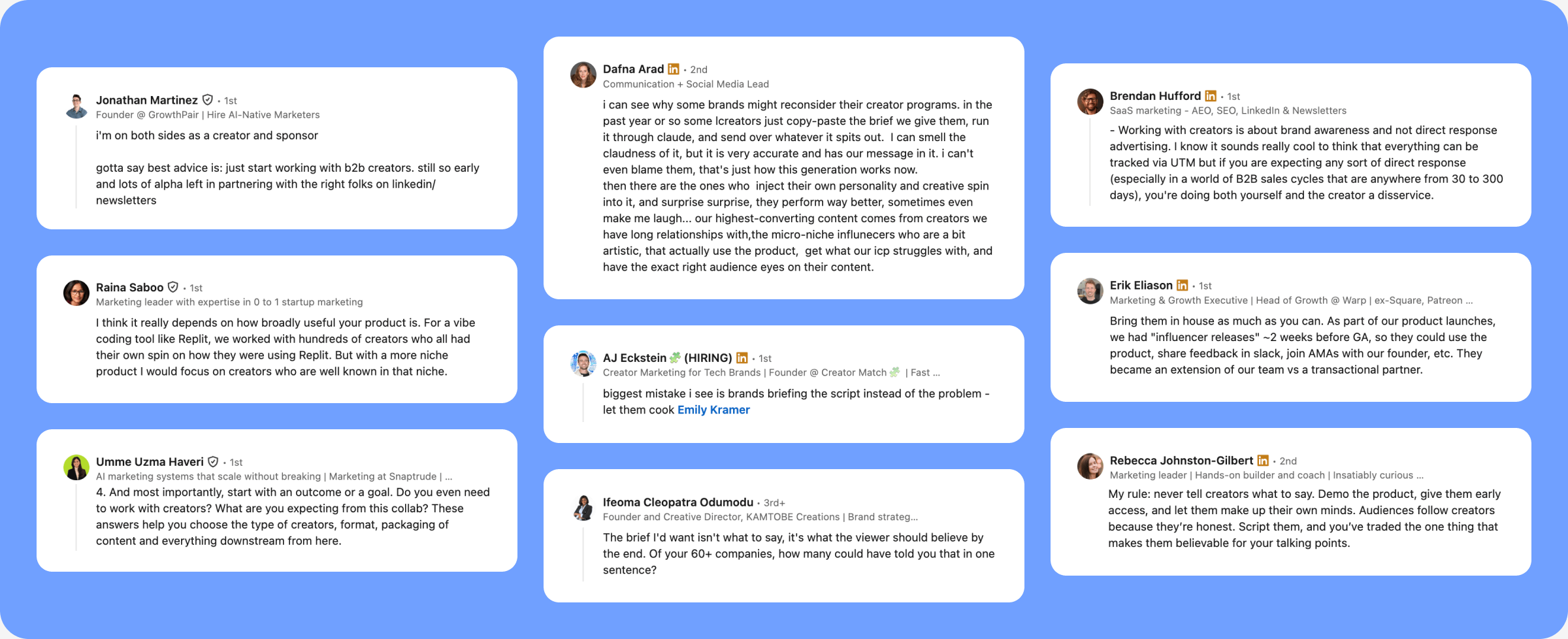
And thanks to all my partners who keep this MKT1 business thriving and let me do my thing, especially this edition’s sponsors: Profound, Primer, and Omni Lab. I think it's a win-win-win for everyone, right?
Being a creator is something I never expected to be, and it's mostly a very fun way to earn a living and stay on top of an industry extremely closely. That said, sometimes the back and forth part can be a buzzkill, and I know sometimes I can be a buzzkill for brands. So I hope this newsletter makes the fun parts happen more.
And next time you need to make a creator brief, don't start from scratch. Use our template, or better yet, get MKT1’s MCP in your Claude or ChatGPT and use our skill to make one!
Make your next creator brief in Claude or ChatGPT
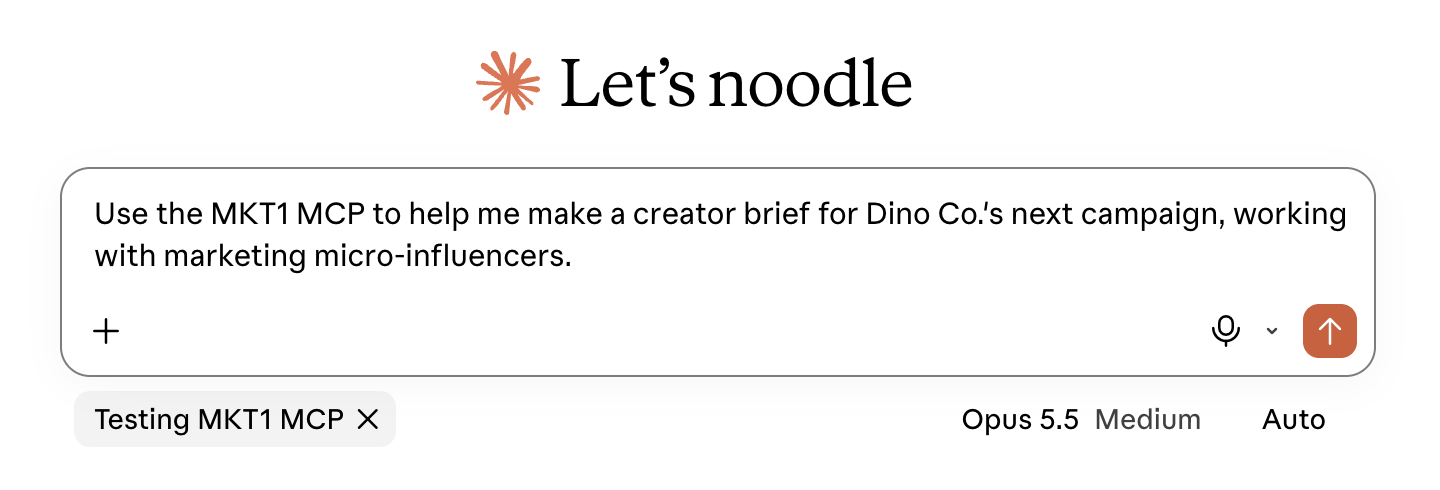
Install the MKT1 MCP, then paste this prompt:
Use the MKT1 MCP to help me make a creator brief for [your company]'s next campaign with [creator name].More from MKT1
🙏 Brought to you by: Profound, the AI marketing platform; Primer, B2B paid media targeting, measurement, and intelligence; and Omni Lab, a paid media and demand gen agency.
💬 Bring this newsletter to Claude: Chat with this newsletter with this pre-built prompt. And use this alongside our creator brief skill for your next campaign!
🤖 MKT1 MCP: Add MKT1 skills to your LLMs or AI harness. Anyone can search MKT1 resources for free (plus a few bonus skills!). Paid subscribers get our full library of 50+ skills and templates, including the new creator brief skill featured in this newsletter.
🧑🚀 MKT1 Job Board: Jobs from the MKT1 community (it’s free to post as a paid subscriber). And our candidate form if you’re looking for a new role (option to remain anonymous included!).
🥞 MKT1 Perk Stack: Exclusive discounts worth $40K+ on our favorite GTM tools. For annual & superfan paid subscribers only.
🧰 Template & resource library: We have 100+ templates and resources available to paid subscribers in our template & tool library.
📚 Additional reading: I mentioned this above, but it’s worth calling out again: Kyle Poyar of Growth Unhinged Newsletter wrote a crash course on B2B creator partnerships in Riding the B2B creator wave recently. It covers why newsletters work so well for B2B, the 4 types of newsletter ad placements, and how to pair newsletters with LinkedIn, YouTube, and podcasts. I think it’s a great complement to this newsletter!