


Dinners are the new trade shows. Here’s how to run them well
Insights from a professional B2B event planner + my learnings from MKT1 Supper Club
👋 This is a monthly free edition of MKT1 Newsletter—a deep dive into a B2B startup marketing topic, brought to you by 42 Agency, Ahrefs, and GrowthPair.
Upgrade to a paid subscription for: 100+ templates & resources | MKT1 Job Board - Free Posts | MKT1 Archive access | New MKT1 Perk Stack, exclusive discounts worth $40K+ for annual paid subscribers.
The hottest B2B marketing trend right now isn’t AI, it’s dinner. Okay, that’s probably an exaggeration. But it’s true that founders and marketing leaders are getting multiple invites every month to some kind of “dinner”: small group dinners, executive roundtables, salons–or even flower arranging classes. We’re right on top of this trend at MKT1, we hosted our own MKT1 Supper Club dinner last week in NYC with Profound.
Whatever you want to call these events, it’s clear that somewhere in the last 5 years, the company-hosted “dinner” replaced the trade show as the B2B event du jour…and I support this “trend.”
I’ve podcasted and written about in-person events before and cautioned against the old strategy of throwing your whole budget at conference booths. But a dinner done right is increasingly a high-leverage way to stand out in a sea of AI slop, and it’s an elegant way to put your ecosystem to work. Especially for high-ACV businesses, getting the formula for a successful dinner right can be transformative.
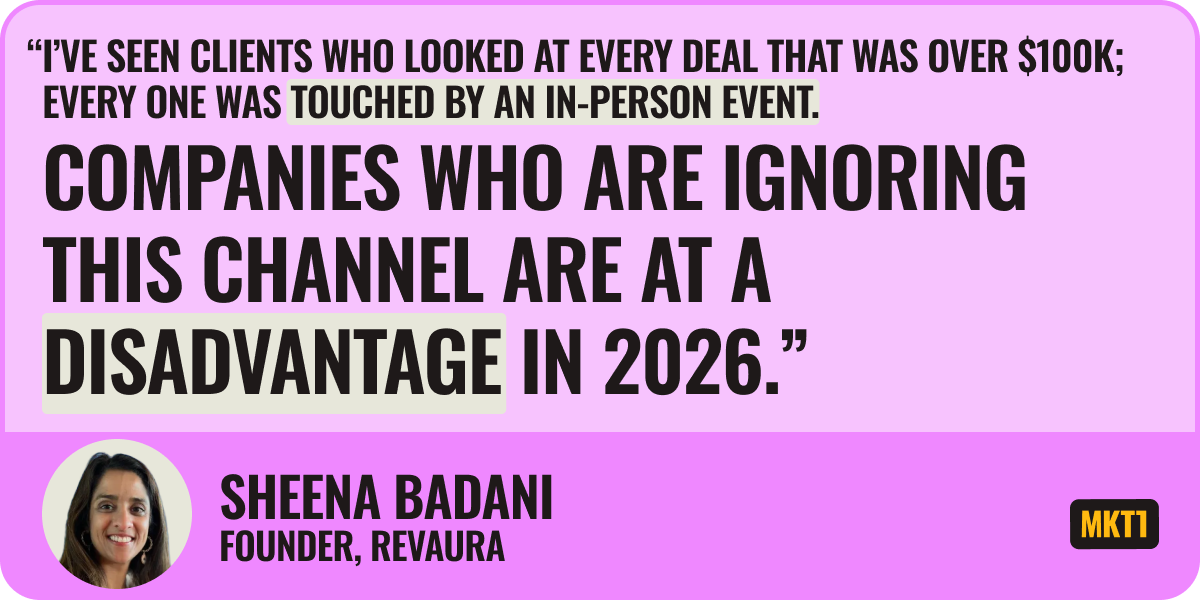
So I called Sheena Badani, who works with companies to host standout events through her company RevAura, to get an expert take on running dinners that work in 2026. At RevAura she’s running dinners, cooking classes, and even nail salons, all aimed at getting the right people in the room. Sheena was previously a marketing leader at Gong, but decided to double down on executive events after seeing their impact firsthand.
In this newsletter, I’m sharing her best tips along with my own to help you get the most value out of this strategy.
Recommended products & agencies
We only include sponsors we’d recommend personally to our community. If you are interested in sponsoring our newsletter, email us at sponsorships@mkt1.co.
42 Agency is a MOPs & paid media agency that kicks off differently. They start with a Revenue Opportunity Analysis that digs into your ad accounts, CRM, and closed-lost deals to find where revenue is leaking. Then they fix it.
🎁Offer: First 5 companies to redeem get 15% off a revenue opportunity analysis.
—
Ahrefs: Search traffic is declining, AI search is changing how products are discovered, and predicting web traffic is harder than ever. I recommend Ahrefs to stay on top of it all: track rankings, brand visibility, and performance across search and AI, all in one place.
—
GrowthPair: If you want to scale your marketing team with top-tier global talent, GrowthPair can help. They handle vetting (only 1.5% of applicants make it through), payroll, and benefits → You get a full-time marketer, from paid social to email and video, all for ~$3,500/month.
In this newsletter:
Why dinners have replaced trade shows as the reigning champ of B2B events
How to make sure your dinner is worth the investment
Why a good dinner nails the 3 Ps: people, place, and programming
Operational tips for making dinners repeatable
For paid subscribers: A map of SF & NYC dinner venues hand-picked by the MKT1 community
MKT1 Unboxing: A quick break to unbox Wistia
Learn how to leverage video in the AI era from video marketing GOAT, Chris Savage, Co-Founder + CEO at Wistia. Wistia has evolved from “video hosting” into a one-stop video marketing shop. They handle hosting, embeds, analytics, recording, editing, social clips, podcast distribution, and multi-language dubbing—so if you’re looking for tools to help you manage video marketing, watch this:
Some stand out moments in this episode of MKT1 Unboxing:
LLMs don’t watch videos, so you need to add context for AI search.
AI tools read text, not video. Wistia makes video embeds LLM-friendly so your videos can actually be indexed and show up in AI search. Watch this clip »
Most social clipping tools only grab what’s obvious.
Clipping a single moment is easy. Finding the best moments across an entire recording is harder. Wistia’s new (beta) Remix feature does this for you, watch at 12:04 »
Webinars work better when they’re part of your video stack
Running webinars in the same place you host, edit, analyze, and repurpose video makes them easier to re-purpose and measure over time. Here’s how Wistia approaches it, watch at 19:49 »
Get started with a free trial of Wistia here »
MKT1 Unboxing is our new video series, each video is a 30-minute demo + conversation where I (Emily Kramer) unbox marketing and GTM tools — no slides, no scripts, no sales pitch. Just real tools, real workflows, and real talk. The goal: help you find AI tools worth using.
Now back to in-person events…
Why the “dinner” replaced the trade show
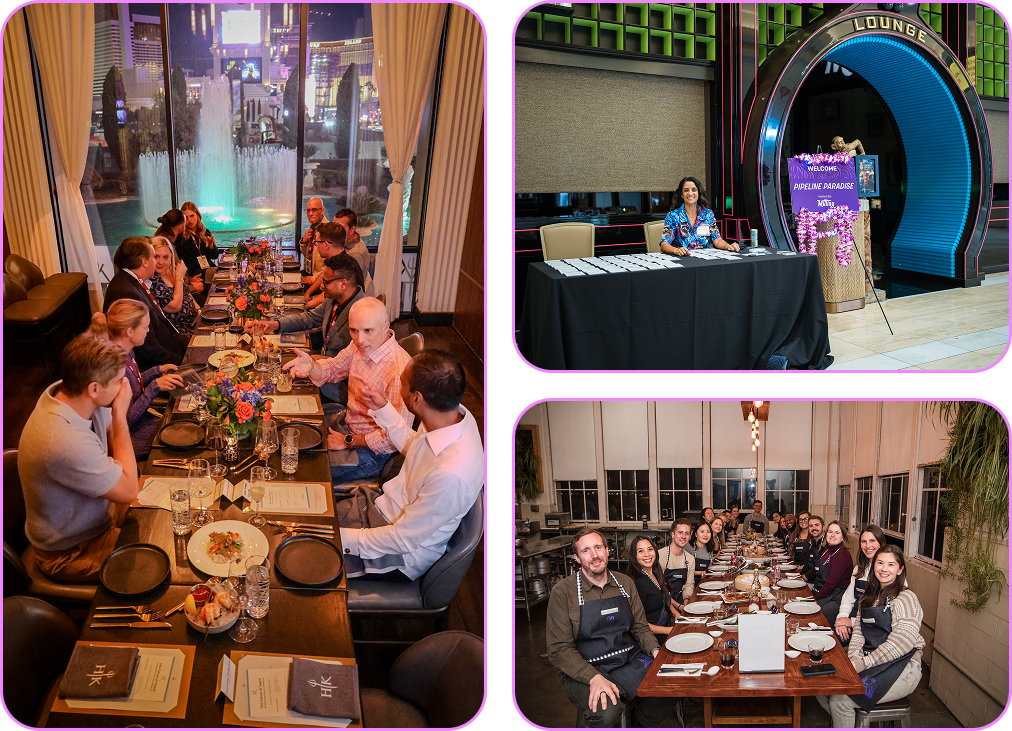
“Events used to be more trade show-oriented, taking advantage of other people’s events to leverage for lead generation. Now attendance at those just looks different. People are less inclined to travel to those large trade shows. So the new event model is using your own hosted events for deal acceleration.” –Sheena
Trade shows were the primary event model for decades. You’d sponsor someone else’s event, set up a booth, and hope decision-makers wandered by. But post-Covid, which forced everyone to figure out deal cycles without conference infrastructure, companies started questioning the ROI.
Companies were investing so much money sponsoring, not to mention their own employees’ travel costs and time, then crossing their fingers that the right people would come find them. As I said in one of my most successful LinkedIn posts to date, when I look at most conference booths, I just see dollars in trashcans.
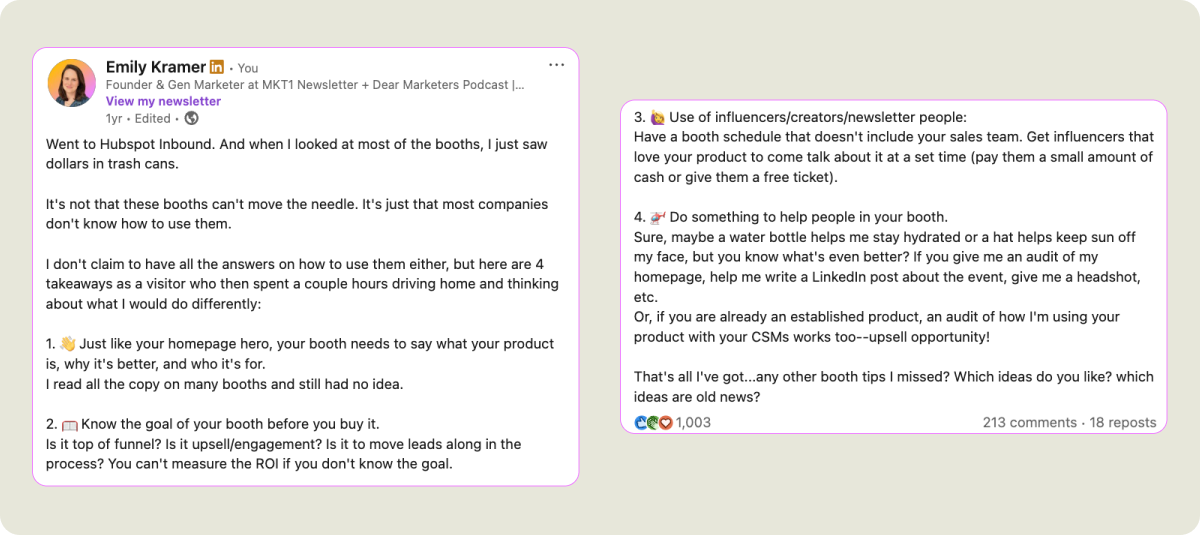
But what many of these booth exhibitors noticed was that the most valuable moments were the side conversations: the dinner the night before, the coffee meeting in the lobby, the drinks after a long day on the floor. At some point, people started asking: Why not just do those things directly?
You control the budget, the venue, and the guest list. You can get the right mix of existing champions, active prospects, and warm accounts. You’re not trying to collect 500 badge scans from people who will never respond to follow-up emails. You’re connecting directly with ~12 people who are actually in your pipeline, actually evaluating you, and giving them a reason to move forward. Seems like a better use of money.
In some ways, the prospect and/or customer dinner is the oldest trick in the GTM book. Wine and dine your potential customers, close the deal. In my recent rewatch of Mad Men, which is the true historical record for how marketing once was, I saw Don Draper do this on repeat (though usually inappropriately).
But I’ve definitely seen this surge recently. The other reason these dinners are a go-to strategy is not just the reaction to the trade show reboot post-Covid, it’s of course, AI-related too. In the age of AI-generated everything, this kind of authentic human connection is a strong differentiator. A dinner forces real conversation. You can’t automate your way through it. That’s why it works.
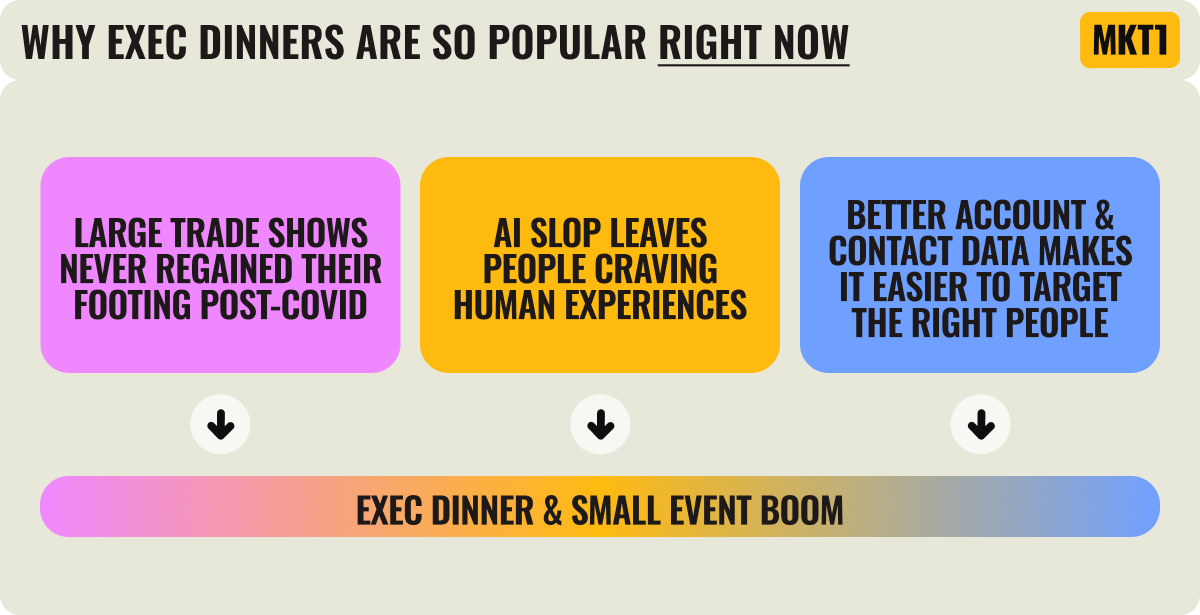
And the last reason I think these dinners are surging right now: It’s never been easier to access and fully enrich account and contact data. What used to be a massive, manual process now takes minutes. You can do this quickly with tools like Clay, then feed it into your CRM—or even manage the entire event invite flow in Attio (like we do at MKT1).
Watch my 1 min walkthrough of how I manage exec dinners in Attio ➜
Watch our in-depth Attio Unboxing with Head of Success, Zev Leibowitz ➜
“People who go to these dinners tell me they want to either meet their peers, somebody interesting, or they want to learn something new that they can take back to their business. That’s ultimately what they care about. And ideally, it’s both. You’re helping facilitate those connections, and you’re helping facilitate the exchange of ideas.” –Sheena
What makes a dinner worth the investment
“Where and when you should do dinners needs some thought, too. What cities are your open pipeline in? Where do your champions live? You could even host around a trade show or another place you know your audience is going to be.” –Sheena
Dinners require real investment: budget, time, and coordination. So you shouldn’t host these with reckless abandon, even if it seems like everyone else is. You need to make sure you can get your money’s worth. This means you shouldn’t book a restaurant until you’ve done the strategic work upfront. Otherwise, you’re just doing Random Acts of Marketing™ (RAM 🐑) at a fancy venue. You’re turning the RAM emoji into a lambchop? Note: I’m a vegetarian, it makes this graphic metaphor acceptable, I think?
Account-driven strategy + dinners go together like wine + cheese
Dinners work best as part of a broader account-driven strategy. You need to know which accounts are top priority right now to determine which cities make sense and who to invite. A simple example: If your open pipeline is concentrated in New York and Austin, hosting a dinner in SF because that’s where your office is doesn’t make strategic sense.
Once you have your target accounts identified, treat each dinner as a campaign, not a one-off event. This is the same approach you need for any marketing initiative: you need fuel (the content and experience) and engine (how you get people there and follow up). An event campaign needs touchpoints before, during, and after.
Upsides you might not have thought of
“Dinners are a great way to get to know your persona. Especially if you’re moving into a new market or into a new persona, this is an opportunity to do some light research that way.” –Sheena
Dinners have upside beyond just hitting a pipeline goal, which is what makes them such an interesting tactic for B2B teams.
I like to think about setting an internal sub-goal for each dinner. Here’s what I mean:
Research & market intelligence: There’s no substitute for talking to your ICP in person, and people get really unfiltered at dinner. You hear what’s working for them right now, what keeps them up at night, what tools they’re evaluating, what their bosses care about. That intelligence is worth thousands of dollars if you’re paying attention…I sometimes wish I could have Granola transcribe the dinner, but I don’t think that’s appropriate?!
Positioning & content ideas: The informal nature of a dinner makes it a great testing ground. You can see whether your new messaging resonates, whether a product launch idea makes sense, and whether the problem you’re solving is actually top of mind. Dinners are a great source of fuel, too, beyond the standard post-event social post with the poorly lit photo of people eating and awkward selfies. You can easily pull 10 content ideas just from what people bring up at dinner.
Community-building: Dinners are primarily about building relationships. Even if these specific people don’t buy, they might give you intros to other accounts. I’m not even opposed to inviting people multiple times. Three dinners later, you could have a core group of advocates who know each other and are invested in your success.
Brand-building: You’re putting your executives in front of prospects in a setting where they can actually have a conversation, not just pitch. You’re demonstrating that you understand the space well enough to convene the right people and ask the right questions. You’re showing up as a peer, not a vendor. That perception shift is worth more than most companies realize, especially in crowded markets where everyone’s product looks the same, and everyone’s content is straight outta Claude.
“Audiences that aren’t as tapped are looking for ways to build community. We did a Women in AI event for Glean, and all these women were like, we just want to stay in touch with each other. So we set up a WhatsApp group for them to stay in touch afterwards.” –Sheena
For paid subscribers: Steal my event planning rubric
Before you start planning any event, make sure it’s worth the investment!
I built an interactive version of my own event planning rubric that helps you decide (and defend) what’s worth the ROI. We have a Docs version too.
The formula for a dinner that stands out
“When a dinner is randomly thrown together, it’s just missing something…that special factor. These dinners really need to have a lot of thought and intentionality behind them to make them successful, and to make them stand out. You can’t depend on one single thing to make your dinner successful, they all tie together.” –Sheena
Most companies throw dinners as a box they must check (often because sales is asking for them). They pick a restaurant, invite some prospects, and hope for the best. And that’s the problem.
Everyone’s running the same play now, so if you’re not thoughtful about differentiation, your dinner blends into the noise. Think about what makes your dinner different. What’s your “it” factor?
Sheena shared a really helpful formula for creating a differentiated event. You have to nail the 3 Ps: people, place, and programming.
People: The most important ingredient
“Rather than going out with an empty invite list, seed a few people to build interest in the dinner. Are there friendlies you can bring in—like an existing customer, investor, or influencer—to get a couple of logos? Now you can use that in the promotion of the event itself, and that helps to drive RSVPs faster than if you had no one.” –Sheena
Of the three elements, people matter most, by a lot. You could show up at McDonald’s with the right people or co-hosts, get people to show up, and still have a good time. The inverse is also true: If you have the wrong people, even the best restaurant and most compelling topic won’t save the dinner.
Social proof matters more than people think. Most of us want to know who else is coming before we give up an evening. A few confirmed logos or names can completely change how the invite lands. Suddenly, it’s not a vendor dinner; it’s a peer networking dinner that happens to be hosted by you.
Think about the obvious factors: Are they at companies you’re actively trying to close? Are they in your ICP? Are they senior enough to make decisions, but not so senior that they won’t actually show up?
But also: Are they going to be good dinner guests? Do they add a new perspective to the dinner? I like to seed the list not only with “big names,” but also with a few natural connectors I know personally who can carry a conversation and make others comfortable.
“I often suggest inviting two people from one account that you’re trying to close. People really hesitate to take advantage of this, because they want to spread the resources across accounts. But they’re both more likely to come, and now you have the chance to create two champions within that company.” –Sheena
If you are an avid reader of MKT1, you know I’m obsessed with ecosystem marketing right now. And this is one of my favorite ways to seed the list: Co-host with a complementary startup, an agency that serves the same audience, or bring in an “influencer” as a guest or co-host. (I do both—I’ll either show up as a guest or do end-to-end hosting like with MKT1 Supper Club.) Piggybacking on the trust and reach of partners is one of the only reliable ways to grow right now when other channels are wavering.
Bonus idea: Some professions, like accountants and lawyers, require continuing education credits. If you can structure your event to count toward those requirements (easier with lunch-and-learns than dinners), that’s a huge incentive.
Programming: Give people something worth talking about
“A dinner is a way for you to extend your brand or a point of view that you have as a company. Just like you would write a blog post or do a webinar, the dinner is another avenue for you to get that perspective out to your audience.” –Sheena
I think it’s obvious that a dinner is an “engine” to reach your audience, but you need to think a lot about the “fuel” component too. A dinner shouldn’t be just “let’s get people together and see what happens.” You should be using the dinner to advance a specific POV your company has, or in MKT1 terms, a Perception™ you’re trying to drive.
Think about the research you’ve published, the frameworks you talk about in sales calls, and the positioning that differentiates you from competitors. Those are all potential dinner topics. The dinner is where you bring that thinking to life in a conversational format, with the right people in the room to discuss it.
But don’t over-program. And definitely don’t show slides, especially if it’s a pitch. If you’re filling every minute with structured conversation prompts or presentations, you’re not leaving room for people to actually talk to each other. The best dinners have just enough structure to give people something to talk about. You might open with a 10-minute framing of the topic, seed a few discussion questions, and then let the conversation flow naturally.
“Specificity is one way to differentiate. Say you’ve done research on how to code 10x faster—tie your dinner into this point of view and this research that you’ve done. Now you have a compelling theme and title for your dinner. So it’s not just, hey, here’s an engineering leadership dinner. How do you take that and make it much more specific?” –Sheena
A note on micro-conferences: Between the trade show and the dinner sits the micro-conference: intimate, curated events with 50-200 attendees. These are rising for similar reasons. But I recommend nailing dinners before you jump to an expensive 2-3 day microconference. Master the basics of getting the right people together and facilitating meaningful discussions first.
How this works at MKT1 Supper Club
At MKT1 Supper Clubs, we put blank question cards at every seat for guests to fill in. They don’t all need to be strictly on topic—adding a few fun questions helps set everyone at ease—but guests almost always end up talking about the dinner theme anyway. If the topic is strong, people are already bought into discussing it by the time they sit down.
Guests write down a question, we shuffle the cards, and use them to spark group discussion. As a bonus, I’ve noticed people take notes on the cards too. It’s a simple way to walk away with a few takeaways from an event that isn’t recorded.
I also post photos of the cards on social afterward. It’s proof I’m not just inventing a dinner conversation as a LinkedIn hook (a trend that must stop—I want receipts).
Want to join MKT1 Supper Club?
I host IRL dinners with a small group of smart marketers, good food, and conversations on topics that actually matter in your role—made possible by some of my favorite GTM tools.
Place: Complement your brand, audience, and programming
“People do want to go to a highly rated, nice place. Maybe something that they’ve been to before and they loved, or that’s on their bucket list, or it’s new and they haven’t tried it yet.” –Sheena
The venue is important, but I’d argue it’s the least make-or-break of the three Ps (Sheena and I might disagree here slightly!). Getting the people and programming right matters more. The venue should complement what you’re already doing, not carry the strategy for you. But if you don’t have strong people or programming? Then yes, make the place the draw.
Match the vibe to your brand: Think about what fits your company and the type of conversation you’re trying to facilitate.
If you’re a fast-moving startup positioning yourself as the scrappy alternative to enterprise vendors, hosting at a stuffy French restaurant sends the wrong signal.
Functional matters more than prestigious: Can you actually have a conversation, or is the music too loud? Is there a private room?
Logistically, Sheena recommends booking your venue at least a month in advance, but waiting to send invites until closer to the date. Three weeks out is the sweet spot for invites. I’ve seen the same thing, and often do my invites 2 weeks out.
And don’t be afraid to send last-minute invites if needed: “We had a spot open up at tomorrow’s dinner” or “Our team will be in [city] next week and we’re pulling together a dinner” both work well. I did this on LinkedIn just last week (and then my original “maybe” RSVP ended up coming too, and we added an extra seat!)
NEW for paid subscribers: SF & NYC restaurant guide
It’s not easy finding a great venue, so we polled the MKT1 community for their recommendations. And then, of course, we ended up vibe coding it into an interactive map of 40+ restaurants in San Francisco & New York.
Making good dinners repeatable
If you’re going to invest in dinners as a channel, you need systems to make them repeatable and measurable. One dinner is an experiment. Three dinners is a tactic. Ten dinners with clear processes is a channel.
Most companies don’t do this. They treat each dinner like a special project: custom invites, one-off logistics, no standard follow-up. Then they can’t scale beyond a few dinners a year, and they definitely can’t prove ROI when someone asks.
Here are some tips for driving the most impact and making sure you can prove it:
Track influence, not just pipeline (or gasp, MQLs):
These events take time to show impact, sometimes six months or more.
While they frequently influence deals, it’s rarely the first or last touch. If someone attends your dinner in Q1 and closes in Q3, your CRM needs to capture that the dinner was part of the journey.
Make sure you are building “campaigns” in Hubspot or Salesforce, then track campaign influence from these events.
You should also track pipeline influence and revenue influence from these events.
I also like to look at account stage progression, too, and look at the campaigns that influenced those movements. To do this in Hubspot, you need to create an Account Stage custom object → log when an account hits each stage → then report on campaign interactions that happened before that date.
Rinse and repeat:
Once you determine if this motion works, document it and turn it into an internal playbook. Include which restaurants work in which cities, who your go-to “seed” guests are, what your invite template says, and how you follow up. This is how you turn a time-intensive custom project into something your team can run without reinventing it every time.
Don’t forget: Follow-up matters as much as the dinner itself. Within 24-48 hours, send personalized notes that reference specific parts of the conversation, not a generic “thanks for attending” email. Add value (e.g. Profound sends custom AI brand visibility reports to attendees) and make connections easy (I send LinkedIn profiles for everyone who attended plus a recap of the questions from the Supper Club cards). Build this into your repeatable process so it happens every time.
Get out of spreadsheets:
You need a real system to track invites, RSVPs, attendance, and follow-up, that plugs directly into your CRM. I walked through how we use Attio to manage MKT1 Supper Clubs here.
Conclusion
Now, is the trade show dead? I would never say that.
Dinners are becoming more desirable and scalable than sponsoring trade shows because they’re more targeted, more efficient, and more authentic. But they only work if you approach them strategically, with clear account targeting, intentional programming (including partners, discussion topics, etc), and systems that let you scale.
The companies winning with dinners aren’t just booking nice restaurants. They’re treating dinners as a core channel, with high-quality fuel feeding them, with the same rigor they’d apply to any other part of their go-to-market motion. If you’re going to do dinners, do them right.
And for paid subscribers…don’t forget about this newsletters resources…
More from MKT1
🙏 Thanks again to our sponsors: 42 Agency, a paid media and MOPS agency; Ahrefs for SEO & AEO; and GrowthPair for hiring top global talent.
📦 MKT1 Unboxing: Watch our new video series to see Kramer (that’s me) unbox Wistia, Luma AI, & Attio.
🥞 MKT1 Perk Stack: Exclusive discounts worth $40K+ on our favorite GTM tools. For annual & superfan paid subscribers only.
🧰 Revamped, upgraded template & resource library: We have 100+ templates and resources available to paid subscribers in our template & tool library.
🧑🚀 Job board: Jobs from the MKT1 community (free to post as a paid subscriber). And our candidate form if you’re looking for a new role (option to remain anonymous included!).
🍽️ MKT1 Supper Club: Get on the list for monthly IRL dinners with Kramer, a small group of smart marketers, good food, and conversations on topics that actually matter in your role—made possible by some of my favorite GTM tools.


Thanks for another great topic. Curious—what’s the ideal group size for a dinner event?
Timely because this topic has been on my mind a lot recently. I think the biggest question/struggle I have is how do you actually convince someone to attend a dinner in the first place?