


👋 This is a bi-monthly edition of MKT1 Newsletter, a deep dive into a B2B startup marketing topic.
🏆 Thanks to our partners: Framer, the AI website builder; 42 Agency, a Demand Gen and Marketing Ops agency; and Conversion, the Agentic Marketing Automation Platform.
📅 Join us on 10/28: I’m co-hosting a free Buildathon with Lovable
Marketing job descriptions read like a time capsule from pre-AI days. This isn’t hyperbole. I analyzed 1,100+ open marketing job posts, and they barely mentioned AI.
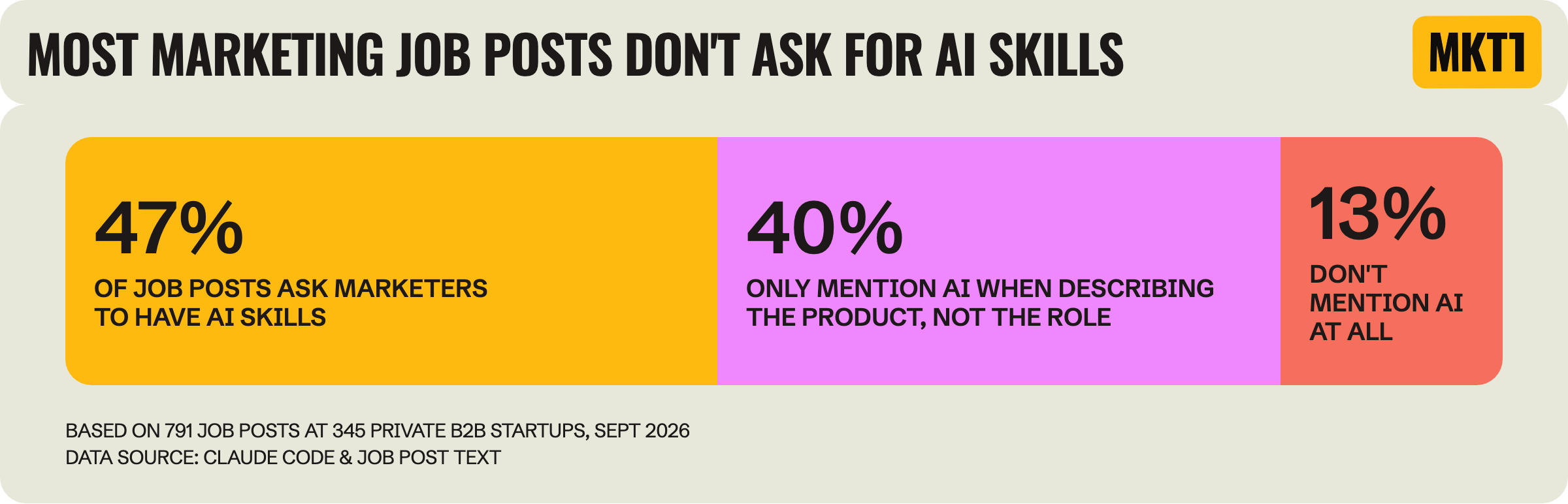
If I asked you how many B2B startup marketing job posts mention the ability to use AI, you’d probably say 97%. But it’s 47%. Yes, you’re reading that right: More job posts leave out AI skills than ask for them!
I thought the majority of job posts would ask not just for basic AI skills, but also for candidates to be able to build with AI, run a team of agents, and operate as a generalist. After all, I’ve been pushing a hypothesis for over a year that marketing generalists will overtake specialists on marketing teams. I call this the Gen Marketer skillset. But, today’s job descriptions mostly skip this altogether, which I obviously think is a miss.
You might not care what job descriptions say, and think they don’t really matter, especially when there are so many candidates applying for every role. But I think this is symptomatic of a larger problem: We aren’t sure how to hire and build teams now. If our job descriptions are stuck in the past, maybe we are hiring for the wrong things.
Your marketing job description needs to:
Give interviewers the right criteria to evaluate candidates.
Set candidates up for success (from the day they apply to day one on the job).
Give agents what they need to assist you in screening and evaluating candidates. Scary, I know. But agents are already screening candidates, so they might as well have the right context!
So while at first I was confused by the data missing the skillsets I strongly believe are needed from marketers today, I’m using that energy to rally us all to improve how we recruit and hire marketers!
This newsletter will break down my analysis of job descriptions (because I love a good graph), show you how to set up a hiring process using AI and agents, and detail the 10 skills I’d put in every marketing job description—which you have full permission to steal for your own job posts.
Recommended products & agencies
We only include sponsors we'd recommend personally to our community. If you are interested in sponsoring our newsletter, email us at sponsorships@mkt1.co.

Framer is the AI website builder that has agents inside of the canvas. You get the speed and capabilities of an agent working alongside you, while maintaining structure and control for a full-company site.
🔓 Offer: Get 30% off annual pro via the code: MKT1
42 Agency: MKT1 has recommended 42 Agency since 2023. They run paid media and marketing ops for lean, growth-stage B2B teams, and they dig into your ad accounts, CRM, and closed-lost deals on day 1, not day 30.
🔓 Offer: First 5 companies to redeem get 15% off a revenue opportunity analysis.
Conversion is the agentic marketing automation platform that replaces Marketo, Pardot, Eloqua, or HubSpot. AI agents run campaigns, workflows, and custom sequences. Used by Profound, ClickHouse, & Plaid.
🔓 Offer: Marketing leaders at enterprises using Marketo, Pardot, or Eloqua qualify for a free MOps audit
In this newsletter
📊 What marketing job posts ask for now, and 4 reasons I think they lag behind how teams work today. Jump to this section ➜
🤖 How to update your recruiting process with AI and agents. Jump to this section ➜
🧠 The 10 skills I think every marketing job should require. Jump to this section ➜
🙋 For candidates: Which skills to focus on, even if job posts don’t ask for them. Jump to this section ➜
For paid subscribers:
➕ Appendix - More analysis & graphs: Including what job posts ask for by career level and area of marketing, and more. Jump to this section ➜
Job description template, updated for modern times. Upgrade for access.
Claude & ChatGPT Skills in the MKT1 MCP for running your entire recruiting process
This is Part 2 of my State of B2B Marketing Jobs Report. Part 1 of this series covered what B2B startup marketers get paid by role and level—with over 20 graphs and a free skill to help you evaluate your own compensation.
Come build with me in Lovable on 10/28!
The Lovable team and I will walk you through how to build your own apps. Then I’ll show you why and how to build MCPs that bring your apps to any LLM or AI agent, with just a few clicks in Lovable.
Agenda: 10/28 at 10am PT / 1pm ET
I’ll build 2 apps live: A brand guide app that checks your marketing assets against your guidelines, and a benchmark tool for your customers built from real report data.
We’ll give you time to start building your own, with 29 prompts to choose from.
SECTION 1
What do hundreds of marketing job posts say right now?
I still can’t believe only 47% of job posts ask marketers to use AI. But the data kept getting weirder the more I sliced it. I genuinely wondered if Claude had pulled some archaic job posts instead of current ones. Why else wouldn't these companies be asking for AI skills?
Here are the numbers:
When it comes to talking about AI, the 791 startup job posts in the sample break down this way:
47% ask marketers to have AI skills. When you add in public companies, OpenAI, Anthropic, and GTM engineer and marketing engineer roles, it’s still just 49% of 1,165 job posts.
40% only mention AI when describing the product, not the role. This means the company itself makes something AI-related, but the post doesn’t mention marketers needing to use or build with AI.
13% don’t mention AI at all…and some of these are at companies you’d really expect to mention it (see the next point!)
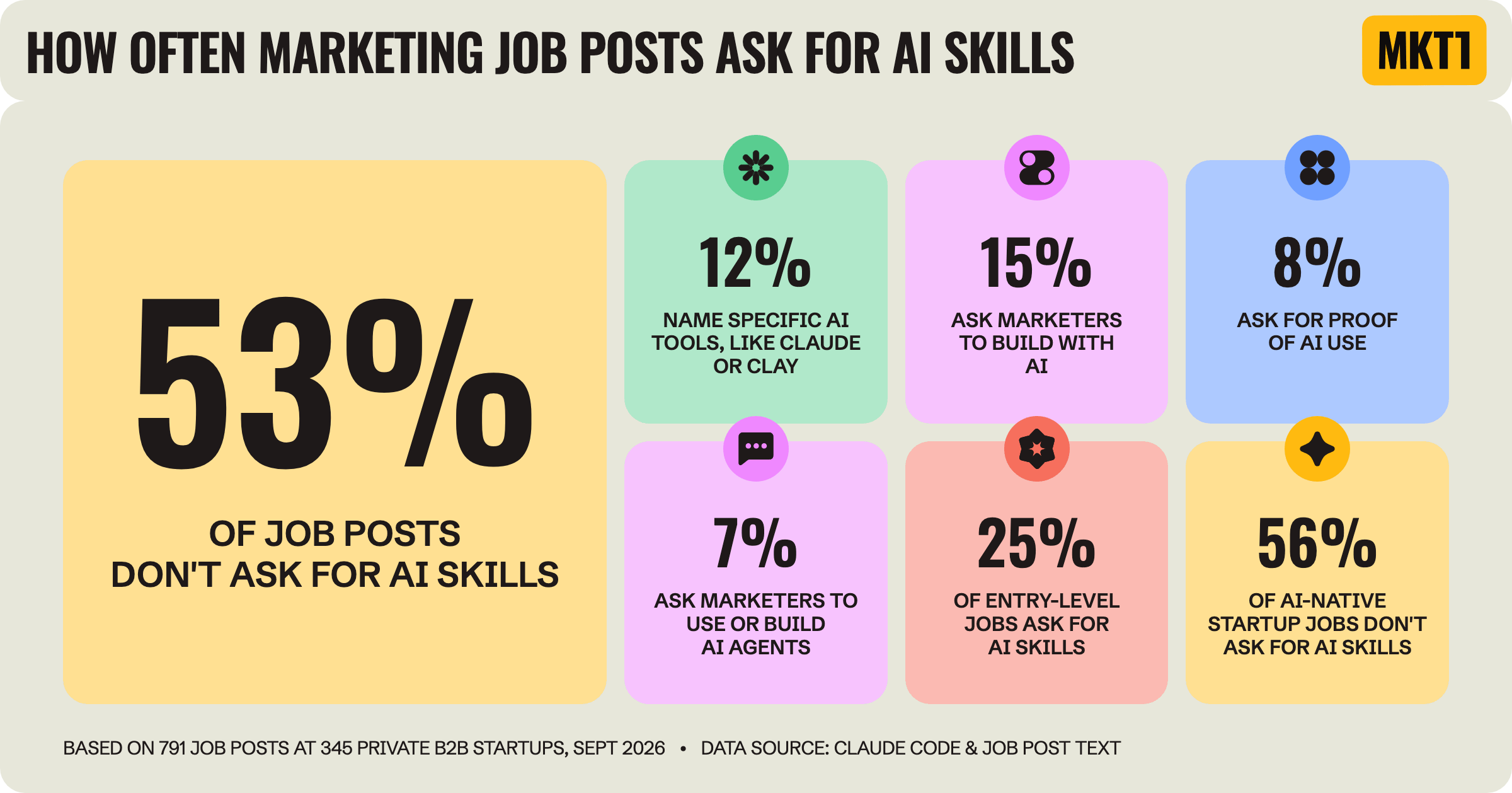
AI-native startups ask even less often about AI skills: 56% of job posts from AI-native startups do not ask for AI skills compared to 51% at other startups. Maybe these startups think it’s implied? I’m not sure it is...
When you break down how marketers are asked to use AI, job posts rarely get specific:
12% of posts mention using at least 1 AI-era tool, like ChatGPT, Claude, or Clay (more on tools below).
15% of posts ask for a marketer who can build AI workflows, agents, or skills, not just use LLMs or agents to write, research and analyze.
Only 7% of marketing job posts mention working with AI agents, even though 44% use the word "agent" somewhere (mostly to describe the company's product). Meanwhile, if you counted the billboards on the SF freeway that say "agent," the number would be at least 75%. Make it make sense.
Very few posts mention an updated hiring process that tests for AI. Only 8% ask for marketers to “show” how they use AI, through examples, a portfolio, or an interview take-home or assignment. This doesn't mean it doesn't get asked for in the process somewhere, but it's not stated explicitly in the posts.
Heads up: I talk all about the hiring process in Section 2.
Here are some more detailed stats, because I can't stop slicing and dicing this data:
Early-stage startups ask about AI less (36%) than growth-stage ones (51%). I would think early-stage companies with smaller headcount would want this more? My guess is these startups truly don't know what to ask for, or don't care about the job description? (More on this below.)
OpenAI & Anthropic ask for AI skills the least: 38% of their job posts ask for these skills, vs. 47% at private startups and 51% at public companies. Back to my thought that maybe these companies think this is implied?
Entry-level job posts ask for AI skills the least: 25%, vs. 44% at mid-level and 52% at senior. This seems really wild to me; this is where I’d expect AI to show up the most! Maybe these companies figure they’ll get plenty of candidates anyway?
Job posts with the lowest salaries ask for AI skills more than job posts with the highest salaries: 54% vs. 43%, comparing job posts for the same role and level.
Job posts still name HubSpot and Salesforce more than Claude and Clay
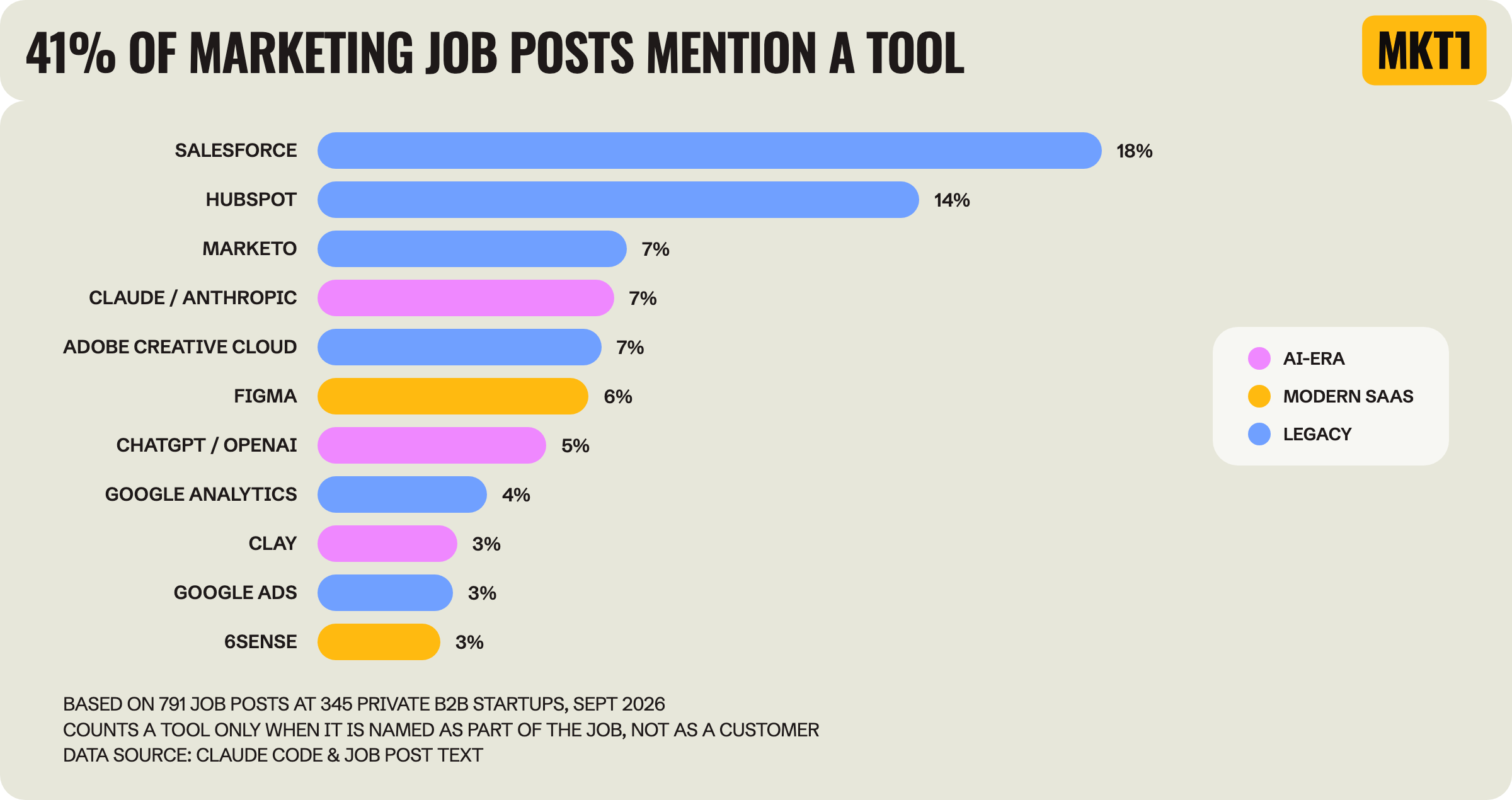
59% of marketing job posts do not mention any specific marketing tools you’ll use. Here are some tools that almost made the graph above, but were just under my 3% graph-inclusion cutoff:
Modern SaaS: Slack, Webflow, Asana, Notion, Canva
Legacy: Looker, Snowflake
Should marketing roles ask for GitHub experience?
This was a big debate on LinkedIn this summer. Here’s the data:
Only 7 of the 791 job posts mention GitHub as part of the job.
The 7 job posts that mention it span 6 different areas of marketing, from marketing ops at Metabase to brand design at ClickUp to product marketing at FullStory.
My take: You need to hire marketers who understand how to contribute to and work from multiplayer AI systems. Whether you use GitHub for that or something else, mention it!
Unlike other marketing roles, GTM and marketing engineer job posts actually do ask for AI skills
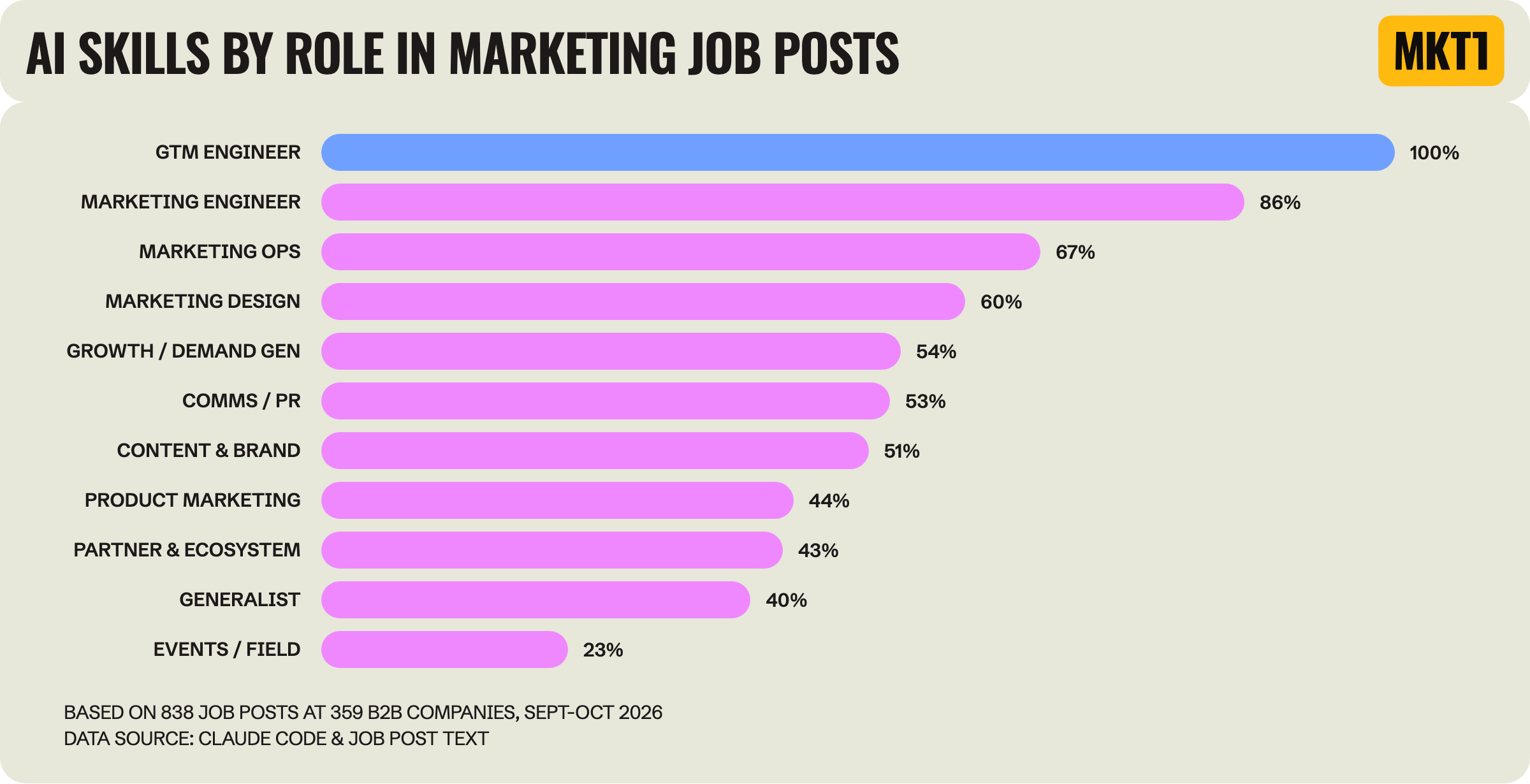
It looks like most companies are handing the job of building AI systems to 1 specialist role, a GTM engineer and/or marketing engineer, instead of asking every marketer to do it. In stark contrast to marketing roles, every GTM engineer post asks for AI skills.
86% of marketing engineer posts ask for AI skills (in a small sample of 14 posts). That’s more often than other marketing roles, but still less than GTM engineer posts. I thought the whole point of adding "engineer" to the title of everything was to signal AI systems builder and expert!
Marketing ops job posts only ask for AI skills 67% of the time (not counting the ones with “engineer” in the title), even though the responsibilities overlap quite a bit with GTM and marketing engineer roles.
76% of GTM engineer job posts and 50% of marketing engineer job posts ask the person to build AI workflows, agents, or skills the whole team uses (aka multiplayer AI systems).
For example, a GTM engineer post at Toast asks candidates to “build the agents and automations that run inside Toast's sales motion.”
Figma's marketing engineer job post asks candidates to "own and evolve a GitHub-managed marketing AI cortex of prompts, skills, context files, and agents."
GTM and marketing engineer job posts are mostly at AI-native and late-stage startups: 74% are at AI-native companies and 65% at Series D+.
Why job posts don't match how marketers work today, IMO
This data clearly didn't match my hypothesis that Gen Marketer skillsets and the ability to use and build with AI are critical, so I came up with a few possible explanations. Why don't these job posts match the skillsets teams actually need (and that everyone's talking about right now)? Here's my take, and I'd love your take too!
1. Companies are optimizing for a high volume of applicants to keep a large top of funnel
They keep the posts as generic and “lowest common denominator” as possible.
They think including specific requirements (that not every candidate has yet) may alienate applicants.
2. They’re putting very little effort into job descriptions right now because they get so many candidates regardless
When so many people apply for every job, the job description doesn't have to work very hard to find someone good.
Maybe these job posts are recycled from a few years ago? Or maybe they're all just AI-generated, and AI forgot to mention AI?
3. They’re actually still hiring for the old skillset—and operating that way too
Companies may not be updating their job descriptions at all (see reason 2), either because they don't think it matters or they simply don't know what to ask for.
Or they don’t include AI-era skills because the teams are actually operating off and hiring for marketers that can run the old playbook.
4. They’re delegating the job of building with AI to GTM or marketing engineers
AI and agentic skills aren't missing from all job posts. They show up in GTM and marketing engineer roles (see the stats above).
Companies may think 1 person or a small team can own, build and maintain the whole multiplayer AI system, from the context layer to the capabilities.
But, the reason these job posts are stuck in the past doesn’t matter. They need fixing!
Job descriptions should be the north star for the role, internally to shape the rest of the hiring process for humans and agents, and externally to set the right expectations and bring in the right candidates.
With more applicants than ever before, you need a crisper job description. Candidates who don’t fit can rule themselves out. And AI skills and agents can help you sort through the high volume of applications and screen for the right things.
That means your job description needs to match reality: Every marketer needs to be building with AI and contributing to the team’s systems every day. They also need to do more with less and develop a broader range of skills.
Marketing is on the hook for its own results, and more and more of those results depend on the AI systems the team builds. Read how LangChain, Buffer, and Mintlify built multiplayer AI systems in my newsletter series.
If your job description asks for the wrong skills, you screen for the wrong things, you interview for the wrong things—and you end up hiring for the wrong things too.
What’s left in this newsletter: How to run a recruiting process and write a job description for 2026
🤖 Next up: How to update your recruiting process with AI and agents, so it tests for the skills marketers need now. Jump to this section ➜
🧠 Then: The 10 skills I think every marketing job should require, plus data on how many job posts include each one today. Jump to this section ➜
SECTION 2
How should you adapt your marketing hiring process?
Use your job description as the context layer
Hiring usually happens in a very disjointed way. The job description lives in one doc, the scorecard in another (if there is one), and often each interviewer preps their own questions. And maybe an agent in your HR tool now auto-screens resumes based on some criteria (that hopefully you’ve actually looked at).
AI now makes it possible to connect all of these steps, but it’s not going to be very helpful if you don’t start with the right context.
The context layer is the information both your team and your agents need to know before they can do effective work. I talked a lot about why context is so important in my multiplayer AI newsletter series.
For your marketing strategy, that context is your ICPs, positioning, KPIs, etc. For hiring, it’s your job description and a scorecard. Get those right, put that context where every person and agent in the process can read them, and build each step of your process on top of them so you’re checking for the same skills the whole way through.
How to use agents and skills in your hiring process
Here's what to build to make your hiring process better. Whether you build these as skills in Claude, with Lovable, inside a recruiting tool, or somewhere else, the same pieces apply.
Context layer: Scorecard and job description
Start with the scorecard, a prioritized list of skills ranked from most to least important.
Align on the ranking with your hiring committee before evaluating candidates—it forces the team to make the hard calls up front.
Build the job requirements list from the skills in Section 3.
Create a skill or agent that checks each new applicant's LinkedIn against your scorecard and flags what a human should look into more.
Have it suggest next steps for each applicant and explain its decisions.
Don't let it rule people out based on missing or unclear information.
Interview question picker for each candidate
Use your scorecard and job description to create a baseline set of interview questions. Associate each question with a skill on your scorecard.
Build an AI skill or agent that assigns questions to each interviewer and customizes the questions for each candidate, preferably based on the gaps flagged during screening or the previous interviews.
Have the skill or agent add the questions automatically to each interviewer’s calendar invite or note-taking tool.
Take-home builder and reviewer
Create an assignment and build out its scoring criteria. Save it to an AI skill.
For each submission, have a human grade the assignment and the skill grade it against the scoring criteria in parallel.
Then have the skill flag where your scores differ, so you can make the final call.
Interview grader
Fill out the scorecard manually based on interview notes.
Have a skill or agent grade each interview against your scorecard (just pull in interview notes from Granola or whatever note-taking or meeting recording tool you use).
Compare grades and finalize your score and note.
Keep all of this context and these skills in one shared place so anyone on the hiring panel can run these skills without starting from scratch. It’s like any multiplayer AI system: One person sets it up, and the whole team uses it.
Come build marketing recruiting tools at the Lovable Buildathon on 10/28!
Start building the AI recruiting tools in this newsletter at our Lovable Buildathon. We have a starter prompt for turning your job description, scorecard, and interview questions into an app and MCP for everyone on your team to use.
Your old interview questions and assignments need an update
Only 8% of job posts ask for proof of AI use, like examples, a portfolio, or an assignment. And only 9 companies give candidates rules for using AI when they apply. But, every job post should do both.
Here’s what to do in your process to ensure candidates are up to speed on what works now and how to work now:
Ask the candidate to walk through real work from start to finish
I've always asked candidates to "walk me through a campaign you worked on from start to finish," but this is even more critical now. You need to make sure they know what to do themselves, with their team, or hand off to AI.Ask for an AI skill or agent they’ve made (the actual .md file)
This goes beyond asking them to share a link to something they worked on. A skill is basically the instructions for a workflow someone runs. Isn't it pretty neat that we can share that now?We screened for both of these in our MKT1 intern application, before we even chatted with candidates. Here’s what we asked:
“Share a video you edited using AI and submit a skill (.md file) you built with AI. If we interview you, we’ll ask you how you built both in detail. Ideally you share something you made in advance of this interview, we don’t expect you to make anything custom!”Ask what they'd change about an AI-native tool
Another question I love: “What marketing tool have you used the most?” It shows how hands-on someone really is. Then ask, “What would you change about this tool? If you could request any feature, what would it be?” It’s very hard to answer this if you don’t actually use it. And ideally they choose an AI-native tool like Clay, Claude Code/Cowork, or Lovable.Tell candidates how the whole process works, up front, including the rules for using AI. Saying “no AI” in the interview process doesn’t make sense to me. It makes more sense to match it to how you expect someone to work: Use AI to speed things up, and use human judgment and thinking for the rest!
Example: How Tom Mansfield, CMO at Tracksuit, runs take-homes
Tom wrote on LinkedIn about how he uses Claude to tailor each candidate’s take-home assignment based on their LinkedIn and interview notes. He was nice enough to share more details with me (thanks, Tom!):
The format: Candidates take ~2 hours to prep and can present in whatever format works best for them (what they choose may be a tell in itself!).
How he personalizes it: Every candidate gets the same task, but with certain areas customized just for them. The rest stays the same, so it’s easy to compare assignments.
What they did at a past job: Candidates walk through real work from a time period they choose in detail. It’s a great way to dig into what they actually did vs. what other teams drove.
How they’d do it at Tracksuit: This is the critical part IMO. Candidates then explain how they’d adapt their example to Tracksuit. This makes sure they realize they can’t just copy a playbook from another company, or (perhaps more important these days) from another time!
He makes it clear they can use AI: Here are the specific instructions: “Use AI as much as you like, we do. But we’ll go deep on specifics in the room, so only include what you actually lived.”
Use the MKT1 MCP to improve your recruiting process
First, install the MKT1 MCP. Then use these skills and prompts (for paid subscribers):
1. Make a job description
I’m hiring a [role]. Use the MKT1 JOB DESCRIPTION AND SCORECARD skill to make sure we hire a marketer with the skills mentioned in this MKT1 newsletter: newsletter.mkt1.co/p/marketing-job-posts
I’m hiring for this role: [job description link]. Use the MKT1 LINKEDIN CANDIDATE CHECK skill to review [Candidate LinkedIn URL]. Evaluate if they are a fit based on the role's scorecard and job description.
I’m hiring for this role: [job description link]. Use the MKT1 INTERVIEW QUESTIONS skill to make a list of questions that are a fit.
If you’re job hunting, these skills are free:
I’m looking for a [area of marketing] role. Use the MKT1 JOB BOARD SEARCH skill to find roles that are a fit in NYC.
2. Check your LinkedIn against a job post
I’m applying for this job: [job link]. Use the MKT1 LINKEDIN CANDIDATE CHECK skill to review my profile against it: [my LinkedIn URL].
3. Check the compensation in your offer
I got a job offer! The role is [title] at [company]. Use the MKT1 MARKETING COMP CHECKER skill to evaluate the salary and equity.
We made a quick video on how the comp checker works. And a reminder that these skills for candidates are all free. We really want to help you with your search!
SECTION 3
What should marketing job posts ask for?
I spent this whole newsletter telling you your job descriptions and process are wrong...so I think I should probably spend some time telling you what I’d actually put in a job post.
I'm going to break down the 10 skills I think every role should ask for, starting with what AI skills job descriptions should ask for. The simple answer is: Include something, anything about using AI (despite what 53% of job posts seem to think!).
Make sure marketers can go beyond chatting with LLMs
The progression of AI use usually starts by chatting with AI. Then you build your own workflows and agents, then you contribute to the systems your whole team runs on, and maybe after that, you even make an MCP or skills for people outside your company to use.
Here’s how I think about this, in diagram form:
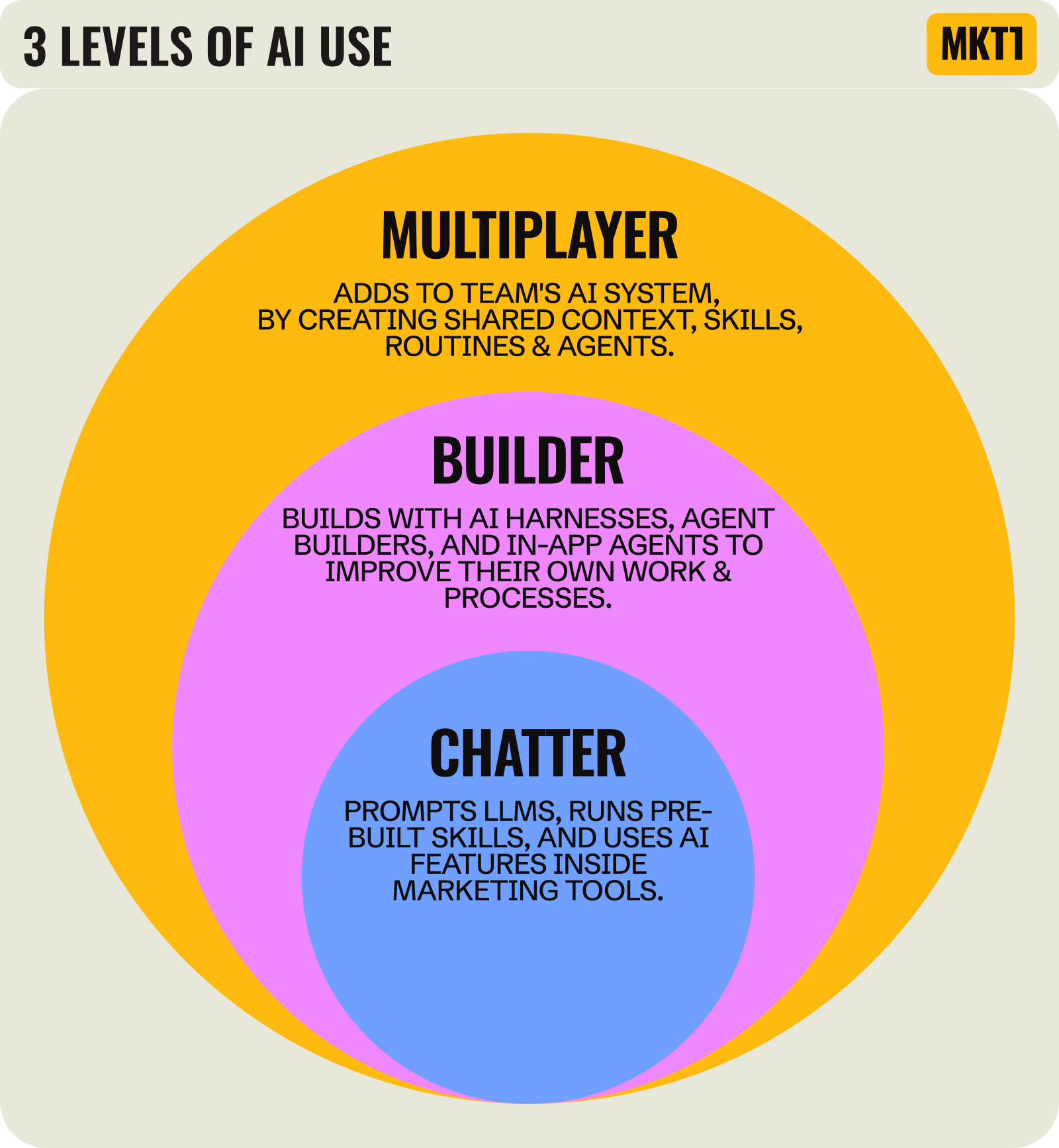
And my definitions for each:
The AI “chatter” uses AI every day for their own work (research, outlines, analysis, summaries). If job descriptions mention AI at all, this is usually all they ask for.
The AI “builder” creates workflows and agents for their own work. Only 9% of posts ask for this.
The AI “multiplayer” contributes to the skills, context, and agents the whole team runs on. Only 6% of posts ask for this.
The stats: Only 15% of posts ask marketers to go beyond the “chatter” level and build with AI for themselves and/or their team (the 9% + 6% above).
If you ask me, every marketer should be at builder level now. And you need some of the team to be at multiplayer level. The team's multiplayer AI system shouldn't be left to the GTM engineer alone, despite what open job posts may suggest.
What every marketing job post should ask for
But AI skills aren't the only thing job posts need to cover to handle the modern marketing skillset.
I think there are 10 skills every marketing job post should cover, and I grouped the 10 skills into 3 categories: Marketing, AI and Operating. When I looked for these skills in the job posts, most of them show up in only about 1/3 of job posts. Again, these job posts really missed the mark for me!
I came up with this list based on conversations I have with marketing leaders and what I observe in the best job descriptions and in the skillsets of marketers who are standing out today.
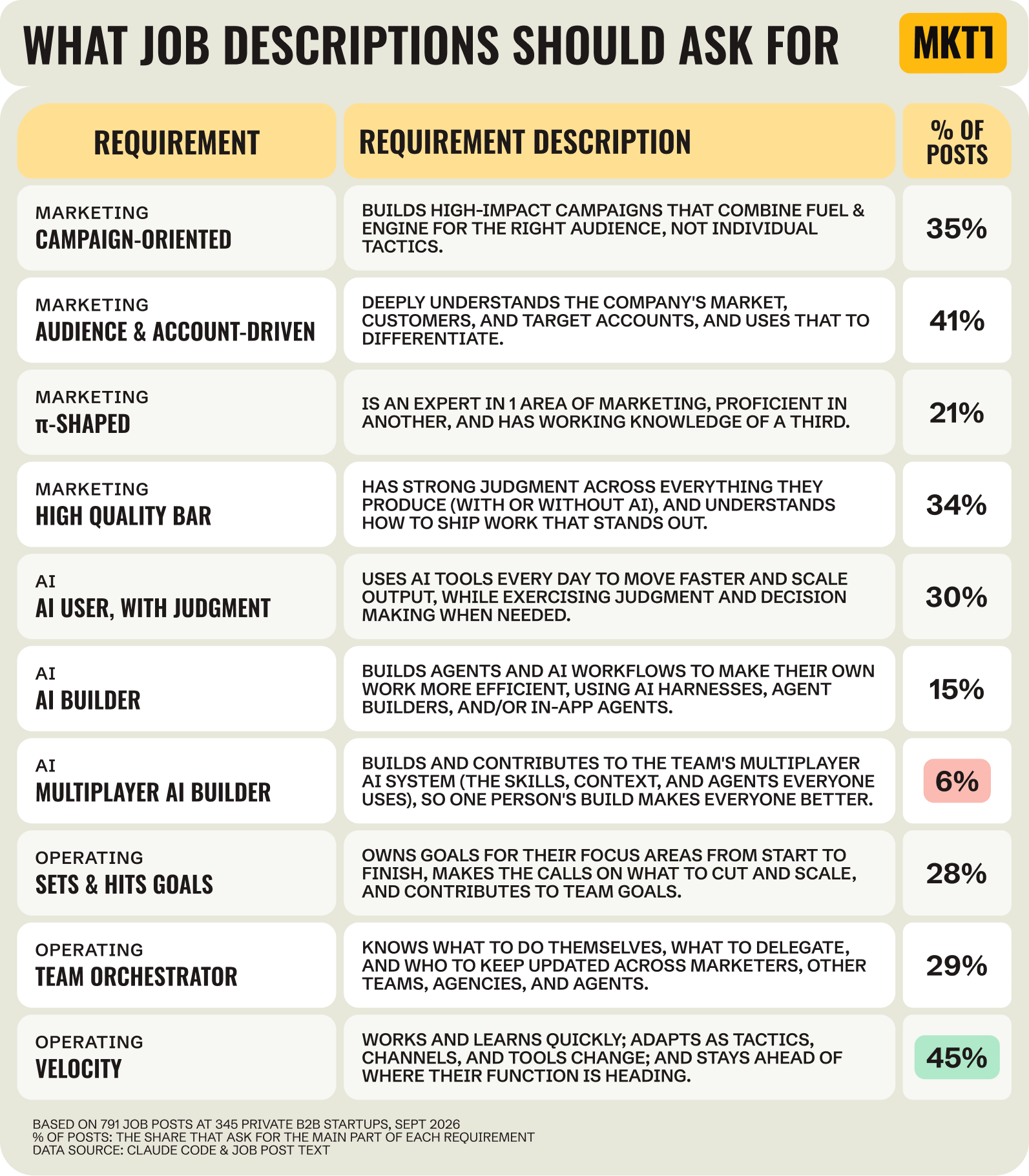
If you’re a frequent MKT1 reader, you’re likely familiar with my Gen Marketer skillset that I mentioned in the intro: A marketing generalist for the AI & agentic era.
These 10 skills are an updated, longer version of that skillset. I’m simply doubling down on it: Every marketing job description needs these skills, and they’re not optional.
More details about what’s in the table above:
Marketing skillset
➜ Campaign-oriented: Builds high-impact campaigns that combine fuel & engine for the right audience, instead of running individual tactics.
Why it belongs in every marketing job description now: You need to run coordinated campaigns to have a real impact. Random acts of marketing won't cut it.
Good examples from real job posts:
"An integrated campaign thinker: you start with the audience and the insight, not the channel." (VTS, Director of Growth Marketing)
"Architect integrated go-to-market programs that connect product launches, thought leadership, digital, events, field marketing, partner ecosystems, and ABM into a scalable growth engine." (Glean, VP, Growth Marketing)
➜ Audience & account-driven: Deeply understands the company's market, customers, and target accounts, and uses that to differentiate.
Why: The data you need to be account-driven is available now (but only 21% of job posts ask the person to focus marketing efforts on a target account list). Instead of waiting for "leads" to come to you, go out and find the right people from the right companies with custom tactics and campaigns.
Good example from a real job post: "Become an expert on your accounts. Understand organizational priorities, competitive dynamics, executive stakeholders, and buying signals so deeply that Marketing becomes a strategic advantage for Sales." (Assort Health, Senior Manager, Account Based Marketing)
➜ π-shaped: Is an expert in 1 area of marketing, proficient in another, and has working knowledge of a third.
Why: Marketing roles are blurring together as teams get smaller (unfortunately).
Good example from a real job post: "Ability to operate in ambiguity, move across shifting priorities, and flex into adjacent areas such as solutions marketing, growth, and demand generation." (Pendo, Sr. Product Marketing Manager)
➜ High quality bar: Has strong judgment across everything they produce (with or without AI), and understands how to ship work that stands out.
Why: When everyone can make stuff, a high quality bar is how you stand out.
Good example from a real job post: "We're looking for someone who can tell the difference between an idea that's memorable and an idea that's just loud." (Alloy, Senior Manager, Content & Product Marketing)
AI skillset
➜ AI user, with judgment: Uses AI tools to move faster and scale output, while exercising judgment and decision making when needed. This matches the "Chatter" in the 3 levels of AI use diagram.
Why: You need to use AI to help you in your role, and also know when not to use it. It's a tricky balance that takes thoughtfulness to get right.
Good example from a real job post: "You use AI to go faster, not to think less." (1Password, Senior Staff Product Marketing Manager)
➜ AI builder: Builds agents and AI workflows to make their own work more efficient, using AI harnesses, agent builders, and/or in-app agents. This matches the "Builder" in the 3 levels of AI use diagram.
Why: Just chatting with LLMs isn't enough: Building agentic workflows for your own work is the new expectation for every role.
Good examples from real job posts:
"Build agent workflows daily: research, list building, lookalike testing, personalization, creative variants, landing page drafts, competitor monitoring, post-test analysis." (MotherDuck, Growth Marketer)
"Build AI-powered workflows in Claude Code and Cortex (our internal AI layer) that turn research and customer insight into finished content faster." (Gorgias, Staff Content Marketer)
➜ Multiplayer AI builder: Builds and contributes to the team's multiplayer AI system, so one person's build makes everyone better. This matches the "Multiplayer" in the 3 levels of AI use diagram.
Why: A team's AI system works best when every functional expert contributes to it. The PMM knows the positioning, the content lead knows the voice, and the growth marketer knows what's working in each channel, so the system is only as good as what each of them puts in.
Good example from a real job post: "The AI workflows you build get picked up by others, so the team produces more without adding headcount." (Grafana Labs, Regional Marketing Manager)
Operating skillset
➜ Sets & hits goals: Owns goals for their focus areas from start to finish, makes the calls on what to cut and scale, and contributes to team goals.
Why: We all say we will set goals and hit them, but marketers need to be making real prioritization decisions against these goals every day (yet only 15% of job posts ask the person to decide what to cut vs. scale).
Good examples from real job posts:
"Turn incomplete or noisy data into a clear call on what to scale, improve, pause, or stop." (Ramp, Performance Marketing Manager)
"You'll be measured on the growth of the business (not just on assets shipped or messaging consistency)." (Runway, Director/VP of Product Marketing)
➜ Team orchestrator: Knows what to do themselves, what to delegate, and who to keep updated across marketers, other teams, agencies, and agents.
Why: We're orchestrating across more people, tools and agents. Thinking like a quarterback (sorry for the sports reference) is now the job of most marketers (which is also why you need to be campaign-oriented, π-shaped, an AI user with judgment, and so on).
Good example from a real job post: "Decide what we produce in-house, what goes to agencies and directors, and what we source from creators, with the economics behind each." (Figma, Video Strategist)
➜ Velocity: Works and learns quickly; adapts as tactics, channels, and tools change; and stays ahead of where their function is heading.
Why: Pace really matters, but maybe not in the way you think. It's mostly about how quickly you learn and adapt when the tools and channels you rely on change, more than how fast you move on things that don't matter.
Good example from a real job post: "Self-sufficiency. You build your own assets end to end and don't wait on anyone to ship." (Basis AI, Content Marketing Manager)
Steal our job descriptions
Of course you have full permission to steal this list for your own job descriptions.
For paid subscribers, we made this very easy:
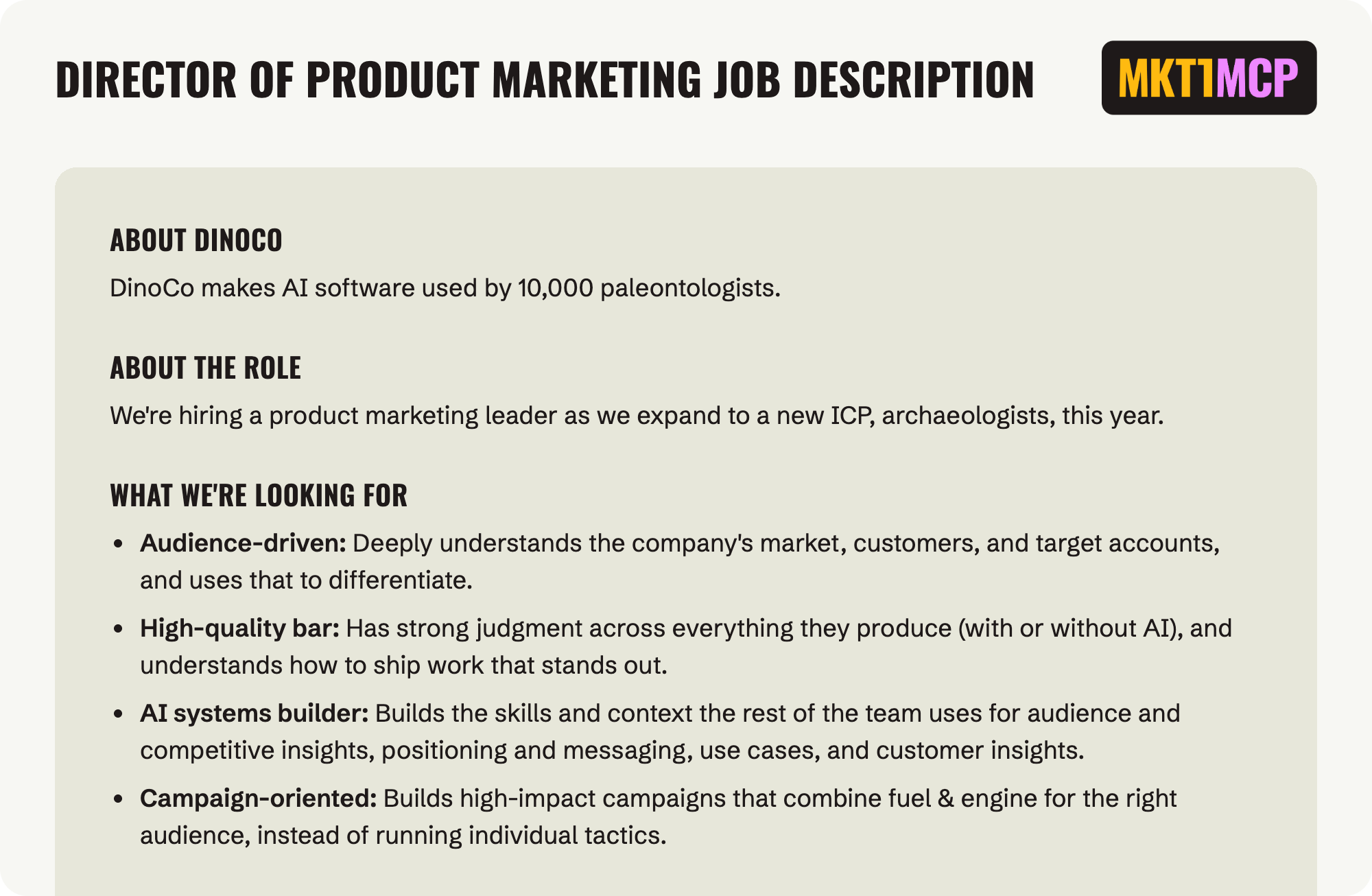
We made 1 new job description template that covers 8 different marketing roles, updated for modern times! Upgrade to access!
And we shipped the job description and scorecard skill to the MKT1 MCP.
The specific skills required for each area of marketing
In addition to the skills above that apply to all marketing roles today, here are some of the skills specific to each area of marketing that are relevant and needed right now.
Content & Brand
Content and brand used to mean dividing up time between ideas and production work. The ratio here should change, with more time going to big creative campaign ideas that stand out from the slop and building the systems that help with quality production.
Production work should be codified into skills and context in the team's AI system, so it feeds everyone's work. That means building skills for the team's agents and LLMs for things like brand guidelines and voice, copy editing, and templates for every type of asset or format the team regularly produces.
Content & brand marketers can't stop at the creative part: They need to understand how to combine fuel & engine into campaigns, and either do the distribution work themselves or partner with the right person to do it. This has long been the case, but the orchestration required to stand out now is greater.
Stats from the content & brand job posts: 69% of these job posts ask for judgment or taste (the most of any role), but only 24% ask the person to run campaigns from start to finish right now, even though in reality content & brand marketers will definitely need to think about distribution.
Product Marketing
Aside from heads of marketing and maybe campaign managers, PMMs need to be generalists more than any other marketing role. I’ve long said they should be π-shaped marketers who can go deep in 2 areas of marketing (like product marketing and growth), with working knowledge of a third (like content). That’s even more true now. Audience, customer and market research, and coordinating and gathering info from other teams take up less time now, so the role is increasingly becoming that of a generalist, orchestrator, and pinch hitter wherever it’s needed (sorry for yet another sports reference).
Given these changes, I see 2 potential paths for PMMs in the near future:
Systems-building PMMs: Setting context for the rest of the team across audience, customer, positioning, messaging, and competitive info.
Campaign-managing PMMs: Helping execute campaigns of all kinds, on top of orchestrating launches.
Should either of these roles still be called PMMs? The jury's out! (More in my LinkedIn post on PMM salaries.)
PMMs should be building the skills and context the rest of the team uses: A positioning file every agent reads, a skill that checks copy against the company's messaging, or an agent that keeps competitive info up to date.
Stats from the PMM job posts: Only 23% of PMM job posts ask for the ability to run campaigns from start to finish. This has always been needed, since launches are just campaigns. But increasingly, PMMs should be responsible for campaign orchestration beyond just the launch.
Growth
Working inbound leads only isn’t going to cut it for the vast majority of B2B businesses these days. Growth marketers need to be working from an account-driven foundation across every channel, and making plans to reach each top-tier account. We didn’t have the data to do this just a few years ago, but now that we do, you should be shooting fish in a barrel, not just waiting for them to swim into your net.
On top of the increase in account, contact, and signal data, the channels that work have changed, and the old playbook doesn't really work. This hits growth marketers hard!
I still see marketers hoping for inbound to spike. Instead, growth marketers might need to get more comfortable with things like ecosystem marketing and outbound.
It’s really critical here: Look at the responsibilities of GTM engineers. This is the skillset growth marketers need too! The line between these roles is blurry, and to stay effective, gain this skillset.
Stats from the growth job posts: Only 20% of growth marketing job posts ask for the ability to build AI workflows, agents, or skills. GTM engineer job posts almost all ask for this: 94% (the other 6% ask them to use LLMs or agents). This disparity concerns me for growth marketers—why aren’t we requiring this?
Ecosystem
Ecosystem used to mean a co-marketing calendar and some logo swaps. Now it’s one of the engines that still works when inbound doesn’t, and the data to run it well is finally available. This role should be building campaigns from partner relationships, not just managing them.
Partner and customer context (overlap, signals, who’s a champion) should live in the team’s shared context instead of in one person's head or inbox.
Run partner and customer work as campaigns instead of as requests for deliverables. That means starting from a shared account list, building the fuel together, running it through both companies’ channels, and owning a pipeline number for it.
Stats from the ecosystem job posts: 59% of ecosystem, partner and customer marketing job posts ask for the ability to run campaigns from start to finish, second only to generalist roles. But none(!) ask the person to build AI workflows, agents, or skills the whole team uses. When managing so many partners, building AI workflows is so useful—we wouldn’t be able to work with nearly as many partners at MKT1 if we didn’t have skills for this!
Events & Field
Events are working right now, I think because inbound is declining, outbound is saturated, and people want more human interaction. The role has changed, though: With enriched account data, events teams can run smaller, targeted events for the exact accounts they want to reach.
Events marketers should think about events as full campaigns instead of a single moment. They need both fuel (a point of view, content, the right people in the room) and engine (the outreach before, the follow-up after). If they can’t build both around an event, they shouldn’t do it.
They should decide which accounts and contacts the event is meant to move before picking a venue, and build the invite, the follow-up, and the pipeline tracking as a system they run for every event.
Stats from the events & field job posts: Only 25% of events and field job posts ask for the ability to run campaigns from start to finish, vs. 35% of marketing job posts overall.
Marketing Ops / Eng
Marketing ops used to mean owning the martech stack: Setting up the marketing automation tool, keeping the data clean, and building campaigns and emails inside it. But the marketing tech stack now includes the context layer, skills, agents, and MCPs the team uses—the role needs to evolve!
Marketing automation tools are increasingly operated by agents. If you aren’t building agentic flows in marketing ops, you aren’t building modern systems.
The lines between marketing ops, marketing engineering, and GTM engineering are blurring. But IMO, all need to be building a similar skillset. While the titles and reporting structure shake out, focus on the skillset, whether you’re hiring for the role or in it!
It might feel confusing to measure success for this role right now. My take: Measure it by how much faster everyone else can ship.
Stats from the marketing ops / eng job posts: This role asks for AI skills more than any other marketing role (72% of these job posts). And 36% ask the person to build AI workflows, agents, or skills the whole team uses, vs. 6% of all marketing job posts.
We have more data! The appendix for paid subscribers has more tables and graphs that break down asks in job posts, including:
The 10 skills broken down by career level, from early-career to VP / CMO
The 10 skills broken down by area of marketing, from content & brand to growth
Which area of marketing asks for the most AI skills
The skillsets required of founding marketers, compared to other roles
Candidates: Highlight these skills in your job search
Don't take job posts at face value for what's required to get hired and keep the job, since most posts haven't caught up to how marketing teams work (clearly, I’m still shook by the data!).
Here's what to think about when you're applying and interviewing, at any level:
Be clear on which skills you spike in from the lists above. And of course, recognize where you have gaps, and work on filling them in.
Be ready to show off what you've done with AI. The best interviewers will ask you to walk through something you built from start to finish, so have examples ready. If you don't have examples of building with AI from your last job, start on your own.
You can even come build alongside me at the Lovable Buildathon I'm hosting on 10/28.No matter what marketing role you're applying for, use GTM engineer job posts as a reference for the skillset you need to develop (here are 3: Runway, Toast, Wispr Flow). Some of it might be a stretch, but every marketing role is drifting in this direction. These posts also show you how companies are building with AI.
For people manager roles specifically, be ready to talk not just about how you hire and manage people, but about how you think about the mix of full-time employees, contractors and agencies, and agents and AI. (I know it's hard to hear that hires might get replaced with agents. It bums me out too, but it's the reality.)
More suggestions and ideas for candidates in my guide to the Gen Marketer skillset.
Reminder: Bring this newsletter into Claude, ChatGPT, or Lovable!
Whether you’re hiring or interviewing, copy this prompt into any LLM to get started:
Read this newsletter: newsletter.mkt1.co/p/marketing-job-posts. Help me use it [to get hired / hire a marketer].
Or install the MKT1 MCP and use these skills:
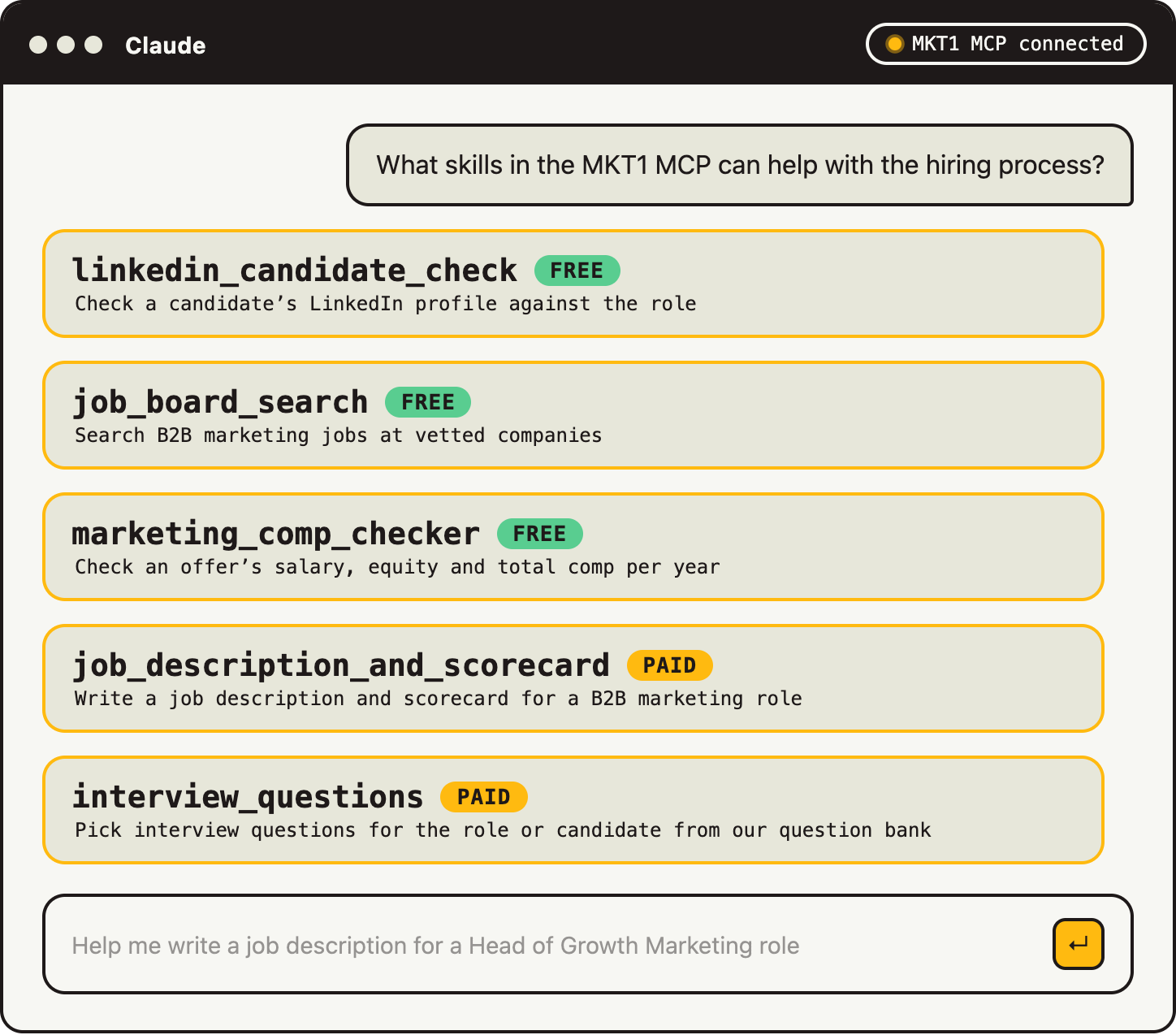
👋 That’s it for this one, well minus the extra graphs in the appendix for MKT1 VIPs (aka paid subscribers).
I expect all of your marketing job descriptions to look better in 30 days. I’ll be checking!
Methodology for the data in this report
I pulled 1,100+ open marketing job posts in September & October 2026 with the help of Claude Code.
Most stats in this newsletter use 791 posts from 345 private B2B startups.
The companies in this analysis are mostly high-growth, with 82 companies from my hand-vetted list. Additional roles were added based on Claude Code research, with all companies approved by me.
The broader 1,100+ sample includes 327 posts from public companies, OpenAI and Anthropic.
The 1,100+ posts also include 47 GTM and marketing engineer job posts pulled in October 2026.
Claude Code tagged every post against my list of 10 skills and the 3 levels of AI use. I spot-checked the results by hand and personally reviewed every data point and graph.
More from MKT1
🙏 Brought to you by: Framer, the AI website builder; 42 Agency, a Demand Gen and MOps agency; and Conversion, the Agentic Marketing Automation Platform.
💬 Bring this newsletter to Claude: Chat with this newsletter with this pre-built prompt. Tons to dig into here!
🔌 MKT1 x Lovable Buildathon on 10/28 at 10am PT / 1pm ET: Come build apps and MCPs for your team or your customers alongside Kramer and the Lovable team. Register here.
🤖 MKT1 MCP: Add MKT1 skills to your LLMs or AI harness. Paid subscribers get our full library of 40+ skills and templates, including all the hiring skills featured in this newsletter.
🧑🚀 MKT1 Job Board: Jobs from the MKT1 community (it’s free to post as a paid subscriber). And our candidate form if you’re looking for a new role (option to remain anonymous included!).
🥞 MKT1 Perk Stack: Exclusive discounts worth $40K+ on our favorite GTM tools. For annual & superfan paid subscribers only.
🧰 Template & resource library: We have 100+ templates and resources available to paid subscribers in our template & tool library.
Appendix: 4 more graphs analyzing marketing job posts
Skills by career level
I looked at the skills required not just overall, but also by experience and level. The data mostly follows what I would have expected: Senior job posts ask for more ownership of campaigns and goals, and early-career job posts ask most about speed.
Most surprising to me: Only 5% ask a VP or CMO to build anything with AI, even though they’re the ones setting the team’s AI strategy. But what’s confusing is that Director and Head of Marketing job posts ask for the AI skills in this table more than any other level.