

👋 This is a monthly free edition of MKT1 Newsletter—a deep dive into a B2B startup marketing topic, brought to you by Profound, 42 Agency, and Framer.
Upgrade to a paid subscription for: Full access to our new MKT1 MCP Server | 100+ templates & resources | Post to MKT1 Job Board | MKT1 Newsletter Archive | $40K+ in discounts in the MKT1 Perk Stack
I’ve long said your website is your most important marketing asset. Lately, I’ve debated if I still believe this is true.
Websites are in a state of flux right now: LLMs are increasingly where people research products, so less traffic is making it to your site. The traffic that does show up is harder to convert, because prospects have already half-formed an opinion in a chat window. It’s fair to wonder if the website is still worth investing in.
But I’ve landed on my answer: Your website is still your most important marketing asset, but for different reasons.
Your website is a major source of what feeds LLMs, so what’s on your site shapes what those models say about you. And your website, at least for now, is still where prospects go to evaluate and buy. In a world where anyone can vibe code a decent-looking site in an afternoon, your website is your chance to stand out in an increasingly crowded landscape. Don’t vibe code it into undifferentiated chaos!
(A recent report by Framer found that 83% of marketing teams manage multiple websites—vibe coded chaos is very real!)
All of this changes what you need to prioritize on your website now:
It’s easier to build (and update) websites than ever. Vibe coding and AI tools mean you can spin up pages and match what competitors are doing faster. If you’re not regularly updating your site, you’re already behind.
Less traffic means conversion matters more. When someone does make it to your site, the stakes on that visit are higher. You need to include the details prospects need to convert, and make sure LLMs can parse those details too.
(In that same Framer report: 71% say conversion is their top KPI, but only 12% run A/B tests to improve it)Credibility is a necessity. Product differentiation is harder (because building products is easier now too), so your brand needs to do the heavy lifting. There are more products in every category and savvy prospects can see through flimsy claims and fake social proof.
You’re building for two audiences now. Humans evaluating your product, and LLMs deciding whether to recommend it. And this is different from just optimizing for search. With search, you controlled what search engines said about you, from the title to the meta description. LLMs generate a different answer every time and you need to do more to guide the LLM correctly.
To see what this looks like in practice, I called Casey Hill, CMO at DoWhatWorks. DoWhatWorks scans millions of websites and tracks tens of thousands of A/B tests, and Casey’s talked to 75+ website teams about what they’re building and why. He posts those findings on LinkedIn and in the DoWhatWorks Substack. I asked him what’s standing out right now, scanned through 100s of his examples myself to pick out my favorites, and put together this newsletter.
Recommended products & agencies
We only include sponsors we’d recommend personally to our community. If you are interested in sponsoring our newsletter, email us at sponsorships@mkt1.co.

Profound: Improve your brand’s AI visibility with Profound. Track how your brand shows up across LLMs, then use agents to turn AI signals into AEO briefs, research competitors, and create campaign-ready content. Used by Ramp, Calendly, Zapier, and MKT1 of course.
🔓 Offer: Mention MKT1 to get a free AI Visibility Report.
—
42 Agency runs signal-based outbound and paid programs for B2B startups. From ops set up, warming mailboxes and signal tracking to personalized sequences, account-specific ad targeting, and cross-channel campaigns, they handle it while you close deals.
🔓 Offer: First 5 companies get a free 30-min pipeline diagnostic.
—
Framer: DoorDash, Perplexity, Mixpanel, and Mutiny’s websites are all built on Framer. From early-stage startups to Fortune 500s, Framer is the website builder I personally recommend. It works like your team’s favorite design tool, with AI-powered building, integrated A/B testing, and one-click publishing
🔓 Offer: Get 15% off a Yearly Pro plan with code MKT15. Annual MKT1 Subscribers get 30% off a Yearly Pro plan in our Perk Stack.
In this newsletter:
I cover the website patterns standing out in the AI era. I’ve categorized 30+ examples into four buckets:
Build for humans & machines: We’re now creating content for LLMs, search engines, and humans. These examples cover how to strike the balance.
Examples include: Wispr Flow, Supabase, Railway, PostHogGo beyond basic social proof to show credibility: AI has lead us all to be more skeptical of what’s real, so the old playbook of basic logos isn’t cutting it. Examples include: Clay, Notion, Linear, Intercom
Lower the bar to get started: It’s harder to get people to your site, so when they show up you need them to convert.
Examples include: Lovable, Replit, Framer, Canva, ZapierQuick wins: Other suggestions to make a high-converting, differentiated site fit for the AI era…and some suggestions of what not to do.
Bonus for paid subscribers: We’ve added all of these website examples and more to our new /website-examples skill in our MCP Server. You can ask Claude for examples of websites that do “X” and it will check the list and report back. I’ll be adding more examples over time.
Build Claude Code Skills with us this Friday
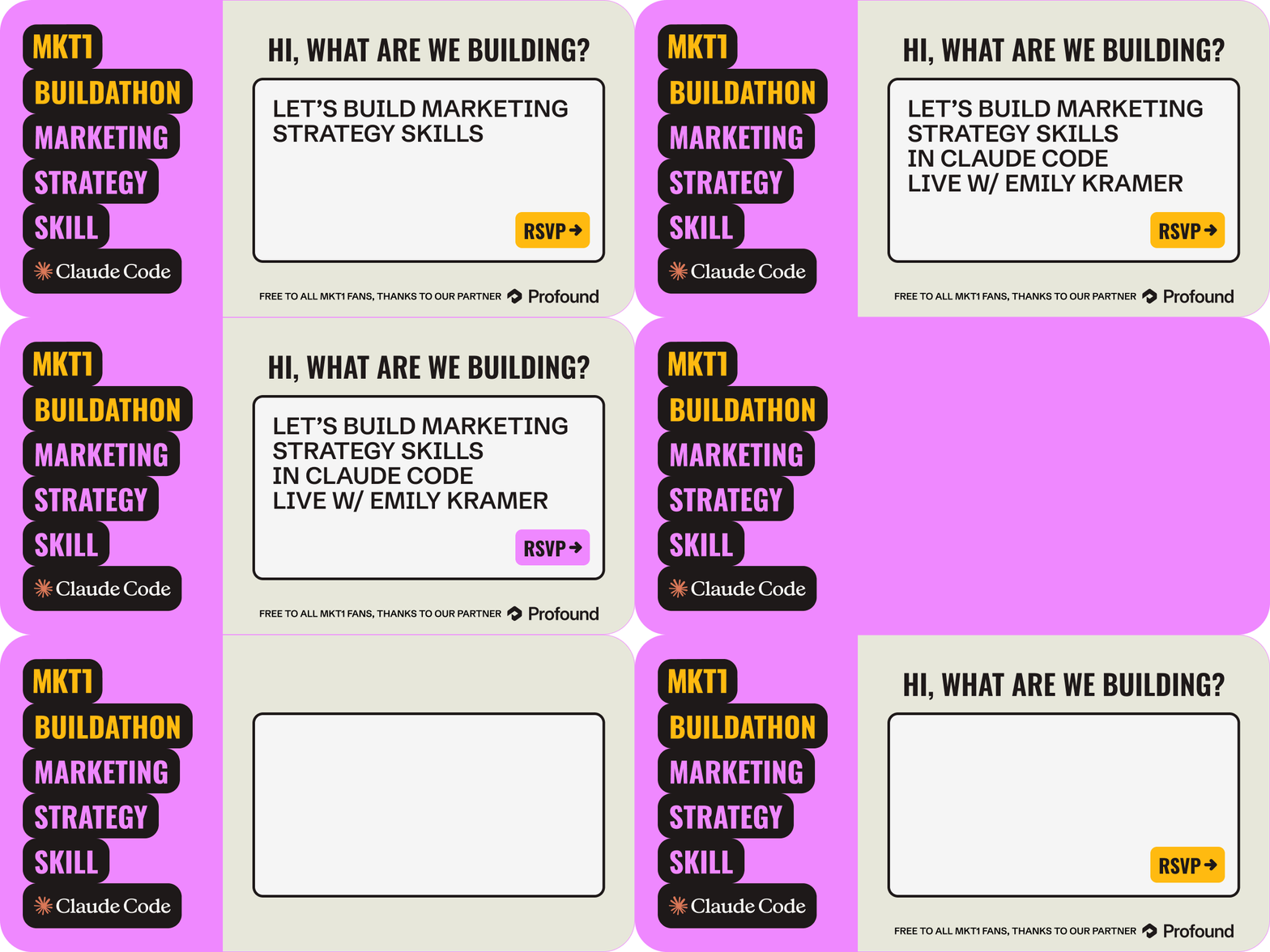
Come to our first-ever MKT1 Buildathon on 4/3/26. I’ll show how to build a /marketing-strategy skill from scratch in Claude Code.
Free to join thanks to our partner, Profound.
Here’s what to prioritize to build a valuable, high-converting website in the AI era…
1. Build for 2 audiences: Humans & machines
You might think we’ve always been writing for machines (the search crawlers), but it’s a different ballgame with LLMs as the new front door. LLMs generate their own answers with their own copy each time. And many people do not click through on LLM answers like they did with search results. So there are new must-haves to make sure your site is AEO-ready, but still valuable to humans.
➜ Make your site readable by LLMs and search crawlers
I could write many newsletters about AEO, and the noticeable changes to websites, but here are a few ways companies are making their sites LLM-friendly. Some are creating what Casey calls “prompt presets,” pre-built links that send visitors straight to an LLM. Others are adding structured, machine-readable files to their sites. And some are just putting genuinely useful content in places where both humans and LLMs can find it.
Here are some examples:
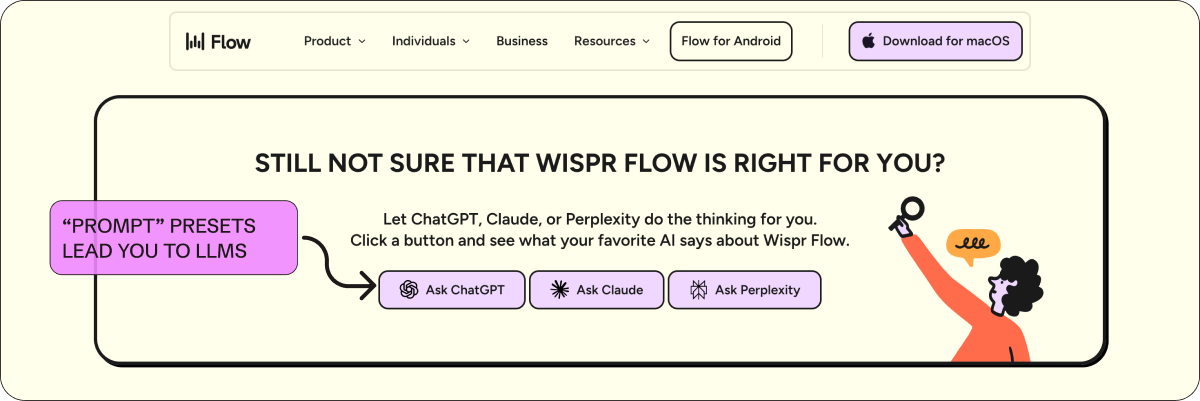
Wispr Flow: The boldest version of “prompt presets” I’ve seen. At the bottom of their homepage they say “Still not sure that Wispr Flow is right for you? Let ChatGPT, Claude, or Perplexity do the thinking for you.” Then three buttons: Ask ChatGPT, Ask Claude, Ask Perplexity. It’s a way of saying “we’re so confident in how machines see us that we’ll let them do the talking”—and in their case not just in the footer, but in the flow of the homepage.
Some other examples of prompt presets include Glean & Galileo.

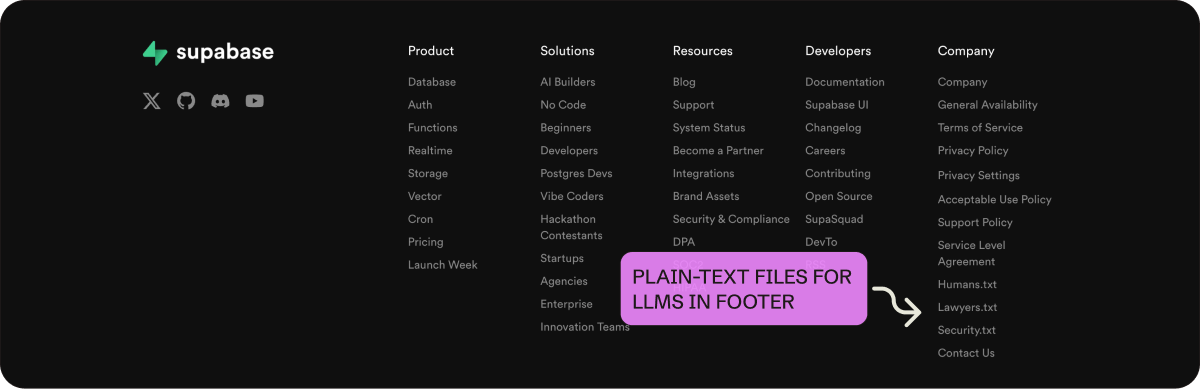
Supabase: They link to humans.txt, lawyers.txt, and security.txt in their footer. These are plain-text files that give agents and crawlers a clean, structured way to parse who built the product, what the security policies are, and where to find legal info. Instead of making machines scrape your About page or navigate your legal docs, you give them a direct endpoint.
More on the point of .txt files in this post from Casey »
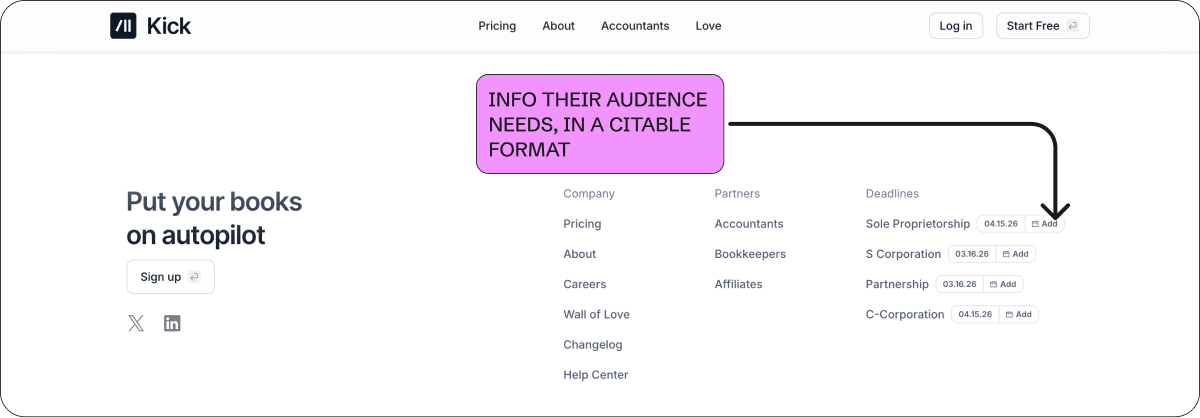
Kick: This is really clever! Kick lists tax filing deadlines by entity type (S Corp, C Corp, Sole Proprietorship, Partnership) with add-to-calendar buttons next to each one. This shows they really understand their audience. Plus, they did this in a format that’s useful to humans (with an add to calendar option) and easy for LLMs and search engines to cite.
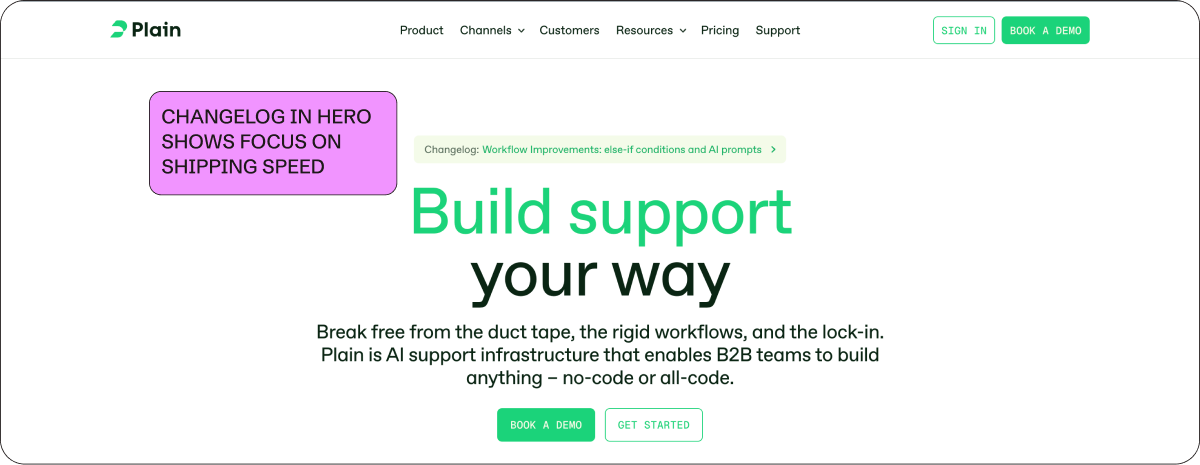
Plain: They put a link to their changelog right in the hero. It signals shipping speed and shows the product is actively evolving. And a changelog is structured, frequently updated content that keeps your site fresh for crawlers.