


👋 This is a monthly free edition of MKT1 Newsletter—a deep dive into a B2B startup marketing topic, brought to you by Traction Complete, Omni Lab, and Attio.
📅 Save the date 7/28: MKT1 MCP Showcase featuring live demos in Claude from Airtable, Attio, Framer, Mutiny, Profound & Softr, RSVP here (free to all).
⬆️ Upgrade to a paid subscription for: Full access to our new MKT1 MCP Server | 100+ templates & resources | Post to MKT1 Job Board | MKT1 Newsletter Archive | $40K+ in discounts in the MKT1 Perk Stack
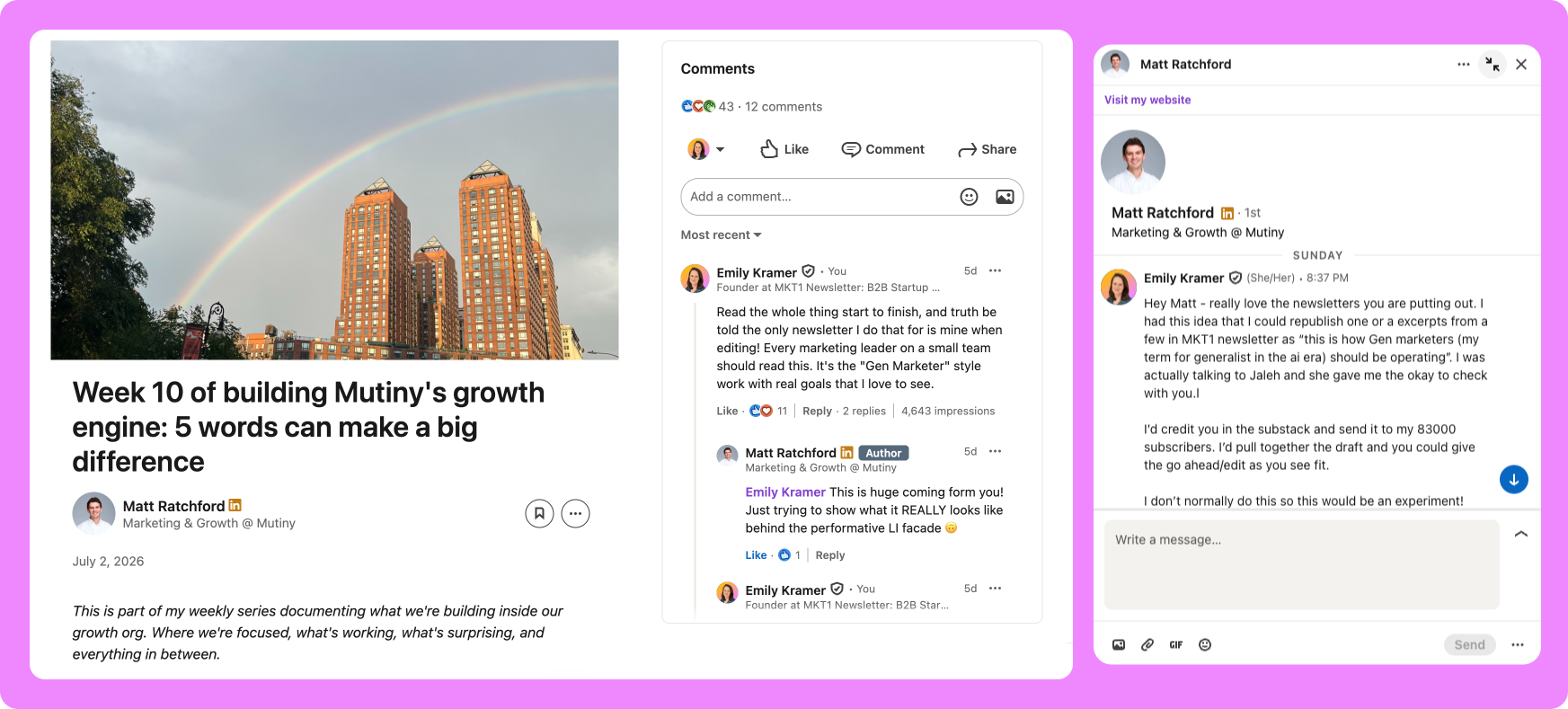
Last week, I read a LinkedIn newsletter from start to finish for the first time in a long time. And it inspired me to do something I’ve never done before: to “repost” something that’s already been published in full.
The author of this newsletter isn’t a mega-creator with 100,000 followers (we all see those posts). Matt Ratchford is a scrappy marketer on a small team at a growth-stage startup. Specifically, he’s the Growth Marketing Lead at Mutiny, an AI agent for GTM teams.
Matt, like many of you reading this, is doing the work of a “Gen Marketer” every day. He sets strategy and goals, while executing in an AI-forward way (but not in an unattainable, braggadocious, top-1%-AI-pilled-power-user way).
Matt’s newsletter series not only shows the Gen Marketer skillset in action (more details below), but his posts reinforce so many things I’ve written about over the years in practice (not just in theory). So I’m sharing his latest newsletter plus shorter excerpts from his entire series, where he documents how he’s building Mutiny’s growth engine week-by-week. It’s different from most build-in-public content—it includes the misses, it’s specific, it’s unglamorous, and it sounds like it’s from a real human, an unfortunate rarity today.
But don’t worry, this isn’t just a repost. In true MKT1 fashion, my commentary after the post exceeds the word count of the newsletter I’m sharing.
Recommended products & agencies
We only include sponsors we’d recommend personally to our community. If you are interested in sponsoring our newsletter, email us at sponsorships@mkt1.co.

Traction Complete's data agents keep accounts deduped, leads matched, and hierarchies accurate inside Salesforce. Because building AI workflows and campaigns on messy CRM data just creates a bigger mess. Used by Mops and Demand gen teams at Miro, Asana & Zoom.
🔓 Traction Complete Offer: Mention MKT1 and pay nothing while they migrate and upgrade your flows.
—
Omni Lab helps growth-stage startups scale their paid media & demand gen strategy. They focus on building early brand awareness, expanding reach, and optimizing for revenue, not just top-of-funnel metrics.
🔓 Omni Lab Offer: Mention MKT1 to get a $2500 paid media assessment free (10 available).
—
Attio is the agentic CRM for GTM teams. New updates to agents and workflows let you act on your data through a single prompt—Ask Attio—and its MCP.
🔓 Attio Offer: MKT1 subscribers get 15% off your first year.
📅 See Attio’s Claude Connector demoed live at our MCP Showcase on 7/28.
In this newsletter:
This issue is a bit different. I’m sharing Matt Ratchford’s full post: “Week 10 Building Mutiny’s Growth Engine: 5 Words can make a big difference,” then a few more excerpts from earlier posts in the same series—with notes and takeaways from me of course. Give him a follow and follow along with the series if you enjoy what you read.
What’s a Gen Marketer? (important context first)
Full share of Matt’s latest newsletter with my favorite parts highlighted (his words are in the gray boxes throughout this newsletter)
Kramer’s takeaways: 5 lessons for Gen Marketers
More (shorter) excerpts & more of my takeaways from the rest of Matt’s series
RSVP to the MKT1 MCP Showcase on 7/28
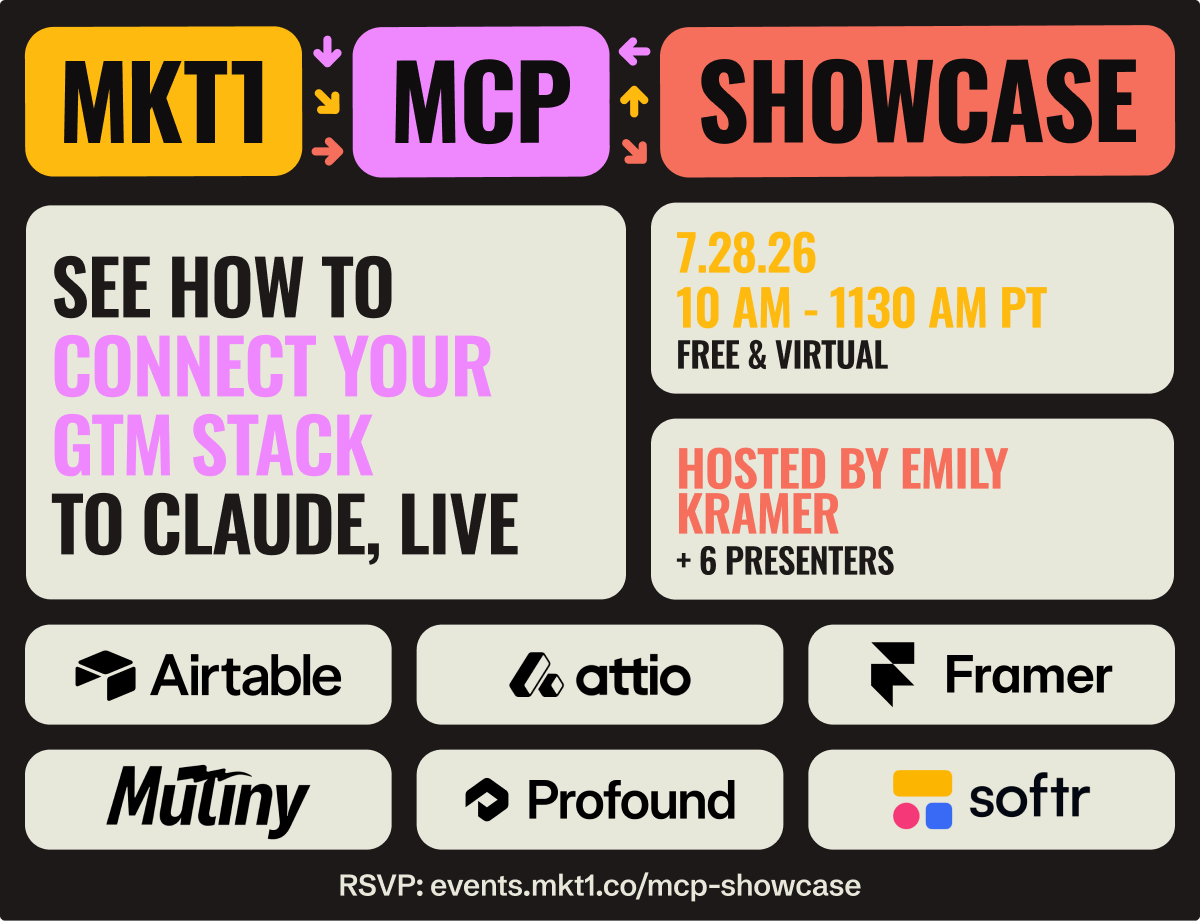
Coming up on July 28th is our next MKT1 MCP Showcase. This time we’ve invited GTM & product leaders from Airtable, Attio, Framer, Mutiny, Profound, and Softr to show you how to use their MCP Servers (aka Claude Connectors).
Get a crash course in using Claude with these tools in 90 minutes, starting at 10 AM PT / 1 PM ET. I’ll be hosting, and guests will be demoing live and answering your questions.
Now onto the newsletter…
Important context: What’s a Gen Marketer?
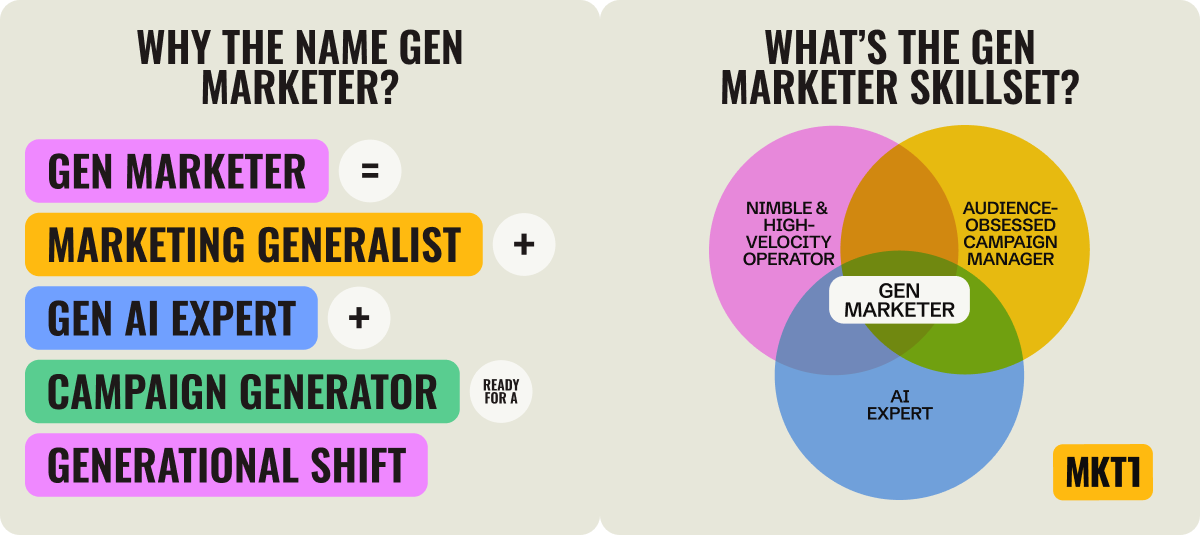
I introduced the Gen Marketer concept last year and ran a half-day Gen Marketer Summit on it in Dec 2025. I believe all marketers can benefit from gaining this generalist skillset. It’s what it takes to stand out in our AI-heavy, agentic world: channels are saturated, content is infinite, products are easier than ever to build, and GTM teams are shrinking. The marketers who can go deep with AI and agents, focus on high-impact campaigns, stay nimble, and learn fast in any area will out-execute the rest.
“It’s the era of the competent generalist. Every team needs someone who can start things, go deep, hold the whole picture, and take a lot of shots at goal. Everything is changing and nobody actually knows what they’re doing so being able to try it all is super important.”
– Matt Ratchford, Week 5 (and 6) of building Mutiny’s growth engine: The thing I’d been avoiding
Part 1: Matt Ratchford’s newsletter repost + my commentary
Here’s Matt’s full newsletter, republished with full permission (minor edits for brevity). My takeaways are below the repost, and I couldn’t resist highlighting some of my favorite parts throughout as well.
Originally published July 2, 2026 on LinkedIn:
Week 10 of building Mutiny’s growth engine: 5 words can make a big difference
This is part of my weekly series documenting what we’re building inside our growth org. Where we’re focused, what’s working, what’s surprising, and everything in between.
Let’s go, we made it to double digits. Still feels like I’m speaking into the void but hey, you don’t create luck by sitting around and doing nothing.
Aside from MKT1: Not anymore Matt, this just got sent to 83K+ MKT1 subscribers!
Coming out of launch and getting back to the growth work
Monday felt like day one of a new job. Somewhat disoriented, coming off a launch, trying to refocus on the steady-state growth levers we need to get back to. Tying up loose ends. Getting everyone the credits we promised. Reviewing plans and updates from agencies that haven’t gotten the attention they deserved over the past two weeks. The stuff you hate to admit but it’s the truth.
There was plenty to feel good about first, so let me start there.
The good stuff coming out of launch
Earned media. We landed a spot on one of the largest GTM podcasts out there, with a chance to contribute to their audience of 150,000 sellers. When you’re a small team trying to get loud, borrowed audiences like that are worth a lot.
The video landed. Great buzz and feedback on the raccoon video. Mutiny brand love is coming back, and you can feel it.
Then I looked deeper at the numbers underneath it, and something was off.
Something’s not adding up here
While we saw a significant increase in people trying the product from launch, it wasn’t quite what we expected. When I dug into the data, the web traffic spiked disproportionately more than the free sign-ups did.
We clearly had a conversion problem. We got people to show up but the message didn’t do its job once people got there.
So, where does any logical person start with a conversion problem? The headline, of course.
So I hopped into Framer, spun up a quick A/B test on a variation of the hero headline, and boom. A 71% increase in conversion immediately.
OK, so the message didn’t land. What did we learn? Specificity in the fewest amount of words matter. “Take accounts from cold to closed” was too promissory, not specific enough, and didn’t lean into our differentiation.
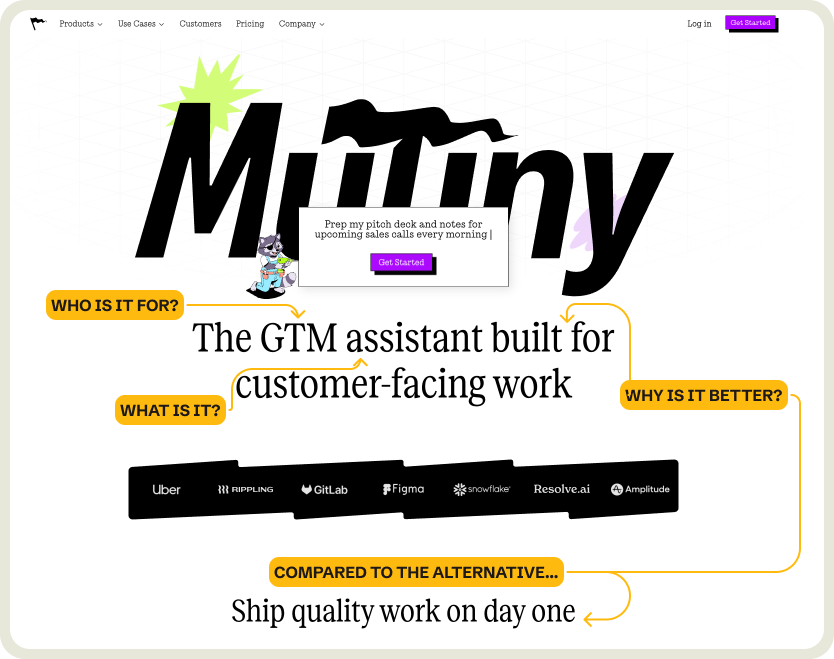
The new headline - The GTM assistant built for customer-facing work - is more specific, leans into our strengths more, and differentiates us against what Claude can deliver for a salesperson. That last part matters. Mutiny is AI built for GTM, pre-loaded with the skills and playbooks reps actually run, that can deliver customer-ready collateral. A general model cannot deliver that to you out of the box. With so much hubbub around AI and what it can and cannot do, you have to lean into what makes you different.
We launched outbound, and it worked a little too well
Week one of outbound went really well. So well, in fact, that we couldn’t keep up with what we were promising people.
The offer was great: we’d send personalized assets that help you land your most important account. Classic use of Mutiny. Great, until 30 companies say yes within an hour and you have no internal resources to actually deliver on it. So I paused the campaign, personally delivered everything that needed to get delivered, and then we went back to the drawing board on how to keep this low-lift while still driving what matters.
We started with the high-volume approach and quickly realized we were spending time on accounts that weren’t a high priority for us.
At our stage, the most important thing to build is social credibility. The way you build it is you land really great logos and you create stories about the success of those companies with your product.
We don’t have a BDR, and we have one AE who has to protect his time. So we need to pick the accounts we would move mountains for, be laser-focused on them, and drive everyone else to product sign-ups with credits to incentivize them to try it.
So we re-oriented around a very short list of Tier 1 accounts. I hand-picked them myself. I started with our original Tier 1 list of 400 accounts and selected the ones we would want to put on our website. Instead of orienting around quantity of meetings, we’re orienting around quality of meeting.
My hope is that we can land 15 meetings from this list of 214 accounts in the next six weeks, and 5 opportunities opened with them. That’s a win and would prove that outbound is a credible channel for us.
What the numbers look like
Sign-ups are steadily increasing, but no breakout channel yet. We need to break through the glass ceiling on one of our channels. Deep focus will get this done.
About 50% of new users came from existing user invites or word of mouth. We have viral growth once we land someone. We just need to land more. That’s the whole game, and it’s much easier said than done.
Channels by volume of sign-ups: Search (12%), LinkedIn (9%), AEO (6%). Although I still think “search” is a bit of a black box that I’m unsettled by.
Website traffic keeps climbing, which is a positive signal on top-of-funnel awareness. Now we need to convert more of it.
The next milestone
We’re planning our next milestone, and the theme is to go from 0 to 1 into 1 to 10, and FAST.
Here are the goals for the next 6 weeks that scare the &%#$ out of me:
10x sign-ups from AEO
Double revenue
Prove outbound as a viable channel
It’s wild to think that these are even possible but 1) I think they are, and 2) better to shoot high, miss and still land is a really good spot.
Where this leaves me
Next week I’m deep in the weeds. Back to the drawing board to figure out how to 10x output. Stay with me and you’ll figure out how we’ll deliver on this.
If you’re building your own growth engine and trying to force a step-change out of a single channel, shoot me a DM.
➜ Kramer’s takeaways for Gen Marketers
Hope you enjoyed reading the play-by-play of someone thinking through growth challenges in real time. Most marketers only publish the wins, after the fact, so I found it very refreshing! If you’ve been reading MKT1 for a while, much of what Matt said may bring to mind some MKT1 frameworks.
Here are 5 lessons from his post connected back to said “Krameworks,” all things I find myself repeating to marketing leaders: focusing on big bets, taking an account-driven approach, being specific and human in the AI era, investing in brand at every stage, and setting goals you actually use daily.
1. Focus on big bets, avoid random acts of marketing
Matt’s post reinforces a lesson I constantly preach: “Winning” doesn’t come from saying yes to every request, copying other companies, or spreading yourself too thin. It comes from extreme focus: finding strategic bets that fit your startup, setting related goals, and doing day-to-day work that connects back to your strategy and goals.
Matt focused on the Mutiny launch almost exclusively the week before and let his other work with agencies and contractors go, knowing he’d pick it back up later.
This is actually how I personally operate at MKT1. I think in terms of “newsletter weeks,” “catch-up days,” and “project days.” Newsletter weeks are all-out sprints. My team knows not to bother me unless it’s urgent…these things take time and extreme focus, and they pay off!
In Matt’s newsletter series itself, he even combined weeks 5 and 6 into one post, recognizing the launch took precedence over documenting his process.
This is why I never commit to anything weekly or a set MKT1 Newsletter cadence by the way, I publish when I have something high-quality enough to ship.
Matt’s goals actually steer his week, not just sit in a doc he never looks at. He’s setting them at a cadence that works for him and Mutiny’s pace with “three scary six-week goals.”
He recognizes that he needs to test multiple channels. He’s in the experiment and learning phase, but he knows he needs to ultimately find a breakout hit.
I frame this as making sure every bet has a chance to be a big bet.
I love this line he quotes from Jaleh, Mutiny’s Co-Founder and CEO, in Matt’s Week 5-6 newsletter (more on this below): “If you’re doing two things, you’re just doing the more important one, less.”
2. Know your top accounts, even with a PLG motion
Even though you can sign up and adopt Mutiny without talking to sales, they aren’t shying away from being account-driven and running outbound to their priority accounts. With all the enrichment data and signals available, most business models can’t afford not to run a motion like this.
More on what I call account-driven GTM and why it’s essential in the AI era ➜
He picks the accounts he’d “move mountains for” and goes all-in on those with personalized outbound, everyone else is pushed to self-serve signup with free credits.
He’s focused on quality of meeting over quantity, especially given the small team size. And he has different routing, rules and marketing activities for different types of accounts.
He recognizes the value of not only driving high-revenue accounts, but also accounts that build social credibility: great logos and the stories that come with them.
They aren’t just sending spammy emails requesting a meeting. That doesn’t make sense given their self-serve model and ease of use—and what their product does! Instead, they send an asset made with Mutiny to help the prospect win a customer to both add immediate value and show what’s possible with the product.
With outbound campaigns, value-add content matters as much as the targeting and deliverability—you have to get both the fuel and engine right for it to work.
3. Specific and human messaging wins in the AI era
All AI products are starting to sound the same, especially with GTM tools, where everything sounds like an all-purpose AI for everything marketing and sales teams do. It’s okay to niche down, and to sound like a person while you do it (in fact it’s way better when you do this).
And it shouldn’t be difficult to decipher who a product is for, what it is, or why it’s better than the alternatives, which happen to be the three questions in the MKT1 positioning framework.
The Mutiny launch in June drove a ton of traffic but didn’t move sign-ups quite as much. Matt diagnosed the conversion issue as a messaging problem—then tested his hypothesis. He got a 71% lift on a headline test: “specificity in the fewest amount of words matter.”
He sharpened the positioning by figuring out what to compare Mutiny against—which makes writing the “why it’s better” part of positioning way easier. The new headline “differentiates [Mutiny] against what Claude can deliver for a salesperson.”
4. Brand matters
Building a recognizable brand is another clear way to stand out when everything feels the same. Mutiny does this in two big ways: a strong visual brand they carry through everything from campaigns to web design and video. And to expand their reach, they tap their ecosystem of customers, partners, and influencers.
Mutiny has always had a fun brand, raccoon mascot and all. They relaunched the company with a new product, their GTM agent, and needed a strong introduction. The launch video did that. It puts the raccoon front and center, but describes the new product clearly.
Even as they step on the gas to acquire new customers, they aren’t only doing the work that ties directly to pipeline. Matt values brand-building too, even without exact numbers to point to: “Mutiny brand love is coming back, and you can feel it.”
And it wasn’t all video and web design. Matt landed Jaleh, Mutiny’s co-founder and CEO, a guest spot on a GTM podcast in front of 150,000 sellers: “When you’re a small team trying to get loud, borrowed audiences like that are worth a lot.”
5. Set your numbers, and actually look at them
Matt doesn’t just set goals and use them day to day, he actually tracks the numbers closely enough to figure out what’s working and what to do next. On small teams this is often what slips, because nobody is asking for the report. You have to be disciplined enough to do this yourself, and hold yourself accountable for the results.
He shoots high on purpose: “better to shoot high, miss and still land is a really good spot.” But ambitious doesn’t mean hand-wavy. He breaks each goal down into numbers he can actually work toward, like outbound: “My hope is that we can land 15 meetings from this list of 214 accounts... and 5 opportunities opened with them.”
He counts two kinds of wins: revenue and learning. Both are super important! His example: “[Hitting outbound targets] is a win and would prove that outbound is a credible channel for us.”
Matt watches numbers at every lifecycle stage, and conversion too, so he can diagnose where the real problem is. Here’s a great example: “About 50% of new users came from existing user invites or word of mouth. We have viral growth once we land someone. We just need to land more.”
Part 2: More lessons from Matt’s series
Across the rest of his newsletter series, Matt shows the Gen Marketer skillset in action, with tangible examples of what’s working for B2B startups right now: using ecosystem marketing in creative ways, approaching AEO the right way, and testing campaigns fast, then doubling down with specialist help. I’ll share excerpts that stood out to me as the best examples of what Gen Marketers should focus on.
1. More on focusing on big bets
Here’s an excerpt from Matt’s Week 5 (and 6) of building Mutiny’s growth engine: the thing I’d been avoiding, on what running marketing alone actually costs:
Here’s the catch to all of this. I’m a one-man band. Anything real I want to get done takes my full focus, which means I’m constantly making the same uncomfortable call: what is the single most important thing I can be doing right now, and what am I willing to drop to do it?
Jaleh says it best. “If you’re doing two things, you’re just doing the more important one, less.”
So right now, that means AEO takes a back seat while I pour almost everything into vendor selection, design, web updates, messaging, positioning. More PMM than anything. It’s slow, it’s a lot of calls, and none of it feels like progress until it suddenly does.
But the team we’ve assembled out of it is a powerhouse, and I think we’re going to crush. More of this to come.
➜ Kramer’s takeaways for Gen Marketers
No matter the size of your team, you should apply the focus you would as a one-human band. As Matt describes, that means constantly deciding the single most important thing to do right now, and being honest about what you’re dropping to do it. This excerpt also gives you the context for the Jaleh quote I share above.
Gen Marketers need to figure out what works, then double down. But for the double down, it’s often best to hand the work off to a specialist who can go even deeper. By making time to assemble a “powerhouse” team of specialists, Matt is prepping to be able to do this so he doesn’t have to stop momentum when he finds what works.
2. More on knowing your top accounts
Here’s an excerpt from Matt’s Week 7 of building Mutiny’s growth engine: the report card, where the outbound motion you read about in the full Week 10 newsletter got its start:
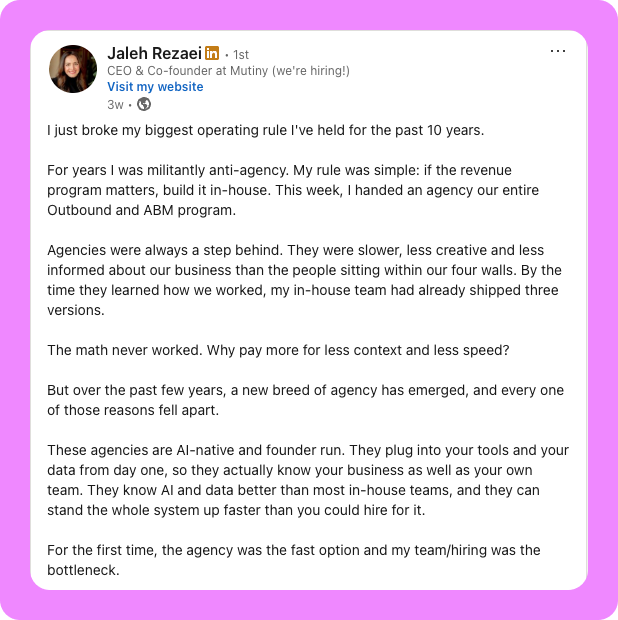
We’re about to test some outbound, very conveniently timed to kick off on launch day. So if you get unusually well-timed outreach, I’m not sorry. This is more experiment than anything at this point. You can see Jaleh’s post about this if you want to see the rationale behind why we are doing this. [excerpted below]
I’m a little excited to throw my BDR hat back on. The one thing I don’t want is to touch any of the system implementation, so we’re partnering with an agency to see if they can ramp up quickly and do it well.
That rationale, from Jaleh’s LinkedIn post on breaking her own 10-year rule, is worth reading, so here it is:
➜ Kramer’s takeaways for Gen Marketers
This is where the outbound motion Matt talks about in the week 10 newsletter started: as a small experiment. They tested, it “worked a little too well,” and they re-oriented around a short list of accounts worth going deep on. You don’t have to launch account-driven GTM as a big program, you can test your way into it.
The roles of in-house and agency resourcing are changing. The new model, especially on small teams: generalists in-house, specialists brought in once something’s proven (not before it’s proven, and not by default). I’ve seen this first-hand, repeatedly over the last year, tracking this closely since my post on Gen Marketers.
3. More on specific and human messaging
Here’s an excerpt from Matt’s Week 8 of building Mutiny’s growth engine: operating without all the pieces, from the lessons he pulled out of rewriting the Mutiny website:
I was exaggerating last week when I said that we were on v5001 of the website but in reality we are on v8 of the web copy... and now structure. Every time I do this, I am reminded of the same lesson, and I relearned it again this week. Less is more.
A few things that actually moved it forward:
Use stupidly plain language. If it reads clever, it’s probably too clever. Although not the sexiest form of marketing, the clearest sentence wins almost every time. The principle we live by is 80% accurate, 100% clear. A real example from this week, our integrations section: v1 read “Anywhere you work, with everything you know.” v2 reads “Works with all your favorite tools.” The first sounds good in a vacuum. The second one a visitor actually understands in half a second, and that’s the whole point.
➜ Kramer’s takeaways for Gen Marketers
I couldn’t agree more with Matt’s “stupidly plain language” rule. I’m always advocating for clear over clever: Don’t spend hours micro-optimizing copy to be pithy when you could just write the way a human (in your target audience) speaks. Visitors give your homepage a few seconds, and if they can’t tell who it’s for, what it is, or why it’s better, the copy failed.
“V8 web copy” makes me pause. Iteration is a good thing, but at some point another round of micro-edits might not be worth it. The questions I’d ask: Are you getting true benefits from these changes? Would testing one big change get you further? And do you have the web traffic to run these tests? Is this a too-many-stakeholders problem?
Want to know if your homepage clears the positioning bar (who it’s for, what it is, why it’s better)? The MKT1 MCP has a homepage positioning skill for exactly this: point it at your URL and it checks for you. Install instructions at mcp.mkt1.co ➜
Matt’s right: copy reads differently in a doc than on a designed page. Get it into Figma early like he does, or better yet a prototyped or draft page. Building pages directly in Claude makes this fast, and you can try the Figma MCP or Framer MCP to connect Claude to the tools you already use.
Come see Framer demo their MCP at our MCP showcase on 7/28 ➜
4. More on why brand matters
Also from Week 7, a very smart ecosystem marketing meets AEO strategy:
One off-site play I’m weirdly proud of: I found an emerging AI-native sales enablement tool, technically a competitor of ours, and noticed they were publishing a lot of strong content around [incumbent] and [incumbent] alternatives. As a fellow emerging player, I know you can’t take on the incumbents alone. So I pitched their Head of Marketing a simple idea. Let’s team up on our best-performing content and squeeze the big guys out together. Win together.
It worked. Now we’re in all of their top content with the LLMs, and they’re in ours. You can’t do this alone. Just find your angle.
And from Week 9 of building Mutiny’s growth engine: the choreography behind a launch, where he gets customers, execs, and investors to all amplify the launch at the same moment:
Which means you need to orchestrate all of this at once so the swarm activates at the same time. Easier said than done.
How do you actually pull that off, you ask?
Calendar invites, of course.
Yes. You literally send the people you want posting about you a calendar invite, reminding them you’re launching. Then the moment the posts go live, you update that same invite with the links and (you guessed it) fire off the “event updated” notification. Make it as easy as humanly possible for them to fulfill your ask.
➜ Kramer’s takeaways for Gen Marketers
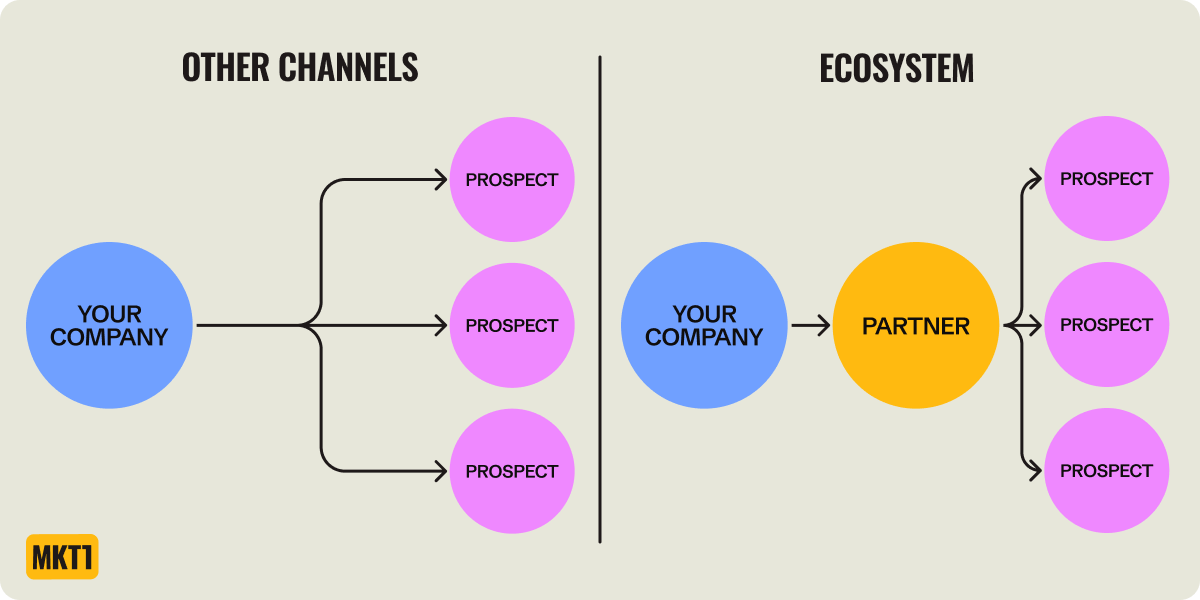
I always say focus on your complements as much as your competitors, and that building a category takes more than one company. Matt’s work with the fellow emerging player put both into action: At first blush these two look like competitors, but they have more to gain from each other than to lose. Very sharp thinking!
This ecosystem idea works especially well for AEO too: LLMs recommend based on consensus across sources, so showing up in each other’s content lifts both companies. Ecosystem marketing and AEO compound each other.
Everyone says yes to amplifying your launch, then almost nobody posts at the right moment. The calendar invite to friendlies works because it removes the remembering and makes fulfilling the ask nearly effortless.
(To be clear: This is for customers, execs, and investors who already agreed to help. Putting invites on strangers’ calendars as an outbound play is not cool, don’t do that.)
5. More on setting your numbers, and actually looking at them
One more from Week 7, Matt’s report card on himself:
I graded myself this week. Here’s where I landed.
Launch: A
AEO: C+
LinkedIn: C-
Sign-ups: A
And here are details from the AEO section, where he graded himself a C+:
I’ve noticed a very clear pattern about AEO. The more you put in, the more you get out. You’re reading that thinking “yeah, no sh*t.” But the correlation between effort and outcome is more apparent here than it is any other area that I’m working on.
Our rule: It’s our job to figure out what to do, how to do it, get it off the ground, and prove results. Once we know what’s working, we can outsource it. We are in the back half of that process now.
The results: the share of total sign-ups coming from LLM traffic is up 100% week over week. Not just because of this, of course. But because of the compounding effect of the last 7 weeks.
➜ Kramer’s takeaways for Gen Marketers
The report card format is worth copying. Regularly grading yourself against your goals and big initiatives keeps you honest. It’s okay to get bad grades... just not in the subjects that matter most to your success right now (I let myself fail accounting in business school, for instance).
Matt’s looking at LLM citations and traffic. While many marketers ignore web traffic or think of it as a vanity metric, it can be a very useful leading indicator, especially when broken down by source and new user sessions.
AEO is a bit frustrating: It drives fewer clicks than search and is therefore harder to track. But I like Matt’s approach of tracking the share of sign-ups that come from LLM traffic, which shows whether the channel is actually gaining ground on your other channels. My favorite tool for this: Profound, who is joining our upcoming MCP showcase.
And he remakes the point from an earlier excerpt: Once he knows what’s working, he hands it off to a specialist. He proves it out himself first, then outsources the double down.
It’s time to develop a Gen Marketer skillset
Whether you’re a first marketer, a marketing leader, or one member of a bigger team, this is the skillset to develop (and to hire for). You need to optimize for speed of learning and double down on what works. Competing with AI-native marketing teams demands it. And you need to use AI to deepen and broaden your skillset at the same time, going deeper in the areas you know while covering ground you couldn’t before.
That’s what you just watched Matt do in 10 weeks: He launched a repositioned product, stood up outbound, doubled LLM-driven sign-ups, rebuilt the website, and helped ship a very fun launch video. Plenty of bigger teams have shipped way less than that in the last 2.5 months.
To be clear, the goal isn’t to run Matt’s exact plays and campaigns. Copying another company’s playbook is never what I advise and leads to my mortal enemy: random acts of marketing. His tactics work because they fit Mutiny’s product, stage, GTM motion, and advantages. What transfers is the skillset and system.
More on building a strategy unique to your company, in Claude ➜
Thank you to Matt and Jaleh for permission to republish and dissect Matt’s newsletters! If you know someone else documenting their work this honestly, send them my way.
Feedback welcome: This is my first post of this style, so let me know your thoughts. Love it, hate it, want more of these?!
Subscribe to get the next edition of MKT1 newsletter straight to your inbox.
Spoiler: It’s about building team-wide systems in Claude.
And don’t forget to RSVP to our MKT1 MCP Showcase on 7/28 ➜

More from MKT1
🙏 Brought to you by: Traction Complete, whose agents keep your CRM data clean; Omni Lab, the paid media & demand gen agency; and Attio, the agentic CRM for GTM teams.
🔌 Event - MCP Showcase: On July 28th at 1pm ET / 10am PT we’re hosting a showcase with 6 MCPs marketers should know. Airtable, Attio, Framer, Mutiny, Profound, and Softr will join me to walk through their MCPs, live in Claude.
🖥️ Webinar - Building an AEO practice: Join me and Profound’s Nick Lafferty for a live MCP build session on July 23 at 1pm ET / 10am PT. We’ll show 3 AEO workflows you can run yourself with Claude and Profound. Register here.
💬 Bring this newsletter to Claude: Chat with this newsletter with this pre-built prompt or search for any newsletter with our MKT1 MCP.
🤖 MKT1 MCP Server: Add MKT1 skills to your LLMs. Paid subscribers get our full library of 25+ skills and templates including the /homepage-positioning and /marketing-strategy-setup skills mentioned in this newsletter.
🧑🚀 MKT1 job board - new & improved: Jobs from the MKT1 community (it’s free to post as a paid subscriber). And our candidate form if you’re looking for a new role (option to remain anonymous included!).
🥞 MKT1 Perk Stack - New Perk: Exclusive discounts worth $40K+ on our favorite GTM tools. For annual & superfan paid subscribers only. We just added 3 months free of Granola, check it out!
🧰 Template & resource library: We have 100+ templates and resources available to paid subscribers in our template & tool library.
Really enjoyed this play-by-play breakdown, Emily. Such a good look at what a founding marketer actually does day to day. Matt wasn’t just moving fast with AI. He was learning fast, seeing what worked, and doubling down. That’s the real edge.