


How to hire & get hired in 2026: The guide to the Gen Marketer skillset
Plus 25+ things you can do right now to gain these skills
đ This is a monthly free edition of MKT1 Newsletterâa deep dive into a B2B startup marketing topic, brought to you by Default, 42 Agency, and Ten Speed.
Upgrade to a paid subscription for: Gen Marketer Summit | 100+ templates & resources | MKT1 Job Board - Free Posts | MKT1 Archive access | New MKT1 Perk Stack, exclusive discounts worth $40K+ for annual paid subscribers.
As I proclaimed back in September, weâre in the era of Gen Marketersâ˘. Gen Marketers are generalists who are fluent in generative AI, and who are ready for the generational shift weâre seeing in marketing.
But âGen Marketerâ isnât another job title. Itâs the new baseline skillset marketers need to succeed in 2026 and beyond. No matter your role in marketing, you will benefit from gaining a Gen Marketer skillset.
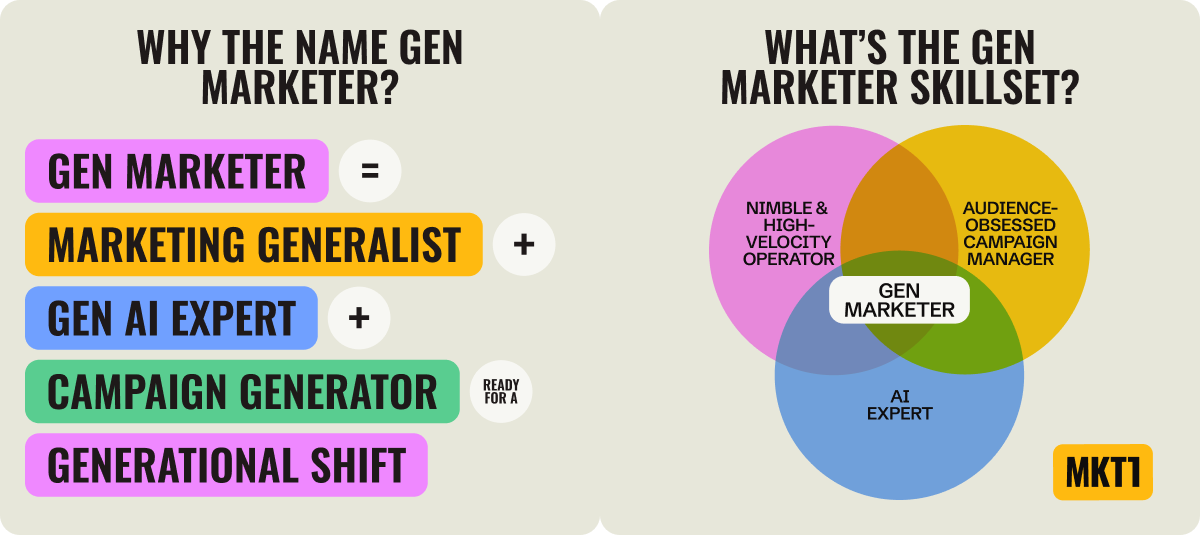
In other words, how we build B2B marketing teams has fundamentally changed in the last 2 years. And if youâre still hiring, interviewing, or organizing teams the old way, youâre probably struggling to keep up with the pace of change.
Candidates need to bring different skills to interviews (and to their roles!). Hiring managers need to evaluate candidates against new criteria. And Heads of Marketing need to evolve their org charts and practices.
This newsletter will help you get hired and hire in 2026. Itâs your guide to the Gen Marketer skillset: the foundational capabilities every marketer needs to be effective now. It covers what types of candidates are most needed in the AI era and how to tactically gain those skills if youâre on the job marketâor if you just want to stay competitive in your current role.
Recommended products & agencies
We only include sponsors weâd recommend personally to our community. If you are interested in sponsoring our newsletter, email us at sponsorships@mkt1.co.
â Default puts scheduling, routing, and enrichment in one platform, so the data in your CRM stays clean and you can orchestrate GTM 10x better. Plus, itâs used by startups like Replit, Profound, Unify, JustWorks, and Decagon.
đ Offer for all readers: Mention MKT1 to get 2 months free on any plan for up to 10 seats ($1500+ value)
đMKT1 Perk Stack offer for annual paid subscribers: Get 5 seats free + 1 year of free intent data with a new annual plan.
__
â 42 Agency: Let 42 Agency handle the MOPS work your team avoids. From routing logic and fixing scoring, to aligning Hubspot + Salesforce, to setting up new GTM tooling, 42 Agency is ready to help your B2B startup clean up and scale your ops.
đOffer: Mention MKT1 to get 10% off a Hubspot Audit or Hubspot Sprint.
__
â Ten Speed is an organic growth agency that unifies SEO, AEO, content marketing, and digital PR. They know how to combine the right fuel and engine for your ICPâand theyâve supported many of my advisees.
đOffer: Mention MKT1 to get up to $5,000 off.
In this newsletter:
Part 1: The skills all marketers need (and need to hire for) in the AI era
Part 2: Actionable steps to learn these skills and become a highly in-demand candidate
Part 3: Interview questions to assess these skillsâwhether youâre practicing or hiring
Conclusion: How to network like itâs [almost] 2026
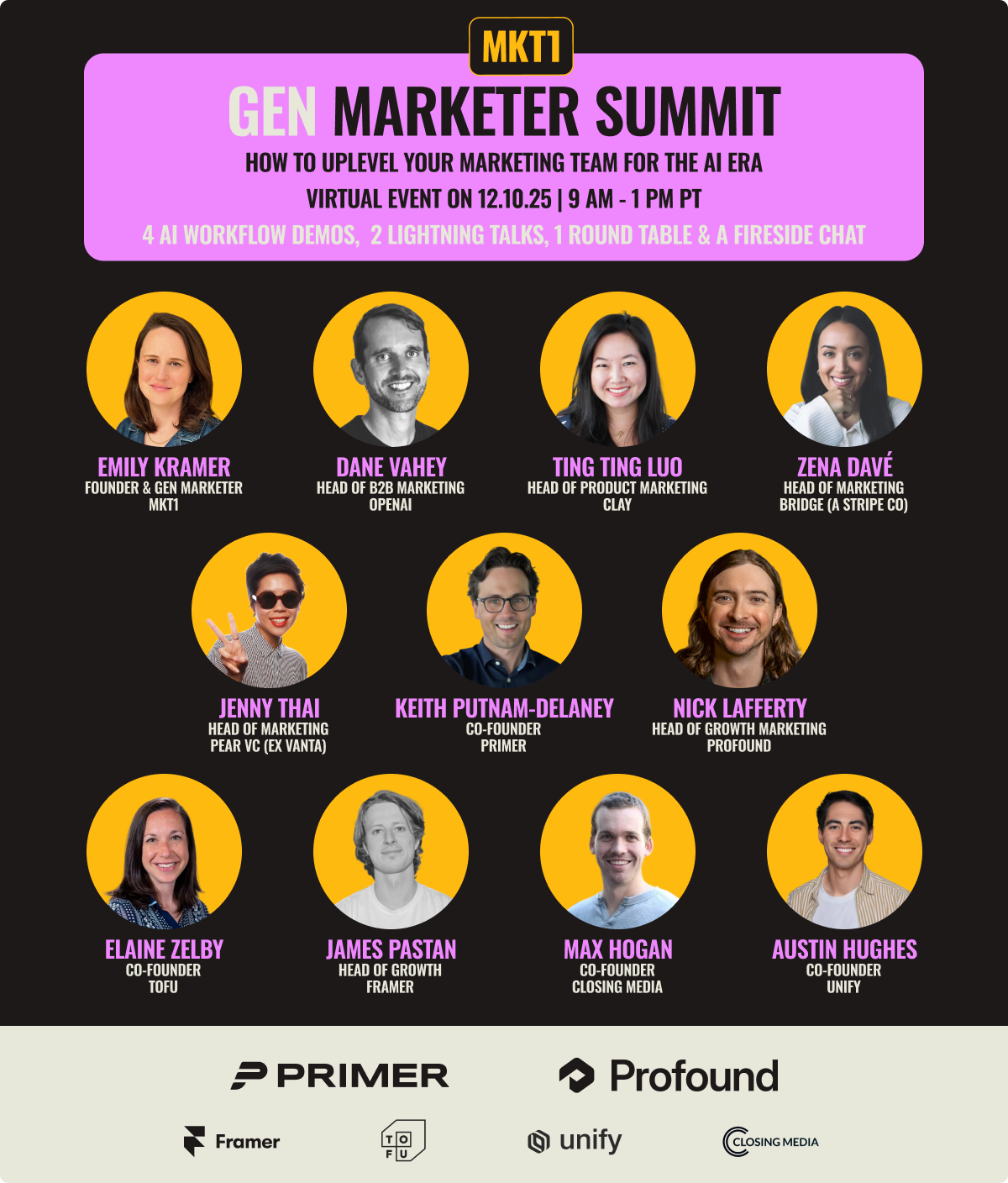
This newsletter is a companion to the Gen Marketer Summit next week!
The virtual Summit is for paid MKT1 Newsletter subscribers only. Itâs only $9 a month or $99 a year. You also get access to our template library, Perk Stack (for annual subs), and all the other benefits of being a paid subscriber.
But, if youâre currently unemployed, you can get free access to the event. Fill out this form (passcode: 1010) to RSVP.
Part 1: Skills all marketers need right now, in the AI era
If youâre job searching, these are the skills that will make you stand out. If youâre hiring, these are the capabilities you need to evaluate forânot just nice-to-haves, but fundamentals that determine whether someone can operate effectively in the AI era.
Do you need to abandon everything you ever learned and just focus on this skillset? Of course not. But since publishing my Gen Marketer newsletter, Iâve had many conversations about what this means for specialists. So let me be clear: This isnât about abandoning specialization. If youâre a killer demand gen marketer or a product marketing expert with deep domain knowledgeâgreat, keep that. But that specialization alone isnât enough. You need to layer generalist skills on top of your depth to stay valuable in 2026 and beyond.
1. Ability to run differentiated campaigns that combine fuel and engine, for your specific audience
Why: AI makes it faster to ship products, content, and campaigns, but harder to stand out. Winning requires focus and tight coordination around high-impact initiatives.
What this means in practice: You need product-management-like skills: the judgment to pick the highest-impact initiatives, the ability to coordinate across marketing and cross-functional teams, and the discipline to make tradeoffs. And you need product-marketing-like skills: the ability to deeply understand your audience, your market, and how your company can differentiate. The goal is to create campaigns that actually differentiate and rise above the sea of sameness and AI slop.
2. Ability to move at a high velocity
Reminder: velocity = speed + direction. This was a very intentional word choice!
Why: Everything from product development to content creation is moving faster. But speed without strategy leads straight to Random Acts of Marketingâ˘âŚ and we know how I feel about those. You need to test, iterate, and scale with intentionality and speed.
What this means in practice: Our siloed marketing teams with a million sub-functions hold us back, and marketers need to actively reduce friction. Real velocity comes from fewer handoffs, AI-automated workflows for repetitive tasks, and marketers who think beyond silos. Generalists who donât flinch at work outside their scopeâand can operate full-stackâare the ones who actually operate efficiently.
3. Ability to be nimble across channels, content formats, and campaigns
Why: Channels (think search), content types (looking at you, blog posts), and long-trusted plays are breaking. Betting on deep specialists for tactics that may collapse is risky.
What this means in practice: Be adaptable. Test new channels and formats, experiment outside your domain, learn quickly, and identify what actually works for your audience, not just what worked for someone else.
4. Ability to delegate wisely: to in-house marketers, external support, or AI
Why: We have more options than ever for getting work done. We can learn specialties faster, use AI agents and automated workflows to speed up processes, and collaborate with contractors or agencies more easily with modern productivity tools. The point is: Use the full toolbox.
What this means in practice: Being a generalist doesnât mean doing everything. The best marketers know they should run lean and know how to mix in-house talent, external partners, and AI in the right way.
Note: Deep specialists will increasingly live outside of in-house teams. By solving the same specific problems across many clients, they get exceptionally good at them in a way thatâs hard to replicate when youâre focused on one company. Weâve already seen this with SEO, SEM, LinkedIn ads, PR, and marketing ops (these areas I almost always recommend partnering with an agency or contractor on, even if you have someone dedicated in-house).
Hereâs how to think about expanding your skillset to a Gen Marketer skillset by function:
Want to hire a Gen Marketer? We have a job description for that (plus other modern marketing roles & 80+ interview questions to evaluate them) here for paid subs.
Part 2: How to learn these skillsâand be an in-demand marketing candidate
The best way to learn these skills and speak about them in interview processes is to actually do the work: build things, test tools, think in terms of campaigns (not activities), and get hands-on experience with the channels and formats that matter now.
If youâre a candidate, this is how you demonstrate competency in interviews and hit the ground running in a new role. If youâre a hiring manager, this is the bar for what you should expect candidates to have already experimented with.
â Get up to speed on AI tools
Do this even ifâŚyou use ChatGPT everyday already. Thatâs not enough!
Why? Because operating at high velocity on a lean team is the new norm. AI is how you reduce handoffs, automate repetitive tasks, and actually move quickly. If you only know how to prompt, you wonât speak the right language in interviews, or keep pace once youâre in the job.
How to build the skill:
1. Try AI tools with free plans
Many of the best AI tools have free or low-cost basic plansâand I looked them up for you. Use them to work on projects directly related to your job search or the companies youâre interviewing with, or just to practice so you have real examples, workflows, and processes to talk about in interviews.
We get into specific exercises you can try with many of these tools in the sections below!

We have exclusive, deep discounts on many of these tools (including free Lovable credits!) in our MKT1 Perk Stack for annual paid subscribers, and additional discounts for all paid subscribers.
2. Take a free course offered by one of these companies, or join their communities
Apply to the Lovable SheBuilds hackathon to vibe code something shareable. Applications just closed for this round, but something tells me theyâll do it again. Not eligible? Join their Discord community of 100K+ members.
Join a free Clay Cohort to learn how to use Clay for account and contact research, enrichment, signal tracking, etc. Note: They are on a winter break, so no cohorts right now.
Join AI company communities: Framer | Replit | Descript | Riverside
â Create in new formats
Do this even ifâŚyou arenât a brand or content marketer.
Why? Content hasnât meant âblog postsâ for a long time, and experimenting with multiple formats is now required. From video to podcasts, executive social posts, and vibe-coded resources, you need these in your portfolioâso go out and make them.
How to build the skill:
1. Vibe code a resource or tool
Experiment with âvibe codingâ (aka building tools, sites, or templates with prompts instead of code) by actually making something. Use Lovable, Replit, Gamma, Figma Make, etc.
Start by brainstorming a manual task youâve done before or a resource that would be useful for a company youâre interviewing with (their existing templates, reports, and materials are great inspiration).
Take notes on the process, limitations, and other ideas, so you can really speak to how to use these tools in interview processes.
Check out tools other people have made to get inspiration. Hereâs a MKT1 tool to generate hackathon/vibe coding ideas (that we vibe coded ourselves!). And here are even more things weâve vibe coded at MKT1.
2. Engage with LinkedInfluencers
Follow thought leaders not only in marketing, but also at companies youâd love to work at, and in industries youâre interested in: Use Clay to identify executives, practitioners, and creators in different areasâthis is a great way to learn Clay and to do interview research!
Engage with them (thoughtfully): Comment your name becomes familiar to people in the space, making future outreach easier. Use PhantomBuster or Relay to stay on top of their postsâor just scroll through LI endlessly. I personally do all 3 of these thingsâŚ
Speaking from personal experience: I remember and appreciate thoughtful, non-spammy, repeat commenters.
Understand the LinkedIn Flywheel Iâve written about. Youâll learn how to take disconnected activities and turn them into campaigns or systems. The LI Flywheel involves: organic posts from execs or influencers, boosting the best performers with LI thought leader ads, connecting and engaging with commenters, and rinsing and repeating.
3. Create and edit some videos
Video is the fastest-growing content format, and every marketer benefits from basic competency in creating, editing, and repurposing video. You donât need to become a YouTuber, you just need enough hands-on experience to speak confidently about formats, tools, and processes.
Make a few vertical social videosâeven if you never post them: Use CapCut, Riverside, or Descript to make an Instagram reel, LinkedIn reel, or YouTube short. Idea: Make a year-end recap (your dog, your kids, your work wins).
Try using AI to generate or remix video: This one is honestly just fun, but it can also be highly practical. Watch my MKT1 Unboxing with Luma AI for inspiration on making cinematic videos with AI, or take existing video or webinar footage you have access to and make it into a short clip for practice.
Hereâs a deep dive on Luma AI:
â Learn new channels
Do this even ifâŚyou arenât a growth or demand gen marketer.
Why? The channels weâve leaned on for years are showing diminishing returns, and the highest âalphaâ wonât come from doing search, paid, or outbound the way you always have. You need to understand the new landscape and the options that actually work now.
How to build the skill:
1. Understand AEO (Answer Engine Optimization) and how to increase LLM visibility
Join an AirOps Cohort on Content Engineering. Youâll build 3 custom-built AEO workflows and join private Q&As with industry leaders. They run these regularly, but you do have to apply, and thereâs often a waitlist. Bonus: AirOps is in our Perk Stack!
Use Profound or Ahrefs to monitor a websiteâs AI visibility. Choose companies you are interviewing with or are interested in, and track what they are ranking for. Or just visit Profoundâs index to understand what companies are doing best here and what prompts they show up for.
Follow AEO experts to learn while you doom scroll LinkedIn! I posted about this on LinkedIn and the comments delivered with many great people to follow.
2. Understand ecosystem marketing
Understand the value of this âchannelâ or âstrategyâ by reading my post in Lennyâs Newsletter, complete with tons of examples.
When researching a company for an interview, donât just do competitor research, do âcomplementâ research. Make a list of everyone they could possibly partner with and analyze if you think any of these relationships could build credibility and reachâand drive revenue. Again, youâll stand out as a candidate by bringing this kind of fresh perspective.
3. Understand account-driven GTM & signal-based outbound
Get familiar with what an account-driven foundation and strategy mean today.
Hereâs a crash course: All B2B startups today should map their accounts and contacts into a CRM or database, enrich them, and run 1:1 or 1:few campaigns to a subset of these accounts. Read my 3-part series on the topic here.
Think through how account-driven strategy would impact a company youâre interviewing with: Do they have a short or long list of target accounts? What criteria would help you identify best-fit accounts? What personalized tactics would work best with their audience?
See the next section on audience research for an exercise you can run in Clay.
Understand what signal-based outbound means.
Hereâs a crash course: You should track behaviors that show intent and time your outreach when accounts show theyâre interested or ready to buy.
Brainstorm some signal-based campaigns for companies you are interviewing at. What signals matter to their audience? (Funding announcements? Job changes? Tech stack additions?) How could they act on those signals?
We have ideas for running personalized signal-based campaigns (plus other tools for setting up account-driven GTM) here for paid subscribers.
â Go deep on an audience
Do this even ifâŚyou arenât a product marketer.
Why? Differentiating your marketing efforts starts with understanding your audience. You canât run high-impact campaigns, make smart tradeoffs, or create anything that stands out if you donât deeply understand who youâre for, what they care about, and how you fit into their world.
How to build the skill:
1. Build a prioritized account list with deep enrichment
Make a Clay table to find the top 20 accounts you believe a startup you are interviewing with should focus on. Build your table with filters that match their ICP criteria. Add meaningful enrichments (not just company sizeâthings like âuses Salesforceâ or ârecently hired a VP of Salesâ). The goal is understanding accounts deeply enough to inform real strategy.
Identify 2-3 insights you could share in an interview about their target market. Reference this in the interview process (âI actually did some audience research using Clay. Hereâs what I came up withâ). Read the room on whether sharing the table or sharing your screen is overkill or just the right amount of preparation.
2. Reverse-engineer how competitors position and message
Review LinkedIn ad libraries for 3-5 competitors to understand the current creative and messaging landscape. Feed examples into an LLM and identify patterns: What pain points do they emphasize? What proof points do they use? Whatâs their angle?
Map out where there might be positioning opportunities or gapsâwhat are competitors not saying that could be an opportunity for differentiation?
â Think in campaigns, loops, and flywheelsânot siloed channels or content formats
Do this even ifâŚyou arenât a campaign manager, producer, or head of marketing.
Why? Learning how to do one-off activities (including the exercises I shared above) isnât enough to be highly effective today. You need to train your brain to think in systems that compoundâand you may not have had a chance to do that in siloed past roles.
How to build the skill:
1. Design a personalized campaign using account segmentation
Take a target account list (see the audience research section for how) and segment it by relevant attributesâindustry, company size, tech stack, growth stage.
Design how a campaign would differ across segments: What messaging changes? What channels? What level of personalization makes sense for each tier? Sketch out one example campaign concept in detail to demonstrate you understand when personalization is worth the effort versus when to go broad.
2. Document and practice explaining past campaigns
Make a list of 3 campaigns youâve been involved in. Pick one and practice talking through it using the GACCS framework: What was the strategy? How did execution work? What were the results? Record yourself explaining it in Granola or Flow, then feed the recording and your GACCS Brief⢠brief to an LLM. Ask it to evaluate whether youâre connecting tactics back to strategy and demonstrating impact clearly.
Take a one-off thing you made or a channel youâve tried and write a GACCS brief for how you could turn it into a repeatable campaign. Think through how the tactics work together as a system rather than isolated activities.
3. Connect dots using agents, automations, or workflows
Set up workflows related to your job search: To notify you about new jobs, send your meeting transcript directly to another tool, or alert you when a list of close connections has switched jobs (just ask your favorite LLM how to set any of these up!).
Choose any two of your favorite tools and in a workflow builder (like Relay), search by tool to see all the pre-built connections or templates. Pick one and actually build it.
Hereâs a short recap of many of the ideas I just mentioned:
Part 3: The new interview questions
Whether youâre a candidate prepping for interviews or a hiring manager prepping the process for your next hire, you need to adjust your questions to test for the new skills needed in the AI era.
Here are some of my favorite questions, organized by the Gen Marketer Skillset from Part 1 of this newsletter. A newsletter in January will dive deeper into how to interview and we have 80+ questions for paid subs here â
Walk me through a campaign you worked on from start to finish. Follow up: Explain the goal, audience, creative, and channels used. Was it successful? How did you know?
After a candidate walks through any project: âHow long did it take? How much of your time did it require? Was it delivered on schedule?â
Assume you just created content about [topic]. How would you turn this into a full campaign?
How would your marketing approach change for our Tier 1 accounts versus our Tier 3 accounts? Can you walk me through an example campmaign for each tier?
We think our [next 1000 customers] will be [X audience], how would you test this? What tools would you use to research this audience?
How do you determine if it makes sense to hire an agency or contractor for [SEO/AEO, Paid, PR, Marketing Ops, etc]? When should it stay in-house? When should it be hybrid?
Have you built workflows in Zapier / n8n / Make / Relay? Walk me through one youâve built and why.
Get the full list of 80+ interview questions, plus job descriptions for a Gen Marketer and other modern marketing roles, here for paid subs.
Bonus: Open roles that value the Gen Marketer Skillset
Hereâs a range of roles that all value the skills mentioned in this newsletter. I know the hiring manager for each of these roles personally.
CMO at Tracksuit - Hybrid, Australia or New Zealand Only (a MKT1 portfolio company!)
Growth Marketing Generalist, Mercor - In-person, SF (MKT1 Advisee)
Associate Growth Operations, Valence - Hybrid, NYC (MKT1 advisee)
Enterprise Marketing Lead, Warp - Remote, US or Canada
Founding Marketer, Passionfroot - Remote/Hybrid, NYC
Growth Marketer, Self-Serve, Profound - In-person NYC
Demand Generation, Metronome (Big news from them yesterday) - NYC, SF, Remote (former MKT1 advisee)
Find more roles on the MKT1 job board (to post a role, become a paid subscriber).
Conclusion: Network like itâs [almost] 2026
Thereâs one final skill everyone should learn, regardless of if you are looking for a job or hiring: Networking.
Do this even ifâŚyouâre not looking for a new role or hiring. But definitely do it if you are!
Why? The only way to really understand whatâs working across companies is through actual conversationsâand the best way to get an interview or find a great candidate is through referrals.
How to do this the modern way:
Start posting on LinkedIn yourselfâor at least start commenting on othersâ posts regularly.
Use Attio or Clay to research companies: find some lists, load in some companies, enrich.
Go to in-person events put on by marketing tech companies, and go to the marketing leader dinners you get invited to. And sign up for the MKT1 Supper Club list!
The bottom line: Specialization alone isnât enough anymore. The marketers who will have the most options in 2026 are the ones who can think like Gen Marketersâcomfortable with AI, strong on strategy, adaptable across channels and formats, confident in one or two specialties, and smart about when to pull in help (human or otherwise).
And thanks to everyone who submitted ideas for this newsletter via this LinkedIn post, I specifically used contributions from Alina Vandenberghe, Austin Lau, Nick Lafferty, Max Hogan, Tarek Reda, Emily B, and Louis Albertini.
And come to thisâŚ
Thanks for reading, hope to see you live at the Summit next week. Now go forth and become a Gen Marketer!
-Kramer
More from MKT1
đ Thanks again to our sponsors: Default, for orchestrating GTM 10x better; 42 Agency, a paid media and MOPS agency; and Ten Speed, an SEO/AEO & content agency. All 3 have discounts for MKT1 subscribers!
đŚ MKT1 Unboxing: Watch our new video series to see Kramer (thatâs me) unbox Luma AI & Attio.
đĽ MKT1 Perk Stack: Exclusive discounts worth $40K+ on our favorite GTM tools. For annual & superfan paid subscribers only. We just added Fellow to the list, more coming soon!
đ§° Revamped, upgraded template & resource library: We have 100+ templates and resources available to paid subscribers in our brand-new template library.
đ§âđ Job board: Jobs from the MKT1 community (free to post as a paid subscriber)
đ˝ď¸ MKT1 Supper Club: Get on the list for monthly IRL dinners with Kramer, a small group of smart marketers, good food, and conversations on topics that actually matter in your roleâmade possible by some of my favorite GTM tools. Join the list, Next dinners are most likely in January in NYC and/or Boston.


This is gold! A ready go-to list for how to upskill yourself in two (+/-) weeks